
Alert grows over relocating financial regulators
Core functions face near-certain disruption
88% of FSS inspection targets are in greater Seoul
Policy banks fear drop in effectiveness
Seoul's financial-hub competitiveness at risk; MSCI upgrade in doubt
Japan, UK, US and Germany all kept their hubs intact
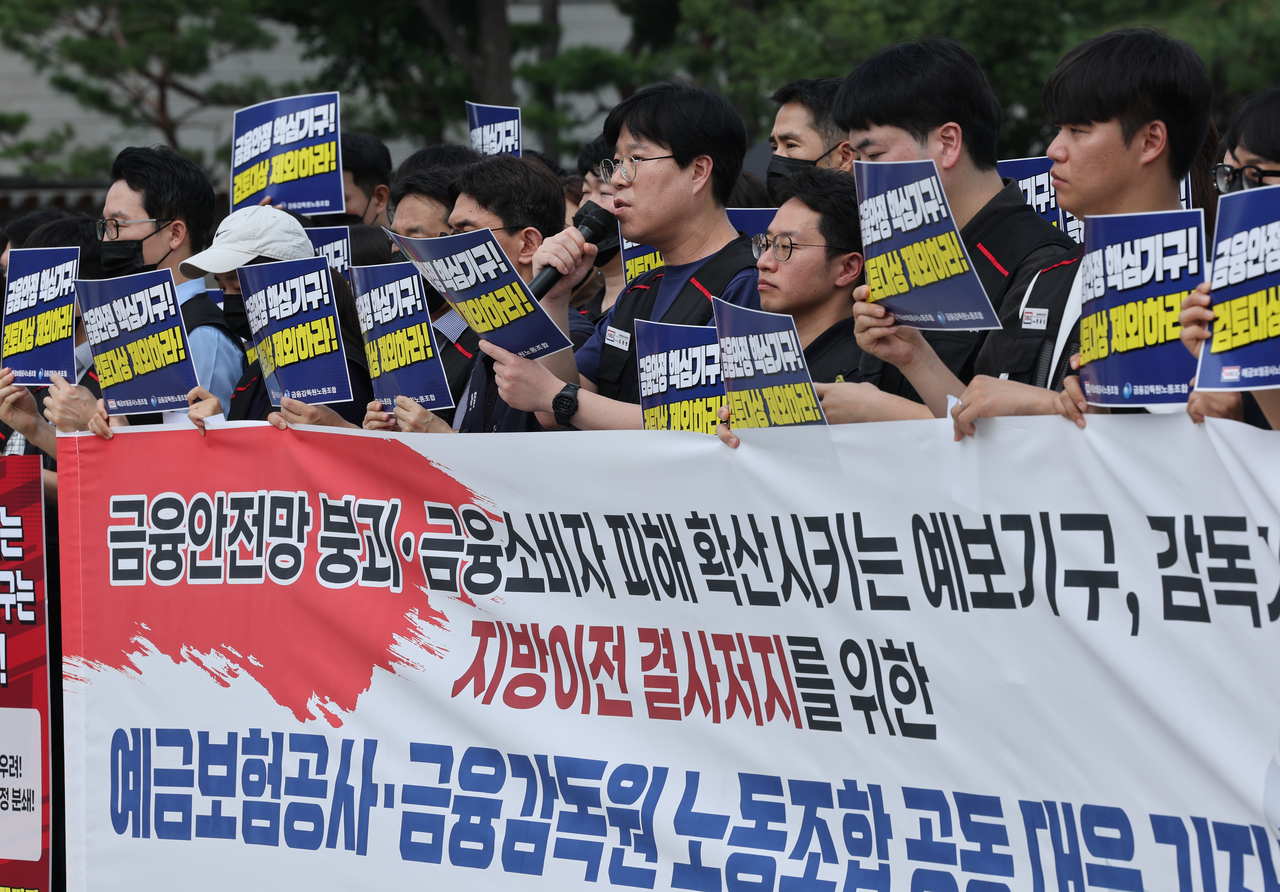
Concerns are mounting that plans to relocate the Financial Services Commission, the Financial Supervisory Service and state-run policy banks to the provinces could significantly weaken the core functions of each institution. Critics argue that moving the agencies wholesale in the name of regional balanced development would inevitably disrupt work requiring constant contact with major financial firms, investors and overseas institutions — spanning supervision and crisis response, venture and advanced-industry investment, corporate restructuring and export finance. Observers also warn the move could clash with the government's own long-running strategy to strengthen Seoul and other cities as competitive financial hubs.
According to financial industry sources Tuesday, a proposal to relocate the FSC and other central administrative agencies — which had been floated as a possible agenda item for the Cabinet meeting that day — was ultimately left off the final agenda.
There had been speculation within and outside the government that the relocation of Seoul-based central agencies, including the FSC and the Personal Information Protection Commission, could be taken up at Tuesday's Cabinet meeting. Industry insiders suggest the government may have decided to slow down, given the growing backlash over the relocation plans and the fact that coordination among the relevant agencies has yet to be completed. Some observers believe the government concluded there was no need to generate additional controversy amid the public pressure it already faces over various policy issues.
Tension in the financial sector remains high, however, as the relocation discussion itself has not been called off. The industry's core concern is that pulling agencies out of Seoul while the related infrastructure — headquarters of financial firms, investors, law firms, accounting firms and global financial institutions — remains concentrated in the capital and its surrounding area would only increase the need for travel and consultations, ultimately slowing decision-making.

Inspection targets, creditors and investors are all in greater Seoul — move the headquarters and staff will just commute back. The FSS's supervisory and inspection work is already heavily dependent on the metropolitan area: 91.6 percent of domestic financial firm headquarters and 88.3 percent of FSS on-site inspection targets are located there. This year, 707 on-site inspections are scheduled, requiring a cumulative total of 28,229 inspector-days. Critics point out that even after a relocation, the financial firms subject to inspection would remain in Seoul, meaning FSS staff would end up making reverse commutes to the capital in even greater numbers.
There are also concerns that physical distance could affect the speed of response when shocks hit financial markets. The FSS and Korea Deposit Insurance Corporation unions said there is a "golden hour" in a financial crisis, adding that "in moments of crisis response where split-second speed is everything, physical distance between institutions means delayed decision-making."
Korea Development Bank also relies heavily on close collaboration with private-sector partners — financial firms and institutional investors — during corporate restructuring and advanced-industry and venture investment. A KDB union official said that as recently as two years ago, during the Taeyoung Engineering and Construction workout task force, more than 400 creditors and related agencies gathered at KDB's headquarters to make decisions together.
KDB's role has since expanded further, to include the 200 trillion won ($145 billion) National Growth Fund. Last year, the bank channeled 45.2 trillion won into innovative-growth sectors and pursued the creation of 5.8 trillion won in new funds. The same official said the National Growth Fund also requires frequent meetings with private investors, including commercial banks, and that investment screening must be conducted with private-sector committee members gathering regularly — underscoring the importance of easy access to Seoul, where private financial firms and investors are concentrated.
Industrial Bank of Korea, which handles a substantial share of small and medium-sized enterprise financing, is also worried about a drop in operational efficiency following any relocation. Its SME loan balance stood at 270 trillion won as of the end of June, accounting for 83.4 percent of its total loan book, and its SME loan market share of 24.4 percent as of the end of last year was the highest among domestic banks. Notably, 427 of its 629 domestic branches — 67.9 percent — are concentrated in Seoul, Gyeonggi Province and Incheon, raising concerns that a relocation could weaken the link between its metropolitan branch network and its headquarters.
The Export-Import Bank of Korea points to the concentration of its overseas financial and diplomatic networks in Seoul. With 43 percent of its customers and 52 percent of its credit exposure originating overseas, the bank works with 179 institutions across 59 countries, including foreign governments, state-owned enterprises and international financial organizations. All 118 foreign embassies in Korea are based in Seoul, as are 27 of the 30 international organizations with a presence in the country — partners with which the bank holds an average of about 1,140 in-person meetings a year.
Foreign currency funding is also intertwined with Seoul's financial infrastructure. The Export-Import Bank supplies about 40 percent of domestic foreign-currency loans, and all 33 global investment banks operating in Korea are based in Seoul. The bank's union says proximity to Seoul is critical for bond issuance and fundraising discussions with overseas investors and investment banks.

Seoul ranked 8th, Busan 23rd — but the hub strategy could unravel. The financial industry also warns that scattering agencies across regions could undermine the government's long-running financial hub strategy.
Since designating Seoul and Busan as financial centers in 2009, the government has drawn up three-year master plans to cluster financial firms and related institutions and attract overseas financial institutions and investors. The approach has been to develop Seoul as a comprehensive financial center and Busan as a specialized hub focused on maritime and derivatives finance.
The rankings of both cities have risen over that period. In the 39th Global Financial Centres Index published in March by Z/Yen Group of Britain and the China Development Institute, Seoul ranked eighth in the world and Busan 23rd. The FSC welcomed the results at the time as evidence of Korea's growing stature as a financial center, and said it would continue pursuing regulatory improvements to attract greater investment from global financial institutions and to secure inclusion in the MSCI Developed Markets Index.
The American Chamber of Commerce in Korea released a "Korea Financial Hub Strategy" in March, presenting 39 reform tasks — including greater regulatory transparency, improved market access and stronger links with the global financial system — to encourage global financial institutions to expand their investment in Korea. AmCham subsequently met with the FSC chairman and the deputy prime minister for economic affairs to discuss the policy direction.
Major economies generally do not consolidate all financial supervisory functions under one roof, but they do tend to maintain a base connected to their core financial markets. Japan's Financial Services Agency is headquartered in Tokyo. Britain's Financial Conduct Authority has offices in Leeds and Edinburgh but keeps its main base in London. The US Securities and Exchange Commission is headquartered in Washington, D.C., while conducting inspection and investigation work through regional offices that include New York. Germany's Federal Financial Supervisory Authority, known as BaFin, operates from bases in Bonn and Frankfurt, with securities supervision and asset management functions carried out in Frankfurt.
Industry insiders warn that dispersing financial institutions across regions could weaken this financial-cluster development approach.
"If financial firms are scattered haphazardly, as the current discussion suggests, rather than being clustered into a financial center, what will foreign buyers think?" one industry official said. "Business efficiency will be severely undermined."
The government maintains that no decision on relocation has been made. FSC Chairman Lee Eok-won, speaking at a plenary session of the National Assembly's Political Affairs Committee on Monday, said regarding the possible relocation of the FSC and the FSS: "Nothing has been confirmed yet. There have been reports that the Ministry of Land, Infrastructure and Transport is actually preparing something, and I understand that various opinions are being gathered in that process."
The FSS union said it had not yet received any official communication from the government and that its position remained unchanged. "We will continue to monitor how the discussion unfolds and determine our response accordingly," it said.
rim@heraldcorp.com
hyuk@heraldcorp.com





