Starting a career at a small or medium-sized enterprise is failing to serve as a "career ladder" that helps young workers climb to better jobs, a new analysis shows. Of every 100 young people who began their working lives at a small or medium-sized enterprise, 11 had left the workforce entirely three years later, while only five had moved up to a large company or the public sector.
Analysts say that dim career prospects — on top of lower wages and weaker welfare benefits — are driving young people to avoid small and medium-sized enterprises and to spend longer searching for jobs. Experts are calling for a shift in youth employment policy away from simply placing young workers at small firms and toward supporting skill development and upward career mobility.
A report released Wednesday by the National Assembly Budget Office, based on the Korea Employment Information Service's Youth Panel 2021 data covering the first through fourth survey waves, tracked labor market movements of young workers over three years after entering their first job. The analysis found that only 4.7% of those who started at small and medium-sized enterprises moved to a large company or the public sector within three years. The subjects were aged 19 to 28 as of 2021; those working fewer than 15 hours a week, day laborers, and workers in very short-term part-time jobs were excluded from the definition of a first job.
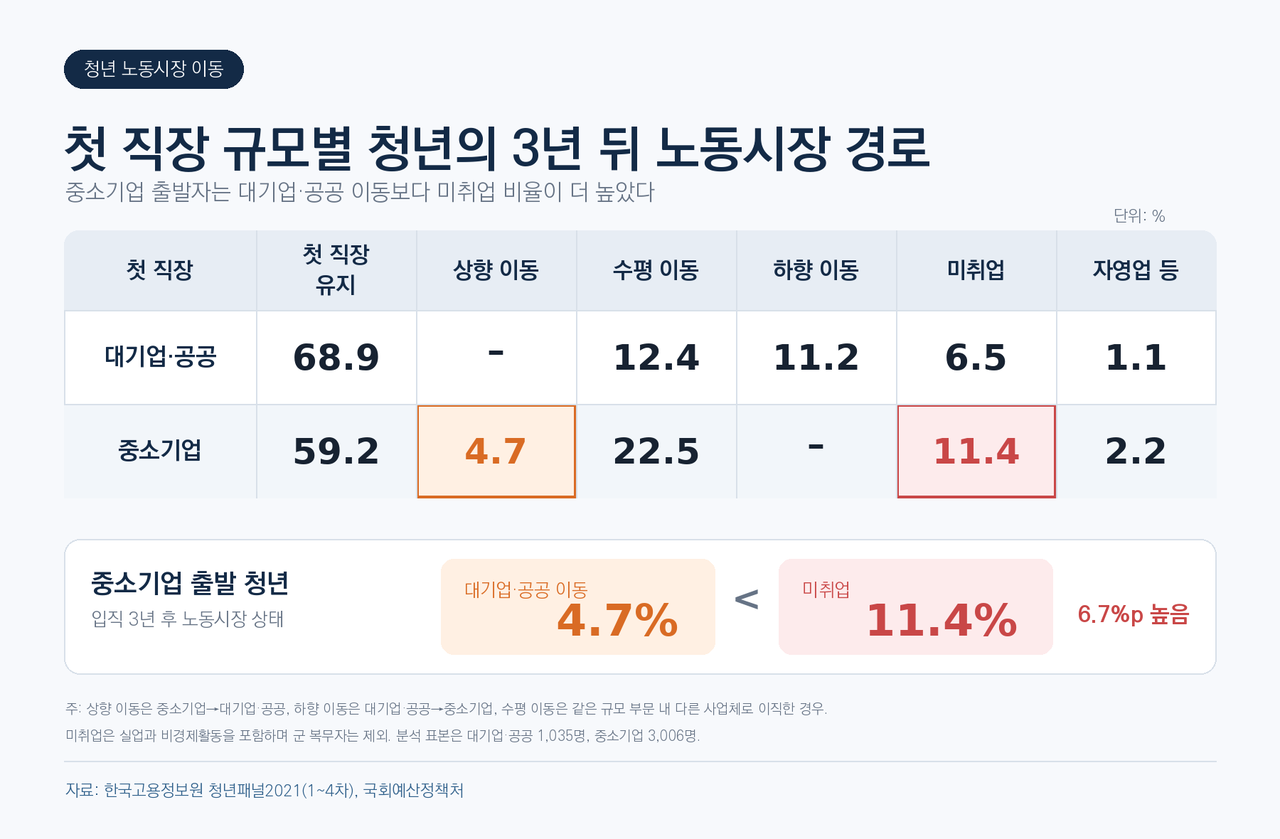
Among the 3,006 young people who started their first job at a small or medium-sized enterprise, 59.2% remained at the same workplace three years later. Another 22.5% had moved to a different small or medium-sized enterprise, while 4.7% had advanced to a large company or the public sector. Those who had become unemployed or economically inactive accounted for 11.4%, and 2.2% had moved into self-employment or similar work.
The gap was stark when compared with young people who started at large companies or in the public sector. The retention rate for that group stood at 68.9% after three years — 9.7 percentage points higher than for those who started at small and medium-sized enterprises. The gap widened steadily: 4.9 percentage points after one year, 7.7 points after two years, and 9.7 points after three.
The share who ended up unemployed or inactive was also lower for those who started at large companies or in the public sector, at 6.5% — 4.9 percentage points below the rate for small-firm starters. The figures show that employment stability and subsequent career paths diverge sharply depending on the size of a worker's first employer.
Even among those who did change jobs after starting at a small or medium-sized enterprise, most moves stayed within the small-firm sector.
Of those who started as non-regular workers at small and medium-sized enterprises and then changed jobs, 44.2% moved into regular positions at other small firms — but 32.1% were still working as non-regular employees at small firms three years later. Only 17.6%, combining both regular and non-regular workers, had moved to a large company or the public sector.
Job changes within the small-firm sector did bring some wage and benefits improvements. Among young workers who moved to another small or medium-sized enterprise, 68.4% saw their real wages rise, with a median increase of 10.6 percent. Among those who moved to a large company or the public sector, however, 73.2% saw real wage gains, and the median increase was higher at 16.7 percent.
The share receiving bonuses rose from 50.7 percent to 66.6 percent among those who moved within the small-firm sector, while it jumped from 49.1 percent to 77.7 percent for those who moved to large companies or the public sector. The share receiving overtime pay also increased — from 39.6 percent to 45.3 percent for those who stayed within small firms — but the improvement was far greater for those who moved up, rising from 41.1 percent to 65.2 percent.
These differences in career prospects lie at the heart of young workers' reluctance to take jobs at small and medium-sized enterprises. In a social survey conducted last year, large companies were the most preferred workplace among teenagers and young adults aged 13 to 34, chosen by 28.7 percent, followed by public enterprises at 18.6 percent and government agencies at 15.8 percent. Only 4.3 percent said they preferred small and medium-sized enterprises.
Yet as of June this year, roughly 17.02 million workers — 82.2 percent of the total workforce — were employed at firms with fewer than 300 employees, highlighting the wide gap between the jobs young people want and the jobs that actually exist. The share of young people who took more than a year after graduation to land their first paid job also rose, from 26.0 percent in 2020 to 31.2 percent this year.
The wage and skills gap is equally wide. The average monthly wage at firms with 300 or more employees was 6.32 million won ($4,580), nearly double the 3.36 million won at firms with fewer than 300 employees. Non-statutory welfare costs and training expenditures at smaller firms amounted to 166,500 won per worker per month — just 32.9 percent of the 505,900 won spent at larger firms.
Higher starting wages and access to social insurance at a first job were associated with a lower likelihood of being unemployed three years later, but showed no clear link to the probability of moving up to a large company or the public sector. This suggests that improving working conditions at small and medium-sized enterprises alone may reduce young workers' exit from the labor market but cannot guarantee upward mobility.
Experts say youth employment policy needs to go beyond hiring and retention support and focus on ensuring that skills built at a first job are recognized by the next employer. One proposed approach would record actual job duties and skill levels in a national job-competency registry and an integrated career certification system, then use that information in hiring and wage decisions. For young workers on fixed-term contracts, the report also calls for providing career counseling, vocational training, and job-placement support before contracts expire, to reduce gaps in employment.
The National Assembly Budget Office said policy should focus on "building a career ladder that connects the work experience gained at a first job to the next step, and turning that into a career outlook that young people can actually predict."
fact0514@heraldcorp.com