

Steam rose steadily from the pressing table as a hot iron passed over each collar, leaving shirts crisp and stiff. Washing machines ran without pause. On Tuesday, a visit to Hanwha Laundry in Mapo-gu, Seoul, revealed a "good price business" designation sign hanging on the door.
The shop has not raised its prices in 23 years. A dress shirt costs 1,500 won to launder; a suit, 7,000 won. That is 67 percent cheaper than the Seoul average of 11,692 won ($8) for dry-cleaning a suit last month.
"Labor costs and the fuel we need for cleaning have gone up a lot — there's barely anything left," the owner said, never pausing the iron. "I thought first about sharing rather than working hard just to pocket more. Because the prices are low, some customers come all the way from Sangam, and regulars have been coming for years — so it's hard to raise prices," he added.
A few alleyways away, a homestyle rice-meal restaurant offered equally striking value. Dishes including fermented soybean paste stew and cheonggukjang — a pungent fermented soybean soup — were priced at 10,000 won, some 2,000 to 3,000 won cheaper than nearby eateries. At 5 p.m., the kitchen was in full swing ahead of a group dinner booking for 20. Asked the secret to keeping prices low, the owner, identified only by the surname Kim, gave a simple answer. "I make the food myself to save on ingredients," he said. "Making it yourself reduces the burden. You have to keep prices low to bring in more customers — that's how you keep the place running." It is, in essence, a high-volume, low-margin strategy.
The owner of a nearby cafe roasts his own beans and makes his own syrups, selling a cup of coffee for 3,000 won. Raw material and labor costs have all risen, but by doing everything in-house, he has left the price tag untouched. A customer encountered outside the shop said: "When you think about coffee costing 7,000 to 8,000 won these days, it's great to be able to enjoy it cheaply. The location isn't as convenient as other cafes, but I make a point of coming here every lunch."
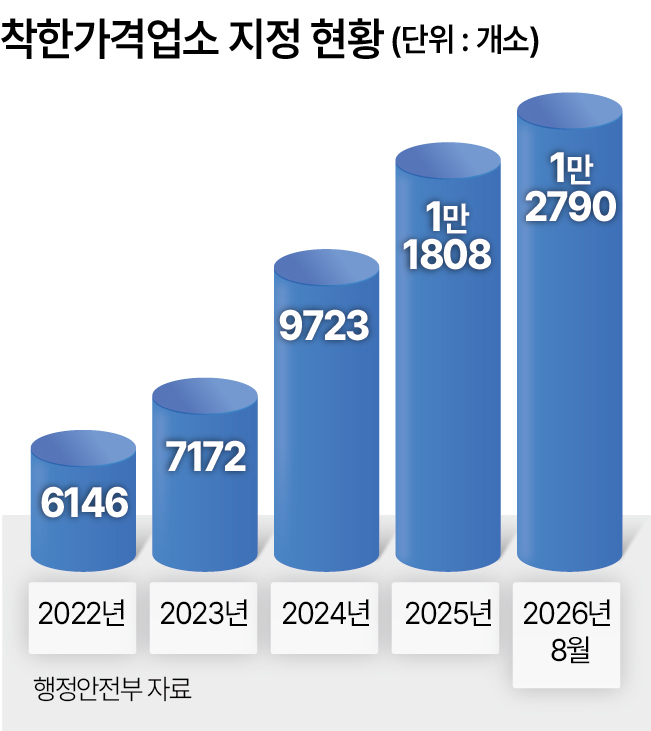
According to the Ministry of Interior and Safety, there were 12,790 designated "good price businesses" nationwide as of this month, up 982 from 11,808 at the end of last year — a rise in just eight months. In Seoul, the number grew from 1,962 to 2,111 over the same period. Busan saw the largest increase, jumping from 863 to 1,239, a gain of 376.
The Ministry of Interior and Safety has run the good price business program since 2011. It covers not only restaurants but also personal service businesses such as hair salons and laundries, evaluating them on price levels, hygiene and cleanliness, and service quality before granting designation. Designated businesses receive government and local authority support as well as promotional benefits. The ministry believes that benefits averaging around 850,000 won per designation, combined with the promotional value of the certification itself, are driving more businesses to participate.
Amid persistently high inflation, good price businesses offer rare relief — especially for workers watching their wallets. The same impulse drove the viral spread of "Geoji Map," an app launched in April that mapped restaurants charging under 10,000 won per meal; it surpassed 62,000 cumulative users within 10 days of its release. As more young consumers embrace value-driven spending, foot traffic is increasingly flowing only to shops that ease the financial burden.
Prices continue to climb. According to the Korean Statistical Information Service, the dining-out consumer price index stood at 128.31 (2020=100) last month, up 2.6 percent from a year earlier. Over the same period, the haircut price index rose 3.0 percent to 120.14, while the laundry price index rose 13.9 percent to 153.40.
"It is a natural phenomenon for consumers to seek out cheaper products and services amid high inflation," said Lee Hong-ju, a professor of consumer economics at Sookmyung Women's University. "As value-for-money spending increases, business owners can expect greater returns from a high-volume, low-margin approach."
siuu@heraldcorp.com





