
As smartphone addiction emerges as a serious social concern, more people are paying attention to eye health. Lutein — a yellow natural pigment found in high concentrations in the eye's macula — is one of the best-known nutrients associated with eye health. Because the body cannot produce lutein on its own, it must be obtained through green leafy vegetables such as kale and spinach. For many busy people, however, eating enough vegetables every day is no easy task.
Amid that backdrop, a domestic study has found that consuming cold-pressed juice made from lutein-rich vegetables such as kale and spinach raises blood lutein concentrations — and that the increase continues for up to 30 hours. The research also observed a decline in high-sensitivity C-reactive protein (hs-CRP), a blood marker used to assess the body's inflammatory state.
According to the Korea Food Communication Forum (KOFRUM) on Wednesday, a research team led by Yoon Jeong-mi, a professor in the Department of Food and Nutrition at Chonnam National University, compared how well lutein is absorbed and utilized in the blood when healthy adults consumed raw vegetables, cold-pressed vegetable juice and lutein supplements, respectively.
The study — titled "Bioavailability of Lutein Following Short-Term Consumption of Raw Vegetables and Juice" — was published in a recent issue of the international journal Nutrition Research and Practice. Bioavailability refers to the degree to which an ingested nutrient is absorbed and actually used by the body.
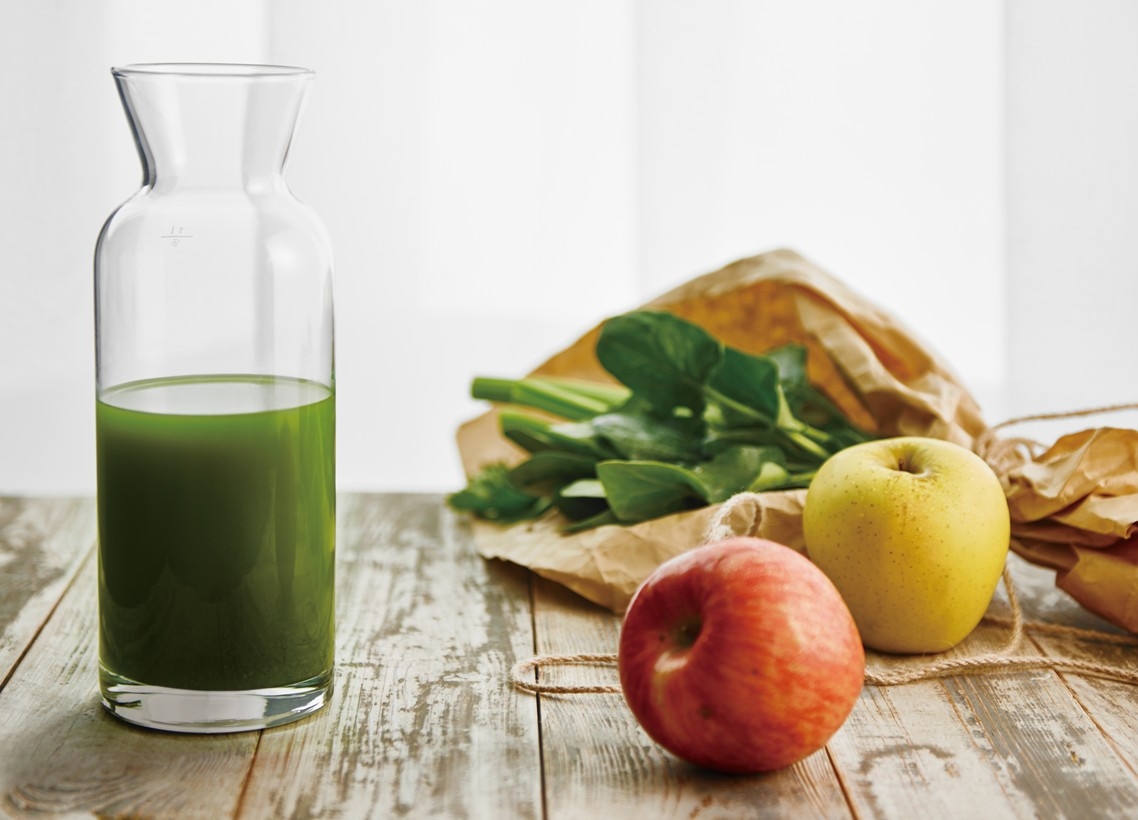
The team conducted a randomized crossover trial with 18 healthy adults. In a crossover trial, the same participants consume different foods or ingredients in sequence at set intervals, allowing their results to be compared. Participants took a lutein supplement, raw vegetables and cold-pressed vegetable juice in separate sessions spaced two weeks apart. The lutein dose was fixed at 20 mg across all three sessions. The raw-vegetable session provided 100 grams of kale, 50 grams of spinach and 150 grams of apple; the juice session provided 200 milliliters of cold-pressed juice made from the same ingredients; and the supplement session provided 20 mg of lutein.
The researchers drew blood before consumption and at 4, 6, 8, 12, 24 and 30 hours afterward to track changes in blood lutein levels. Blood lutein peaked at 0.37 micrograms per milliliter 12 hours after raw vegetable consumption. With the lutein supplement, levels peaked at 0.61 micrograms per milliliter at the 24-hour mark.
After cold-pressed juice consumption, blood lutein reached its highest point of 0.42 micrograms per milliliter at 30 hours. Unlike raw vegetables or the supplement, blood lutein levels continued to rise through the final measurement point at 30 hours, meaning the upward trend lasted comparatively longer after juice consumption.
The team also analyzed changes in hs-CRP, a blood marker reflecting the body's inflammatory state. hs-CRP measures C-reactive protein — which rises when inflammation is present — at very low concentrations, and is used to assess systemic inflammation and cardiovascular disease risk. In general, higher values indicate greater inflammation in the body.
After raw vegetable consumption, hs-CRP fell 19 percent from baseline at the 12-hour mark. After the lutein supplement, it dropped 32 percent at 24 hours. Following cold-pressed juice consumption, hs-CRP declined 17 percent at 12 hours and 26 percent at 24 hours, reaching a maximum reduction of 39 percent below baseline at 30 hours. In short, the short-term trial observed that cold-pressed juice consumption was associated with rising blood lutein levels and, at the same time, a decline in the inflammation-related blood marker.
However, lutein is a fat-soluble compound — meaning it dissolves in fat rather than water — so the degree of absorption can vary depending on the fat content of foods eaten alongside it. To minimize this effect, the researchers provided meals with similar fat content in all three sessions.
"For people who do not eat enough vegetables, cold-pressed juice made from lutein-rich vegetables such as kale and spinach can be a convenient way to take in lutein and a range of plant-based nutrients," Yoon said. "This study observed that consuming cold-pressed juice was associated with an increase in blood lutein levels and a decrease in hs-CRP, the inflammation-related blood marker."
She added that eating plenty of vegetables and fruit rich in essential nutrients is above all the most important thing for good health. "To increase daily vegetable and fruit intake, it can be practical to eat them at breakfast — when it is relatively easier to prepare your own meal than at lunch or dinner, when eating out is more common — and to make use of cold-pressed juice," she said.
kty@heraldcorp.com





