Center targets government's seven SEED projects in aerospace, advancing drug development and future medical technology research
NASA expert delivers keynote as hospital eyes global space medicine partnerships
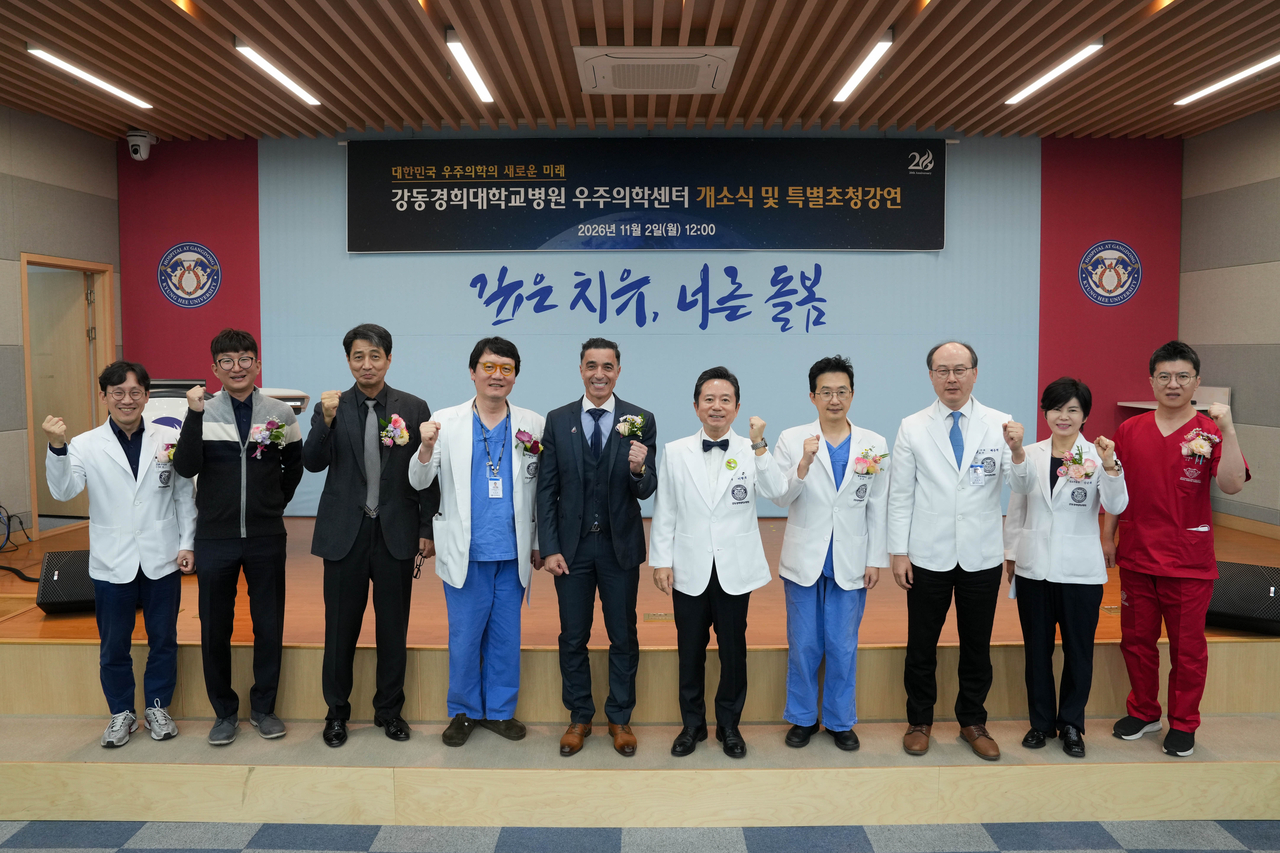
Gangdong Kyung Hee University Hospital has opened a Space Medicine Center to develop future medical technologies using space environments and strengthen its global research capabilities. The hospital held an opening ceremony Monday at Chahuyeong Hall on the fourth floor of its annex building, launching an integrated research initiative in medicine, dentistry and Korean traditional medicine to pursue space medicine research applicable to above-ground healthcare — including drug development and treatment of aging-related and chronic diseases.
Space medicine is the study of how space environments — including microgravity and cosmic radiation — affect the human body, and the development of preventive, diagnostic and treatment methods to protect astronauts' health. NASA has identified five major risk factors in space: cosmic radiation, isolation and confinement, and changes in gravity, among others. In space, the body undergoes rapid changes resembling accelerated aging, including reduced bone density, muscle atrophy and declining cardiovascular function. Studying these changes can yield insights applicable to treating osteoporosis, sarcopenia and other age-related and chronic conditions on Earth. Protein crystallization research conducted in microgravity environments has also drawn attention for its potential in drug development. As private space companies have lowered the barriers to access, the scope of space medicine research has continued to expand.
Gangdong Kyung Hee University Hospital has been building a space medicine research foundation through its Clinical Medical Research Institute, responding to the government's seven SEED projects and other aerospace development policies while strengthening its future medical technology research capabilities. With the center now open, the hospital plans to identify priority research projects linked to its pursuit of research-focused hospital certification and establish a specialized research framework in space medicine.
The center's defining feature is a convergence research model that combines expertise in medicine, dentistry and Korean traditional medicine. The hospital plans to use its integrated clinical infrastructure across all three disciplines to analyze the effects of space environments on the human body from multiple perspectives and translate findings into new preventive and treatment technologies. Specifically, the medical division will pursue clinical research on rehabilitation, cardiovascular health and anti-aging; the dental division will study changes in oral health under microgravity and cosmic radiation and develop related management technologies; and the Korean medicine division will conduct research on metabolic and immune regulation and the adaptation to space environments using acupuncture and herbal medicine. The goal is to build an integrated medicine-based space healthcare research model that organically links findings across all three fields.
The hospital will also expand research and development collaboration with domestic medical industry partners — particularly in drug development using microgravity environments and particle structure optimization — and plans to strengthen joint research with industry to ensure that related technologies can be applied in actual clinical settings. In addition, the hospital will pursue international joint research and the recruitment of specialized researchers in collaboration with institutions including NASA, Baylor University and Mayo Clinic. Through "Space-to-Earth" translational research — applying findings from space environments to the prevention and treatment of diseases on Earth — the center aims to broaden the clinical applicability of space medicine.
Cha Jae-myeong, the vice president of research who led the center's establishment, said aerospace medicine and healthcare represent "a core area of Space-to-Earth translational research that connects directly to the treatment of chronic diseases and aging on Earth." Cha added that the hospital would "lead space medicine research in South Korea and generate tangible results, drawing on our integrated clinical resources in medicine, dentistry and Korean traditional medicine."
At the opening ceremony, Dr. Fathi Karouia of NASA's Ames Research Center delivered a keynote lecture titled "Human Health Beyond Borders: From Space Exploration Discoveries to a Healthier Tomorrow." Karouia shared 25 years of experience conducting space life science research with NASA, the Japan Aerospace Exploration Agency and the European Space Agency. Karouia highlighted protein crystallization experiments with the immunotherapy drug Keytruda conducted in microgravity, as well as cases in which mesenchymal stem cells cultured in space showed enhanced immunosuppressive efficacy — demonstrating how space environments can accelerate drug development and advances in terrestrial medicine. Karouia also said multi-omics analysis and AI are critical to interdisciplinary research that translates space findings into clinical medicine. The hospital plans to use the event as a springboard to expand international academic exchanges and strengthen the foundation for global collaborative research.
kty@heraldcorp.com