
Approach also shown effective against cancer cells resistant to existing targeted anticancer drugs
The National Cancer Center said its research team, led by Ko Sung-ho of the Cancer Metastasis Research Branch and Choi Yong-du of the Convergence Diagnosis and Therapy Research Branch, has for the first time identified the interaction between two proteins — FOXM1 and ELF3 — that help cancer cells survive and contribute to anticancer drug resistance.
Conventional cytotoxic anticancer drugs affect not only cancer cells but also healthy cells, causing significant side effects. Targeted anticancer drugs, meanwhile, can only be used in patients with specific genetic mutations and may lose effectiveness over time as cancer cells adapt to the medication — a phenomenon known as drug resistance. New treatment strategies capable of simultaneously suppressing cancer cell survival and drug resistance are therefore needed.
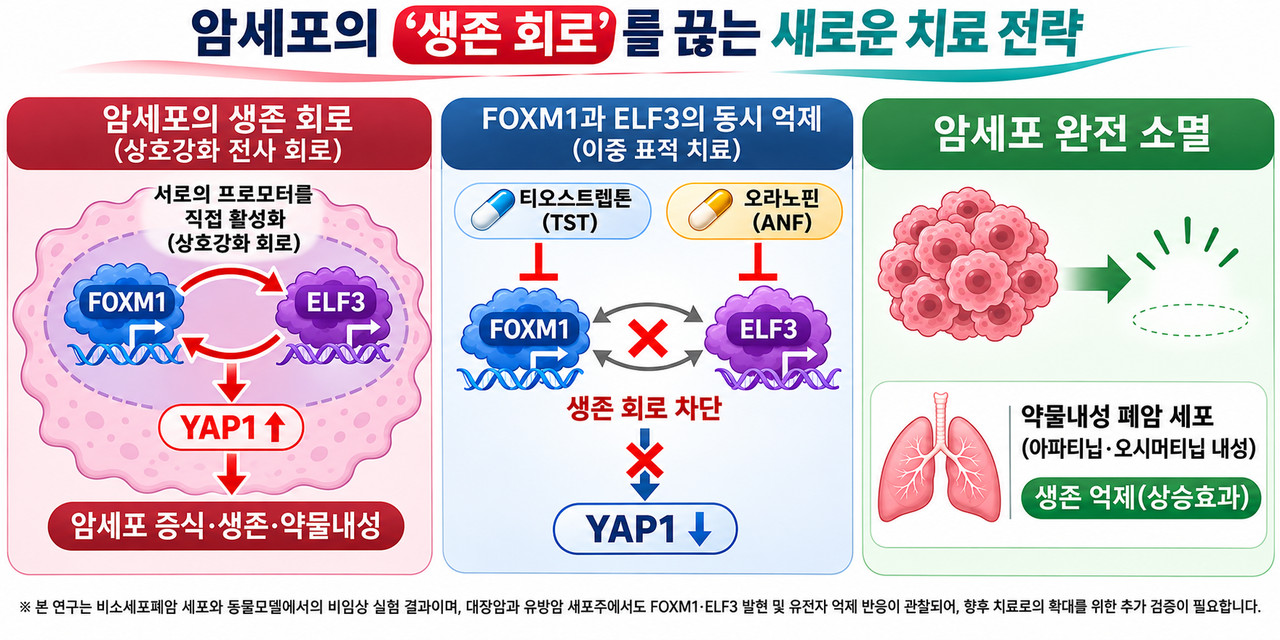
The research team focused on the fact that FOXM1 and ELF3 form a mutual reinforcement circuit, each amplifying the other's activity. When one protein becomes more active, the other follows. The team also found that this process increases the expression of YAP1, a protein linked to resistance against a range of targeted anticancer drugs.
To disrupt this feedback loop, the researchers conducted animal experiments using auranofin, a rheumatoid arthritis drug, and thiostrepton, an antibiotic. When the two drugs were administered together to simultaneously suppress both FOXM1 and ELF3, lung cancer tumors disappeared entirely. No significant side effects or major organ dysfunction were observed.
The treatment strategy also proved effective against cancer cells that had shown resistance to existing targeted anticancer drugs. The findings suggest a new path toward overcoming the limitations of conventional cancer treatment by severing the link between proteins that support cancer cell growth and survival.
"FOXM1 and ELF3 are proteins that are highly expressed across multiple cancer types, and a strategy that simultaneously suppresses their mutual reinforcement circuit has the potential to develop into a new approach for treating a wide range of cancers," Ko said. "We plan to continue verifying its applicability and safety across various cancer types."
"Drug resistance that develops during targeted therapy is a critical challenge in lung cancer treatment," Choi said. "This research is significant in that it confirmed the possibility of suppressing even cancer cells resistant to existing targeted anticancer drugs by blocking the interaction between FOXM1 and ELF3."

The research was supported by the National Research Foundation of Korea and the National Cancer Center's public-interest cancer research project. The findings were published online Nov. 5 in the International Journal of Biological Sciences (impact factor: 11.7).
kty@heraldcorp.com





