![A liquor aisle at a hypermarket in Seoul. [Yonhap]](https://wimg.heraldcorp.com/news/cms/2026/08/26/rcv.YNA.20260823.PYH2026082304140001300_P1.jpg)
South Korea's liquor industry, long troubled by falling domestic consumption, is setting its sights on overseas markets — and making inroads into the United States, once considered barren territory, on the back of the global K-food wave.
OB Brewery entered the US market late last year under an export soju brand called Charlang, according to industry sources Wednesday. The company has been expanding its distribution through Korean restaurants frequented by Korean expatriates. OB had long focused solely on beer, but its acquisition of Jeju Soju broadened its strategy. A brand called Geonbae Zzan, originally launched in August last year to target Southeast Asian markets, laid the groundwork for the US push.
Hite Jinro, the top soju maker, is competing in the US under its global brand Jinro, while second-ranked Lotte Chilsung is pushing its Soonhari label. Both have put fruit-flavored soju front and center to appeal to consumers unfamiliar with the spirit's traditional taste. Jinro offers grapefruit, green grape, plum, strawberry, peach and lemon varieties, while Soonhari has expanded its lineup to include apple, apple mango, yuzu, green grape, peach, strawberry, yogurt, plum and lychee. Charlang has also rolled out peach, yogurt, green grape and grapefruit flavors.
Hite Jinro named BTS member V as a brand ambassador in July, pairing the soju brand with K-food and K-pop marketing. The company recently ran a tasting booth at a "chimaek" — chicken and beer — festival in California and released a limited-edition line featuring its signature toad mascot styled as a K-pop star. A toad figurine and a bottle-shaped limited-edition microphone became must-have items among local consumers.
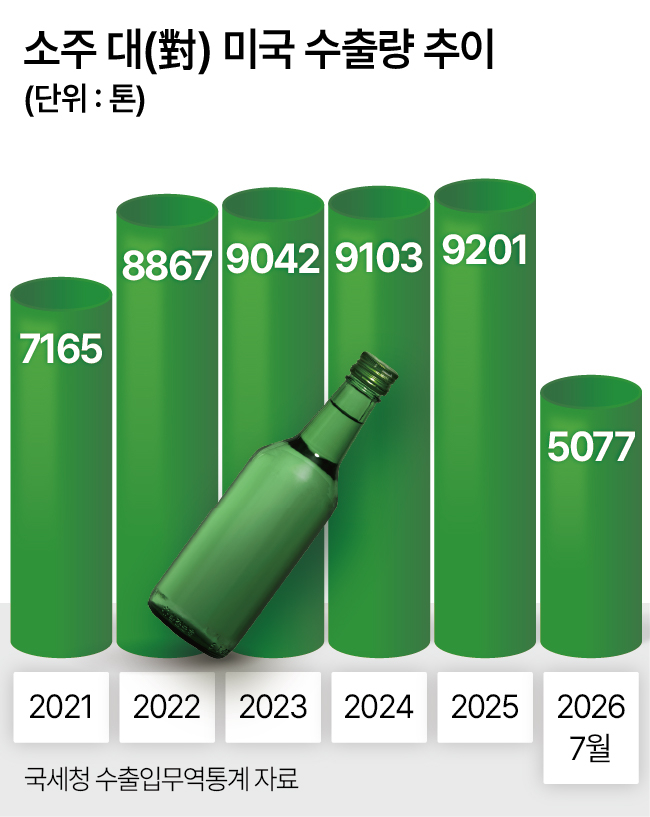
The numbers reflect soju's rising profile in the US. According to Korea Customs Service trade statistics, South Korea's soju exports to the United States grew 28.4 percent over the past five years, from 7,165 tons in 2021 to 9,201 tons in 2025. That outpaces the 9.1 percent growth in total soju exports over the same period, which rose from 59,529 tons to 64,975 tons. Last year's US export volume was also the largest since records began in 2000. For Hite Jinro alone, exports of fruit soju to the US grew at an average annual rate of about 25 percent from 2020 to 2025.
The industry's focus on the US is driven by sluggish domestic demand. According to the National Tax Service, domestic shipments of diluted soju briefly rebounded to 862,000 kiloliters in 2022 after COVID-19 social distancing measures were lifted, but then fell for three consecutive years — to 844,000 kiloliters in 2023, 816,000 kiloliters in 2024 and 793,000 kiloliters in 2025. A shift in drinking culture, particularly among younger generations increasingly focused on health, has driven the decline.
Adding to the optimism is growing interest among North American consumers in Korean alcohol through films, drama series, social media and K-pop. The official US Instagram accounts for Jinro and Soonhari have climbed to around 56,000 and 26,000 followers, respectively. "The US soju market is still not large, but its potential is limitless," an industry official said. "Companies are looking to seize growth opportunities through localization efforts such as fruit soju."
spa@heraldcorp.com