
The mood in South Korea's IPO market has cooled sharply in the second half of this year. While the first half saw a string of newly listed stocks quadruple on their debut — a phenomenon known as "quadruple-up" — most companies that have gone public since July have fallen below their offering prices.
According to Newsis and Korea Exchange, the 11 companies that listed in the second half of this year have posted an average return of minus 25.61 percent against their offering prices as of Thursday.
Of the 11, only two — Neoview and Ingenia Therapeutics — are trading above their offering prices. The remaining nine are all below.
Several stocks have suffered steep declines. Lemon Healthcare, HLGenomics and Delicious have each lost more than half their offering-price value. Gido Industry, which listed on Kosdaq on Friday, fell from its offering price of 28,400 won ($21) to 15,020 won within a week — roughly a 47 percent drop.
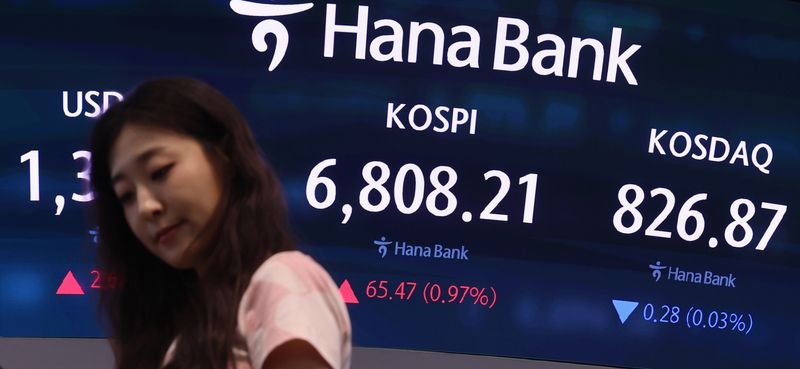
The IPO market's chill is tied to a broader correction in domestic equities. In the first half, strong gains in the Kospi and Kosdaq drew investor money into new listings. But as major indexes fell sharply in the second half, sentiment toward newly listed stocks deteriorated quickly.
The contrast with the first half is stark. Between March and June, six companies — starting with Esteem in March, followed by Axbis, IMBiologics, Cosmo Robotics, Polled and MakinaRocks — hit the daily price ceiling on their first day of trading, quadrupling their offering prices.
In the second half, by contrast, stocks have been falling below their offering prices from day one. Among IPO investors, the sense that quick profits are no longer easy to come by has spread, dampening buying interest.
Weak post-listing performance has also reduced institutional demand. Skylabs, which conducted its book-building from Aug. 14 to Friday, set its final offering price at 10,000 won — below the lower end of its indicative range of 13,000 to 16,000 won.
The institutional competition ratio was limited to 63.41-to-1, and the lock-up commitment rate — the share of institutional investors pledging not to sell for a set period after listing — stood at just 0.17 percent. Institutional investors' expectations had already been scaled back at the pricing stage.
Analysts say the recent weakness in the IPO market reflects a combination of the domestic equity correction and deteriorating investor sentiment. Some, however, expect conditions to partially recover in the remainder of the second half if markets stabilize and reforms to the IPO regime gain traction.
"Listed companies this year have underperformed not only in terms of fundraising amounts but also in medium- to long-term returns," said Kang Young-hun, a researcher at Samsung Securities. "We expect investor sentiment toward IPOs to improve in the second half as various uncertainties are resolved."
Kang said specific catalysts to watch include the resolution of uncertainty around dual listings following the release of related guidelines, the completion of preliminary review submissions for Kospi listings by Sono International and FFC along with listing pushes by Musinsa and Gudai Global, and the introduction of a pre-book-building system and a cornerstone investor regime.
The pre-book-building system allows underwriters to gauge institutional demand before the indicative offering price range is finalized in the securities registration statement. By incorporating market demand from the earliest stage of pricing, the system is expected to help set more appropriate offering prices.
The cornerstone investor regime allocates a portion of IPO shares in advance to institutional investors that commit to a lock-up period of at least six months. Its advantages include increasing the share of medium- to long-term investors and allowing market demand to be reflected more rationally in the offering price.
Yun Cheol-hwan, a researcher at Korea Investment & Securities, noted that the Kosdaq fell 21.4 percent last month, creating an unfavorable environment for book-building and subscriptions. "In the second half, bargain-hunting inflows and policy momentum to revitalize Kosdaq are expected, so investors need to be proactive in picking winners amid the many opportunities," he said.
Analysts say that for the IPO market to recover, post-listing price stability matters more than a flashy debut. As the gap in returns among newly listed stocks widens depending on the appropriateness of offering prices, the volume of institutional lock-up commitments and the visibility of corporate earnings, a more selective approach by investors is expected to become increasingly important.
rainbow@heraldcorp.com





