Foreign, institutional investors net sell 11.9 trillion won in August
Other corporations absorb 8.8 trillion won, cushioning the market
Buyback programs on track to wrap up in November
Next leg up hinges on foreign investor flows
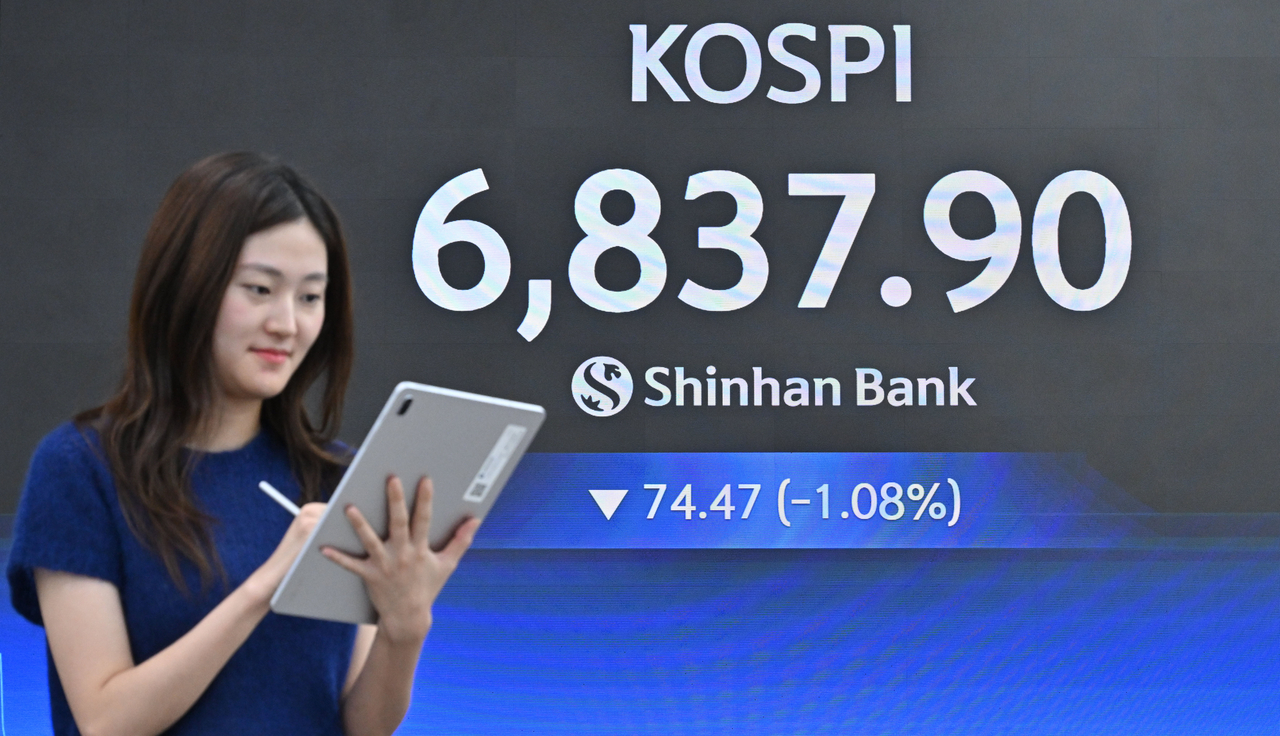
All eyes are on Federal Reserve Chair Waller's Jackson Hole speech, scheduled for Friday night (Korean Standard Time), as investors watch whether foreign buyers will return to the South Korean stock market. This month, foreign and institutional investors combined to net sell nearly 12 trillion won ($8.69 billion) worth of Kospi shares, but other corporations stepped in to absorb the selling pressure. With retail buying momentum also fading, share buybacks by Samsung Electronics and SK hynix have been propping up demand. The key question now is whether foreign investors will come back as the next major buying force to drive a fresh rally.
According to Korea Exchange data released Friday, foreign investors net sold 8.75 trillion won worth of Kospi shares this month, while institutions net sold an additional 3.13 trillion won. Retail investors managed only 3.09 trillion won in net purchases, while other corporations — a category that includes companies buying back their own shares — recorded net purchases of 8.79 trillion won. With foreigners and institutions offloading a combined 11.88 trillion won, other corporations absorbed a substantial portion of that supply.
The surge in other-corporation buying coincided with the start of the two chipmakers' buyback programs. In the two days after SK hynix launched its buyback on Friday, Aug. 21, other corporations recorded net purchases in the 1 trillion won range. From Monday, when Samsung Electronics joined in, other corporations posted net purchases of around 1.5 trillion won for six consecutive trading sessions. Cumulative net purchases from Friday, Aug. 21, through Thursday reached 8.57 trillion won.
The two companies' buyback windows largely overlap. SK hynix plans to repurchase 40 trillion won worth of its own shares from Aug. 20 through Nov. 19, while Samsung Electronics is set to buy back approximately 15 trillion won from Aug. 24 through Nov. 21. Kwon Beom-seok, a researcher at Samsung Securities, said that if the current pace continues, "the net purchase trend by other corporations is expected to persist for about 30 more trading sessions — at least a month and a half."
Retail buying, meanwhile, has weakened sharply. Retail net purchases fell from 35.09 trillion won in May and 42.4 trillion won in June to 5.37 trillion won in July and just 3.09 trillion won so far this month. As the buying power that drove the index in the first half of the year has diminished, the role of other corporations has grown correspondingly larger.
Against this backdrop, the return of foreign investors has emerged as the pivotal variable for the next upswing. Morgan Stanley suggested this month that the Korean stock market, after a sharp correction, could be entering a sustainable recovery phase. Unlike the retail-led rally of the first half, the bank said, "foreign investors are likely to set the direction in the next up-cycle," citing AI-driven memory chip demand, improving corporate earnings, and better governance and capital allocation as factors that could draw foreign participation — noting that deleveraging, including the unwinding of leveraged positions, has already progressed considerably.
Market conditions have in fact shifted. After being pushed down to the 6,200 level early this month, Kospi has been gradually climbing back toward the 6,900 range heading into month-end. The Kospi Volatility Index (V-Kospi) has also eased from around the 80 level at the start of the month to around 50. The won-dollar exchange rate has likewise fallen from the 1,550-won range in early July to the 1,380-won range late this month.
The next variables for a foreign investor comeback are US interest rates and the direction of the dollar. Sustained rate pressure could constrain global capital flows into emerging markets — which is why Chair Waller's Jackson Hole remarks are drawing close attention. Analysts note that given recent consumer price trends, the Fed is unlikely to lean toward further tightening.
Han Ji-young, a researcher at Kiwoom Securities, said that "with the US Treasury's expansion of government bond buybacks and other market-stabilizing measures, and with upside inflation uncertainty eased by the July CPI and PCE readings, Chair Waller is likely to take a cautious stance on additional tightening."

kacew@heraldcorp.com