Fourth Basic Plan for Transfer Center Development
Nine new transfer centers to be built at Gimpo Airport Station, Yangjae Station and other Greater Seoul hubs
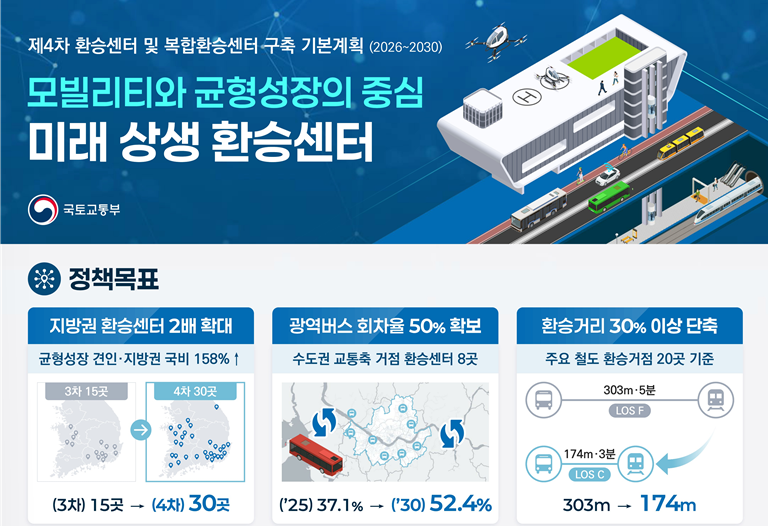
The number of public transit transfer centers across the country will double. Nine new centers will be built in the Greater Seoul area — including at Gimpo Airport Station, Yangjae Station, Sadang Station and Changdong Station — while 15 more will be added in regional cities.
At 20 major rail transfer hubs nationwide, transfer distances and times will be cut by more than 30 percent through proactive improvements to transfer convenience, with technical reviews by specialized agencies made mandatory.
The Metropolitan Area Transportation Commission, an arm of the Ministry of Land, Infrastructure and Transport, announced Thursday that it had finalized the Fourth Basic Plan for Transfer Center and Complex Transfer Center Development (2026–2030) and would officially publish it Saturday.
The commission developed the five-year plan — covering medium- and long-term development directions and key tasks — through demand surveys of local governments and public institutions, consultations with relevant agencies, and input from experts, before finalizing it through a review by the National Transport Commission. The plan sets three core goals under the vision of "future co-prosperity transfer centers at the heart of mobility and balanced growth."
The first goal is to expand transfer centers in regional areas to twice the number called for under the third basic plan, in order to guarantee mobility between the Greater Seoul area and the regions and support improvements in living conditions and balanced regional growth. The number of regional transfer centers will increase by 15, bringing the total to 30, backed by 44.7 billion won ($32.4 million) in national funding.
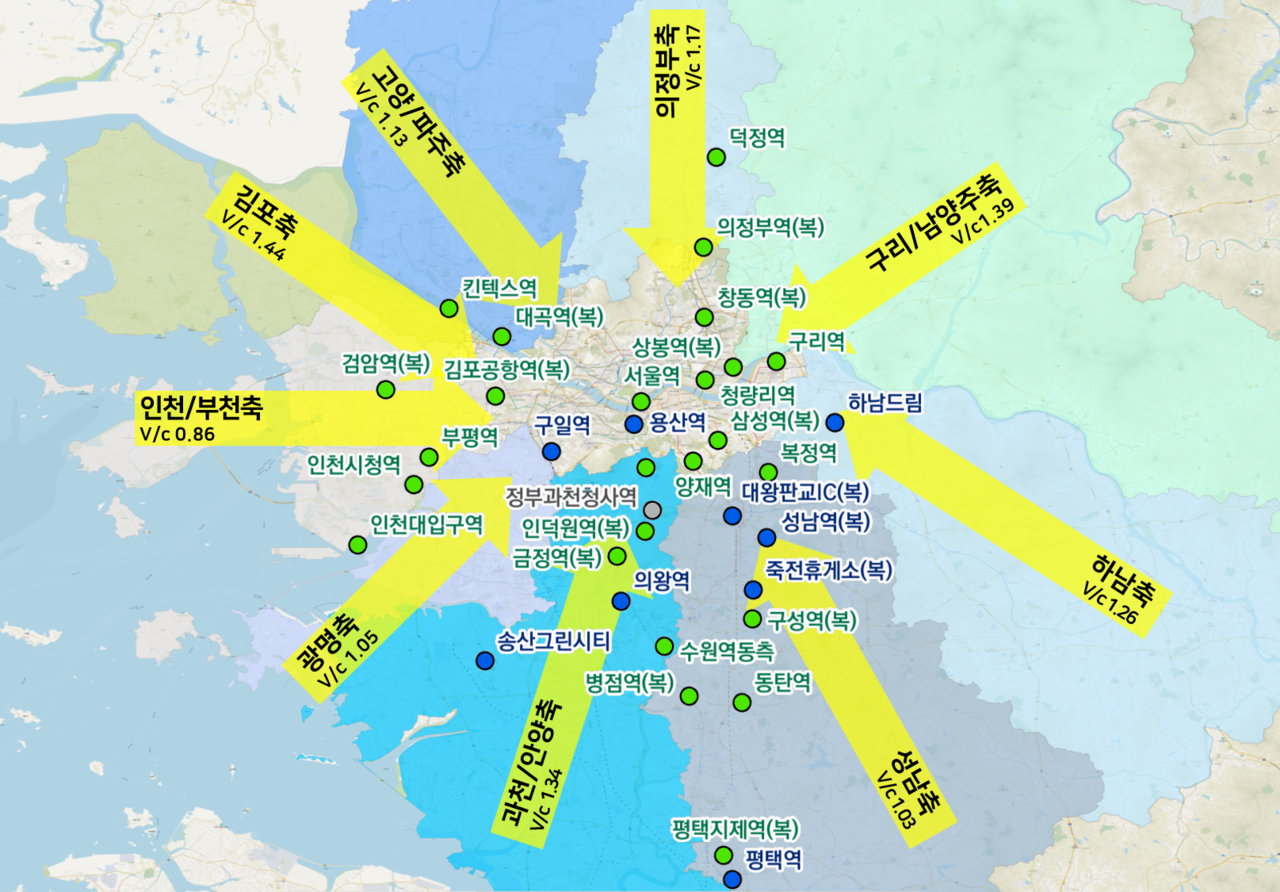
In the Greater Seoul area, new hub transfer centers will be established along nine transit corridors to increase the turnaround rate of wide-area buses, effectively adding service capacity and reducing headways. The commission expects that raising the turnaround rate from 37 percent to 50 percent will also help ease congestion in central Seoul.
Planned locations include Gimpo Airport Station on the Incheon-Bucheon and Gimpo-Ganghwa corridors, Changdong Station on the Uijeongbu corridor, Sangbong Station on the Guri-Namyangju corridor, Yangjae Station on the Seongnam-Yongin corridor, and Sadang Station on the Gwacheon-Anyang corridor.
Transfer distances and times at 20 major high-speed and wide-area rail stations nationwide will be cut by more than 30 percent. Alongside the physical construction of transfer centers, the plan calls for enhanced transfer services — including the development and deployment of AI and advanced technologies such as real-time in-station congestion prediction and detection, walk-through payment systems, and personalized route guidance — to support fast and safe transfers. A model service will be developed and pilot projects launched.
Once the fourth basic plan is fully implemented, 65 transfer centers and complex transfer centers will be in operation nationwide. The regional total of 30 includes 14 in the Busan-Ulsan and Daegu areas, 10 in the Daejeon area, and six in the Jeonju and Gwangju areas.
To facilitate the expansion of transfer infrastructure in the regions, the national funding share for new regional projects will rise from 16 percent to 59 percent, while the share allocated to the Greater Seoul area will fall from 84 percent to 41 percent.
The plan also calls for continued development of a next-generation transfer center concept — tentatively named the "AX Mobility Hub" — to accommodate new modes of transport such as deep underground rail and urban air mobility, and to deliver innovative transfer services powered by AI and other advanced technologies.
"Through the fourth basic plan for transfer centers, we will work to practically resolve the inconveniences people experience in their daily commutes, creating a 'co-prosperity transport transfer system' that provides growth momentum for regional areas and mobility efficiency for the Greater Seoul area," said Kim Yong-seok, chairman of the Metropolitan Area Transportation Commission.
smh@heraldcorp.com