
Typhoons Mekkhala and Higos strengthened the monsoon front and pushed back the North Pacific High; heat released during heavy rain then reinvigorated the high-pressure system, driving temperatures 4.1 degrees above the seasonal norm in just six days
Typhoons that never make landfall on the Korean Peninsula can still intensify heat waves there, according to a new analysis. Two typhoons that passed near Japan in late June altered the behavior of both the monsoon front and the North Pacific High in quick succession, contributing to a sharp temperature spike on the peninsula in early July.
The Korea Institute of Ocean Science and Technology (KIOST) announced Monday that typhoons which bypassed the Korean Peninsula this summer changed atmospheric circulation patterns and influenced the strength and position of the North Pacific High, ultimately affecting heat wave conditions in South Korea.
More than 20 typhoons have formed in the western Pacific this summer, yet not one has made landfall on the Korean Peninsula. Even so, a typhoon far from the peninsula can alter atmospheric flow and affect the movement of the monsoon front and high-pressure systems — changes that can translate into shifts in temperature and precipitation on the peninsula days later.
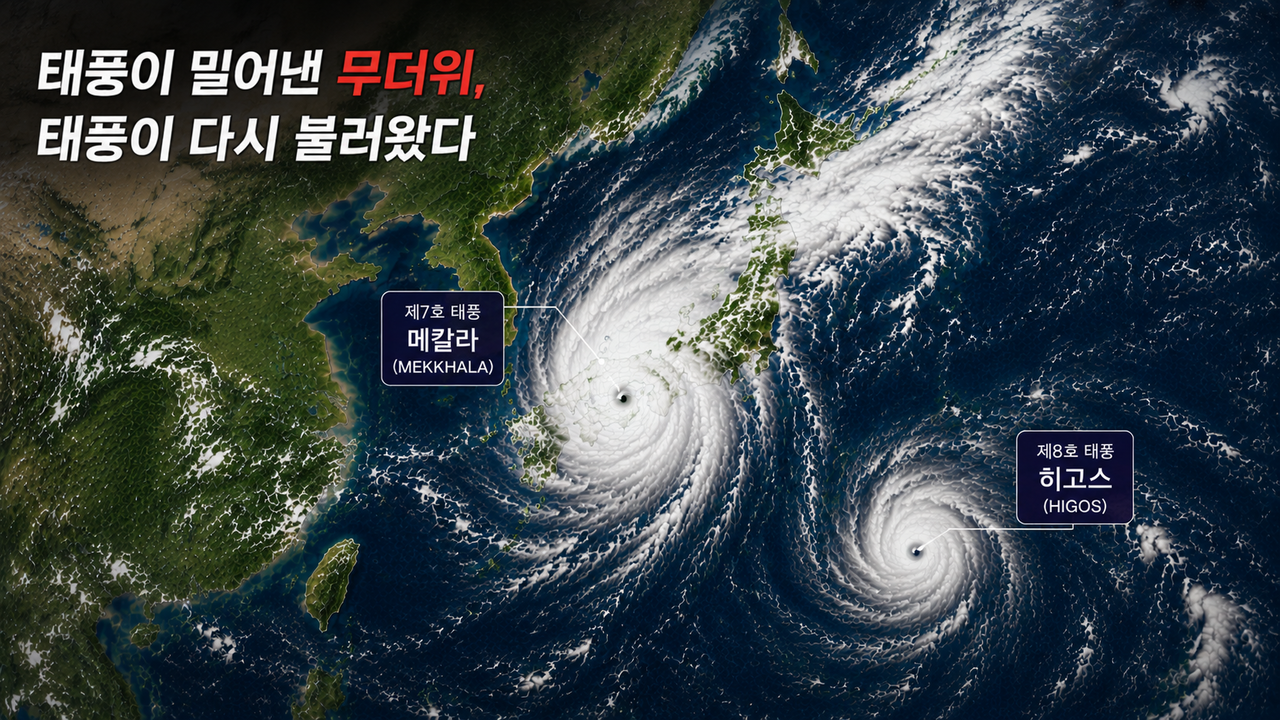
KIOST's Marine Climate Prediction Center analyzed the atmospheric impact of Typhoon No. 7, Mekkhala, and Typhoon No. 8, Higos, which passed near Japan in late June one after the other.
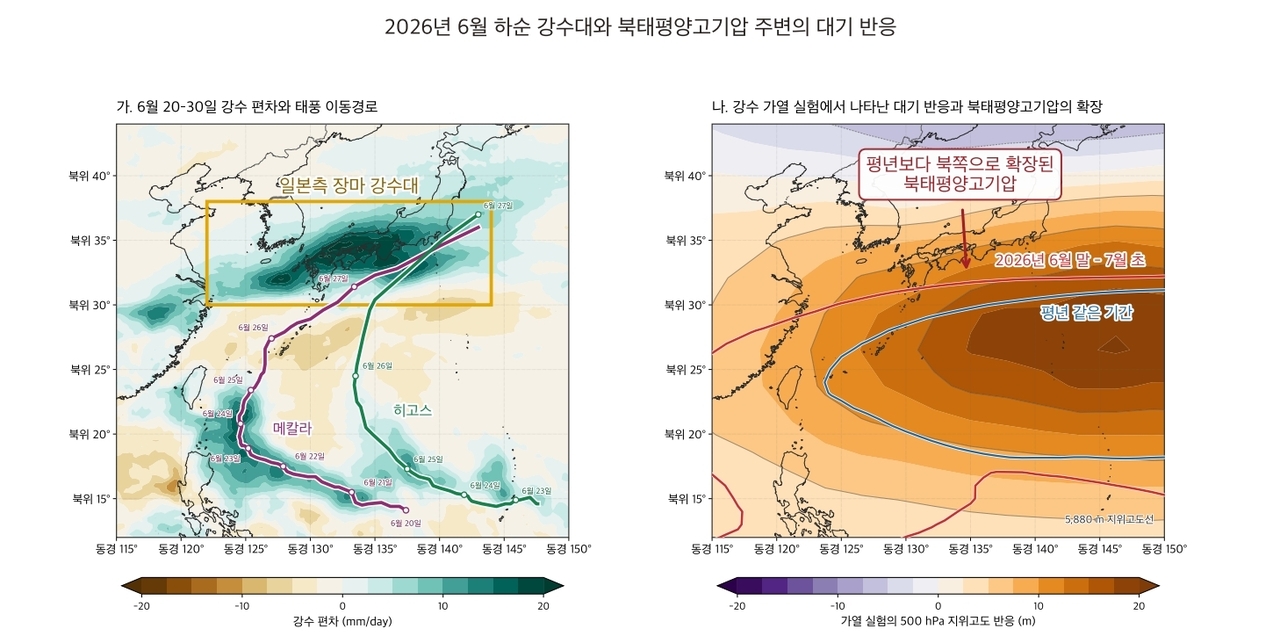
Although neither typhoon approached the Korean Peninsula directly, both supplied warm, moist air that significantly intensified monsoon front activity and rainfall over the peninsula. At the same time, they pushed the North Pacific High — a major driver of summer heat on the peninsula — eastward, temporarily suppressing its expansion toward Korea. As a result, the peninsula briefly moved out from under the high's influence in early July, and temperatures fell.
The situation then reversed. As the typhoons' moisture condensed into raindrops during heavy downpours, large amounts of heat were released into the atmosphere — a phenomenon known as precipitation heating. That heat reinvigorated the North Pacific High, creating conditions for it to expand back toward the Korean Peninsula.
When the Marine Climate Prediction Center applied the precipitation heating effect to its model, the North Pacific High strengthened at an altitude of roughly 5.5 kilometers above the area near Japan and expanded back toward the Korean Peninsula. The distant typhoons initially pushed the high away and cooled temperatures, but the atmospheric changes they left behind subsequently reinvigorated the high and drove temperatures back up.
Observed temperatures rose rapidly as well. An analysis of data from 60 Automated Synoptic Observing System stations operated by the Korea Meteorological Administration showed that the national average temperature was 1.3 degrees Celsius below the seasonal norm on July 1, but 2.8 degrees above it by July 7. The deviation from the seasonal norm widened by an average of 4.1 degrees Celsius in just six days. A clear warming signal was also detected across the southern and southeastern regions, including Busan.
However, this analysis alone cannot attribute the entirety of this year's heat wave to the typhoons.
Kim Seong-hun, director of KIOST's Marine Climate Prediction Center, said the findings should not be taken as a definitive explanation for this year's heat wave, but they demonstrate that typhoons which do not approach the Korean Peninsula directly can still alter the monsoon front and the North Pacific High and influence temperatures in South Korea. "We will continue to analyze similar cases to better understand the link between typhoons and East Asian atmospheric circulation, and apply those findings to summer climate monitoring and outlooks," he said.
adastra@heraldcorp.com





