Farmers eager but cautious as agrivoltaic system nears launch
One farm reports annual net income of 14.33 million won from 99.7 kW installation
Government to require 80% of farmland to stay in cultivation, ease business regulations
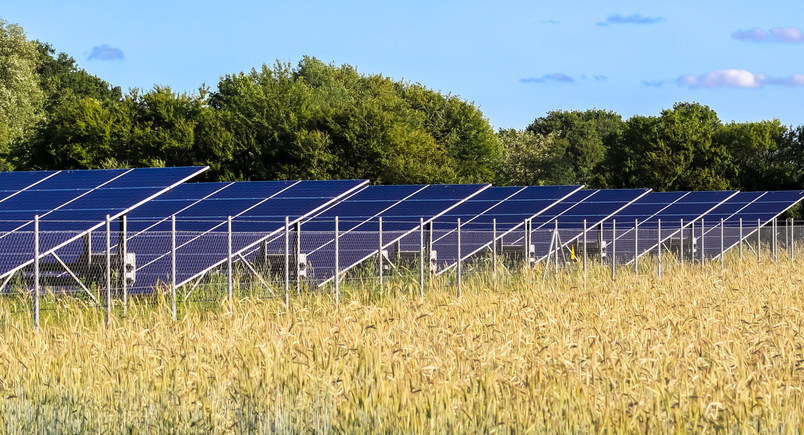
"How much does crop yield drop when you farm under solar panels?"
"If I install a 100-kilowatt generation facility, how much money will I actually take home?"
Questions like these filled the room at an agrivoltaic community forum held Friday at Osco in Cheongju, North Chungcheong Province. Farmers pressed government officials on whether solar power could genuinely supplement their farm income, even as concerns mounted over upfront investment costs and potential crop losses. With the country's agrivoltaic regime set to launch Dec. 17, what farmers wanted to know most was simple: how much more can I earn while still farming?
About 220 people attended Friday's event, including farmers, local government officials and experts, according to the Ministry of Agriculture, Food and Rural Affairs. It was the first time the government had held a direct dialogue with farmers specifically on agrivoltaic farming.
Agrivoltaic farming involves installing solar panels at set intervals and heights above farmland, allowing crops to grow below while electricity is generated above. Unlike conventional rural solar projects — which convert farmland to other uses to install generation facilities — the agrivoltaic model is designed to maintain agricultural production while adding revenue from power generation.
The most attention at the event went to real-world income figures from a farm already running an agrivoltaic operation.
Moon Byeong-wan, head of the Boseong Agricultural Cooperative in South Jeolla Province, shared his experience installing a 99.7-kilowatt generation facility on a 2,145-square-meter plot. The initial investment came to 190 million won ($142,000). Annual net income reached 14.33 million won — of which 1.41 million won came from rice farming and 12.92 million won from solar power generation.
Solar income outpaced crop income by roughly 9.2 times. Moon cautioned, however, that this was his individual operation and did not guarantee the same returns for every farm.
Farmers quickly turned their questions to investment costs and profitability. One farmer from Iksan asked how much net profit remained after accounting for annual generation output and operating costs on a 100-kilowatt installation.
Nam Jae-woo, secretary-general of the Korea Agrivoltaic Association, identified upfront construction costs as the key variable determining profitability. Assuming certain conditions based on 2026 figures, he said annual net returns would be roughly 8 million to 9 million won, and advised farmers to evaluate the return on their investment rather than focusing on gross income.
"A return of just over 5 percent is roughly the floor," Nam said. "Don't simply size your operation around hitting 10 million won in income — you need to assess the return relative to what you put in."
Some farmers also raised concerns that installing more panels to boost power revenue could end up ruining their crops.
Jeong Sun-yeon, a farmer from Ganghwa, asked how much shading from solar panels would affect crop growth and yields. The dilemma was that generating more electricity requires more panels, but crops need sunlight.
Im Cheol-hyeon, a professor at Korea Energy University of Technology, said shading from panels inevitably reduces photosynthesis. The impact on yields varies by crop depending on how sensitive each plant is to light, he added. Rice and soybeans are relatively sensitive to reduced sunlight, while some vegetables and green tea may be less affected.
Taking these concerns into account, the government is preparing subordinate regulations that would cap the shading ratio of solar panels at below 30 percent. Minimum structure height has been set at 2.5 meters, with a post spacing standard of 4 meters — measures designed to ensure enough room for farm machinery and crop growth.
The government also plans to require that at least 80 percent of the farmland beneath the panels remain under active cultivation, a rule aimed at preventing operators from installing generation equipment without actually farming.
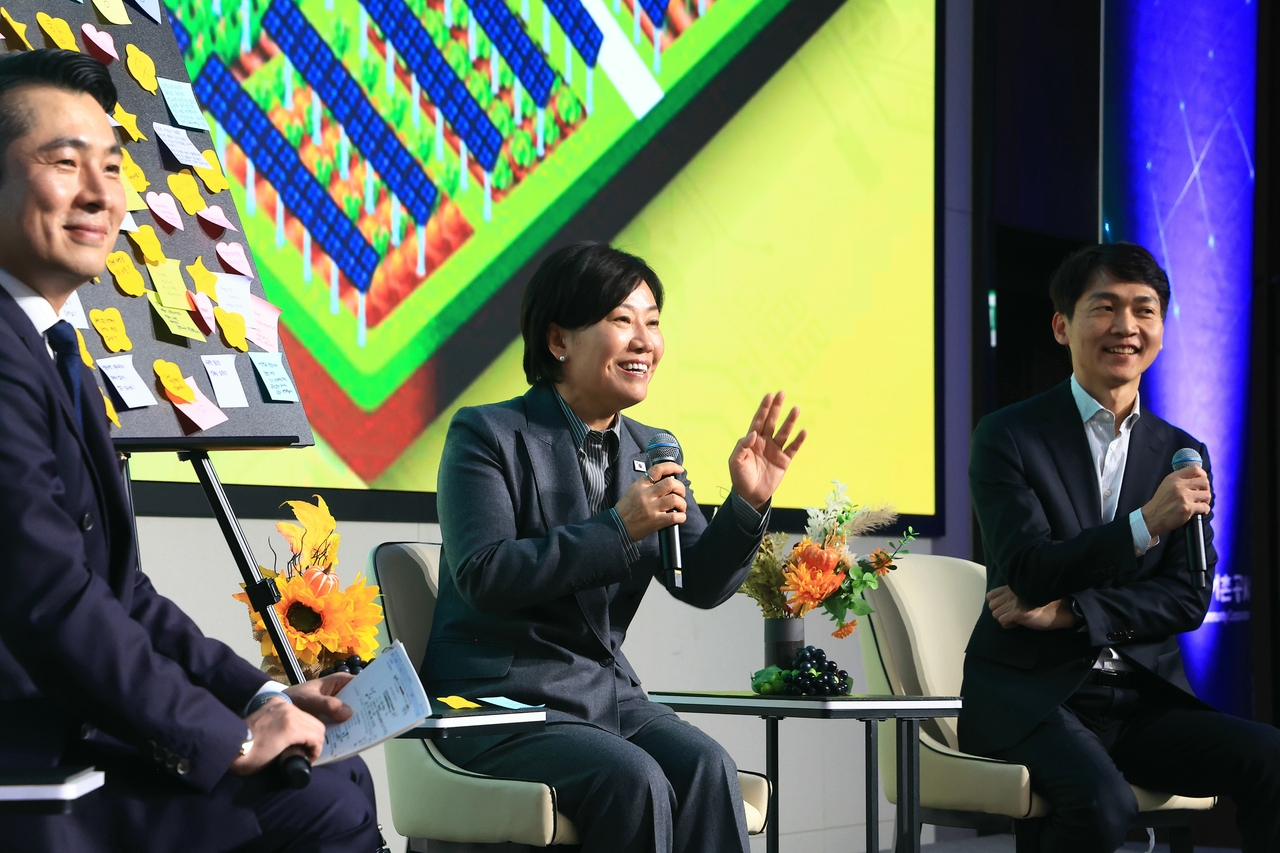
Agriculture, Food and Rural Affairs Minister Song Mi-ryeong said Friday that protecting farmland is the foundation of the agrivoltaic regime.
"If we go with conventional solar, we keep losing farmland from a food security standpoint, and that affects the entire population — so the most important thing is to protect food security," Song said. "That is a goal we cannot abandon."
Farmers also wanted to know whether tenant farmers and young farmers could participate in the program.
Song said individual farmers who have lived in the relevant area for at least three years are eligible to participate, while young farmers face no residency requirement. Resident-participation cooperatives can be formed by 10 or more residents who have lived in the village for at least one year. Tenant farmers may also take part provided they meet the necessary requirements, including the landowner's consent.
Song cautioned, however, that farmers starting a generation business on a small plot should carefully assess whether they can recoup their investment.
The government is also streamlining regulations to support expansion of the program. At a regulatory reform strategy meeting held Friday, the Ministry of Agriculture, Food and Rural Affairs finalized 50 deregulation tasks, including adding agrivoltaic farming to the permitted business scope of agricultural corporations.
Currently, agrivoltaic farming falls outside the permitted activities of agricultural corporations. The government plans to amend relevant enforcement decrees or issue new ministerial notices by June next year to allow agricultural corporations to operate agrivoltaic businesses.
The government is also pursuing an exemption from small-scale environmental impact assessments for generation projects covering less than 20,000 square meters. Working with the Ministry of Climate, Environment and Energy, it is targeting an amendment to the relevant enforcement decree by December this year.
Preventing conflict among rural residents as the program expands is another challenge. The government plans to require advance disclosure of project details and public comment periods, while also developing mechanisms for cooperatives and other operators to channel a portion of generation revenue into village community funds, energy welfare programs and cooperative farming initiatives.
"If farmland is used for power generation but the profits flow only to the investors, the rural community ends up doing nothing more than lending out its land with nothing to show for it," Song said, calling for a structure in which both farmers and local residents share in the benefits.
The government plans to release guidelines covering operator eligibility, permit procedures and farming plan requirements in time for the Dec. 17 launch. Whether the vision of farming alongside power generation — and keeping those earnings in rural communities — translates into real gains for farm households will ultimately depend on how the program performs in practice.
adastra@heraldcorp.com