
Satellite set to ride Nuri rocket's fifth launch; Daejeon space firms Steplab, CSO, PS Tec, MID and Contec take part
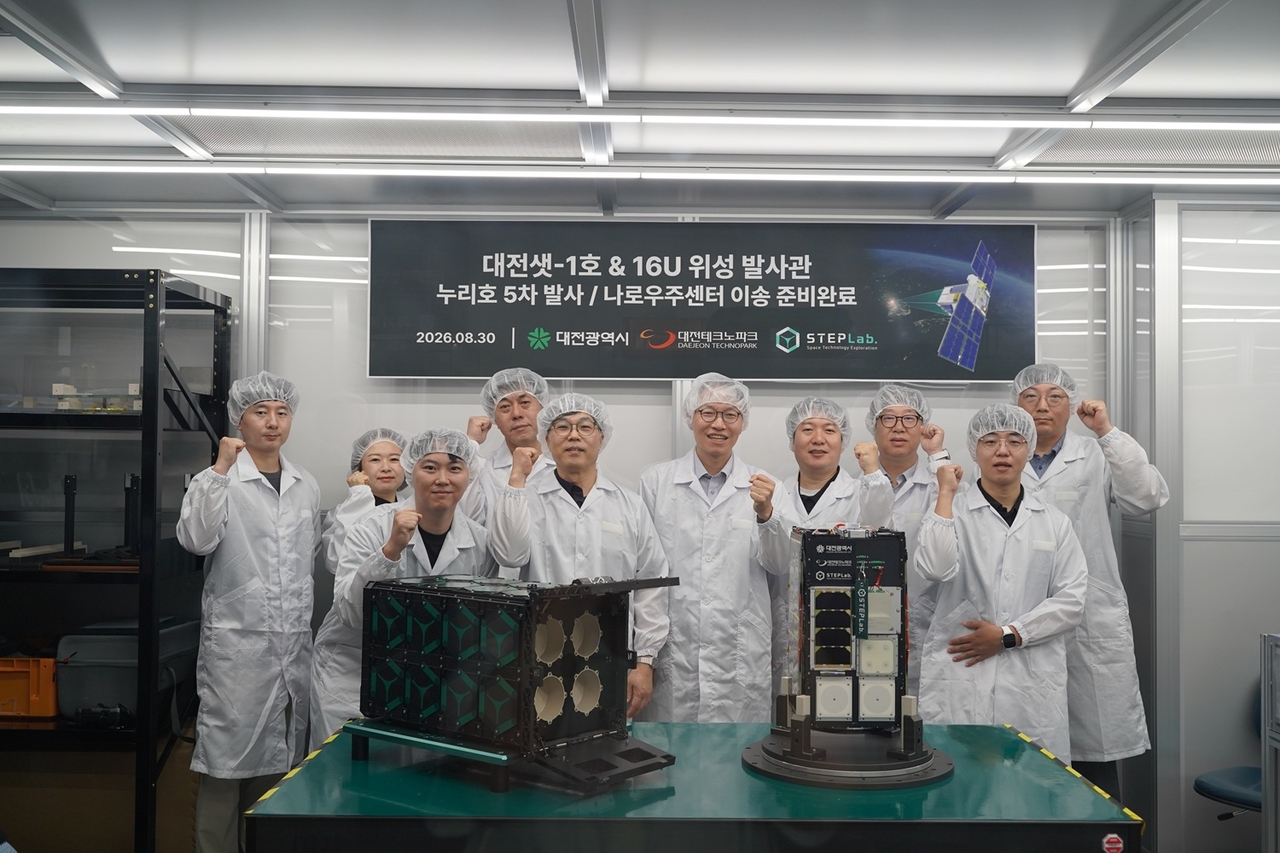
Daejeon's space industry has reached a turning point, moving beyond research and development to an actual presence in orbit.
The city of Daejeon announced Monday that it has successfully completed all pre-launch procedures for Daejeon SAT, a microsatellite developed by local space companies.
Daejeon SAT is a flagship public-private partnership project the city launched to strengthen its regional space industry. Local space firms participated directly in developing the satellite, with the mission designed to verify their proprietary technologies and components in an actual space environment.
The project began in April 2024 and was selected in February 2025 as a secondary payload for the fifth Nuri rocket launch. Development was completed in December 2025, with all pre-launch administrative procedures wrapped up at the same time. The satellite is scheduled to ride the fifth Nuri launch vehicle into space around October.
The launch carries significance beyond simply sending a locally developed satellite into orbit. It will allow Daejeon space companies to verify their technologies in an actual space environment and build the space flight heritage needed to compete in future satellite and space-component markets.
The Daejeon SAT project brought together local space firms including Steplab, CSO, PS Tec, MID and Contec.
Steplab led the project overall, while CSO developed the primary payload — an electro-optical camera. PS Tec handled the power system, and MID developed technology for high-capacity space-grade memory chips. Contec will support ground control operations using domestic and overseas ground stations.
Daejeon plans to use the flight heritage and technology validation results that local firms gain through Daejeon SAT as a foundation for pursuing future government satellite projects and entering overseas markets, while raising the competitiveness of regional companies across the full spectrum of the space industry, including satellite platforms and payloads.
The city also plans to put high-resolution imagery captured by Daejeon SAT — at 1.5-meter resolution — to use in public services such as urban management, environmental monitoring and disaster response, and to deploy the satellite as an educational tool for training the next generation of space professionals.
"Daejeon SAT is not simply a microsatellite — it is a challenge for Daejeon's space industry, built together by the city's companies, technologies and scientific talent," said Yang Seung-chan, director of Daejeon's future strategy office. "As Daejeon's technology moves beyond the ground and into actual space, we will use a successful launch and mission to prove the capabilities of our local companies and translate that into new projects and jobs."
kwonhl@heraldcorp.com





