
Dongwon F&B, Paldo, Samlip, Ottogi all raising prices in September
High oil prices, weak won cited as cause — but both have been falling since mid-year
Some companies saw cost ratios climb above 80% in the first half
'If costs fall but prices don't, that's a problem,' expert warns
![A shopper browses ramyun products at the Yangjae branch of Hanaro Mart in Seocho-gu, Seoul. [Herald DB]](https://wimg.heraldcorp.com/news/cms/2026/08/31/ams.V01.photo.HDN.P.20260313.P12026031314110050239471695_P1.jpg)
Major food companies are raising product prices across the board starting in September. They cite rising input costs driven by high oil prices and a weak won — but both have long since reversed course.
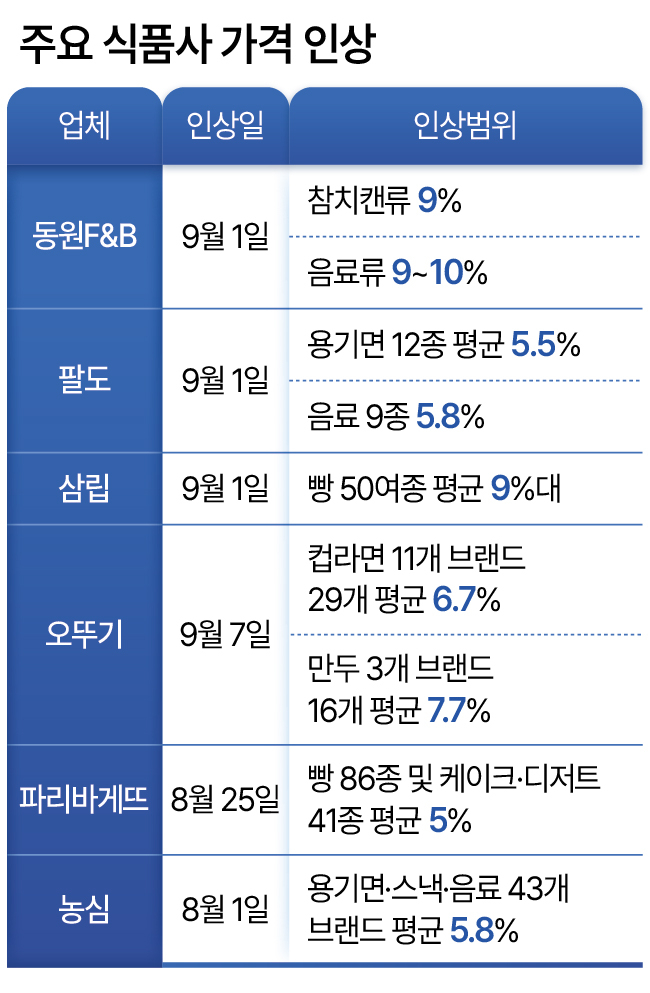
According to industry sources Monday, Dongwon F&B will raise prices on its canned tuna line, including its flagship Dongwon Tuna brand, by 9 percent starting Tuesday. Beverage products will go up 9 to 10 percent. Paldo will raise prices on 12 cup noodle products, including its Wang Ttukkeong line, by an average of 5.5 percent on the same date, with nine beverage products rising an average of 5.8 percent.
Samlip, operated by Sangmidang Holdings — formerly SPC Group — will also raise prices on more than 50 bread products by an average of around 9 percent starting Tuesday. Its signature convenience store item, Jeongtong Boreumdal, will jump from 1,800 won to 2,000 won, an 11.1 percent increase. Ottogi will raise prices on select cup ramyun and mandu products starting Sept. 7. The increases cover 29 products across 11 cup ramyun brands, including Jin Ramen, at an average of 6.7 percent, and 16 products across three mandu brands at an average of 7.7 percent.
Companies uniformly point to rising input costs as the reason. They say that after a war broke out in the Middle East last February, months of high oil prices and a weak won drove up expenses at every stage — from importing raw materials to logistics and packaging. The same rationale was used in July and August, when CJ CheilJedang, Sajo, Nongshim, Pulmuone, Coca-Cola Beverage and Paris Baguette all raised prices in succession.
The problem is that oil prices and the exchange rate have already turned around. According to Korea National Oil Corp., Brent crude stood at $89.31 per barrel and Dubai crude at $93.20 as of Friday. Brent had surged to $120 per barrel during trading in April, at the height of the Middle East conflict, while Dubai crude briefly topped $170 during trading in March. Both have since settled into a stable range. The won-dollar rate also peaked in the 1,560-won range in May before falling back to around 1,380 won.
![Shoppers browse the aisles of a large supermarket in Seoul. [Yonhap]](https://wimg.heraldcorp.com/news/cms/2026/08/31/rcv.YNA.20260716.PYH2026071614790001300_P1.jpg)
Lee Hong-ju, a professor of consumer economics at Sookmyung Women's University, said government efforts to hold down prices earlier this year had constrained companies from raising them, forcing them to absorb high raw-material costs through July. "Companies have been taking losses, but it appears that those who can no longer absorb the accumulated costs are the first to raise prices," she said.
In practice, some companies saw their cost ratios climb into the 80 percent range in the first half of this year. Ottogi posted a cost ratio of 83.7 percent in the first half, driven by higher import costs for edible oils — the supply prices of soybean oil and palm oil rose from $1,114 and $1,098 per ton, respectively, in the first half of last year to $1,296 per ton. Dongwon F&B recorded a first-half cost ratio of 79.4 percent, with total procurement costs rising 12.1 percent year-on-year to about 2 trillion won ($1.45 billion).
Nongshim tells a somewhat different story. Its cost ratio fell to 69.5 percent from 71.8 percent in the first half of last year, though total procurement spending still rose from 976.1 billion won to 1.01 trillion won. The sharpest increase came in packaging and other subsidiary materials, where costs climbed from 231.9 billion won to 256.5 billion won, reflecting a naphtha shortage triggered by the Middle East war.
Experts say the real problem is an asymmetric pricing pattern — fast to rise, slow to fall. Lee Eun-hee, a professor of consumer studies at Inha University, said, "Companies raise prices when costs go up, but if they don't bring them back down after costs fall, that's a problem." She added that the government needs to sustain price stability over the long term through a range of support measures.
Experts also say companies should make greater efforts to hold back domestic price increases by securing overseas sales channels. Samyang Foods stands out as the one major ramyun maker among the top four that has not raised prices. Riding the global success of its Buldak series, Samyang Foods now generates more than 80 percent of its sales from abroad. Its last domestic price increase was in February 2022.

soho0902@heraldcorp.com





