Camp Greaves unlocked after half a century
Walk-in visits now possible without advance reservation
Korean War documents, photos and records on display
Concrete bunkers transformed into cultural and arts spaces
![The Panmunjom Experience Hall near Camp Greaves, which opened in June [Kim Myung-sang]](https://wimg.heraldcorp.com/news/cms/2026/08/31/news-p.v1.20260831.0aa76d3c1466460481cbfe51f1a034d7_P1.jpg)
For more than 50 years, this was not a place just anyone could go. A frontline US military base that once radiated cold, knife-edge tension has broken its seal and opened itself to strangers. A gondola now glides across the river where that tension once ran deepest, collapsing in an instant the distance that division had imposed.
The barracks that hold sharp memories stand weathered like old soldiers full of hard-won stories, yet their bearing has grown noticeably more welcoming. The shadow of a division not yet fully lifted only sharpens the drama of Camp Greaves' story.
Imjingak Peace Gondola: crossing the river of division
![The Imjingak Peace Gondola boarding station in Paju [Korea Tourism Organization]](https://wimg.heraldcorp.com/news/cms/2026/08/31/news-p.v1.20260831.bd331e66d9394e1fa7770e4015ba87b4_P1.jpg)
Baengnyeon-ri, Gunnae-myeon, Paju — a village just 2 kilometers from the southern limit of the Demilitarized Zone where civilians were long forbidden to set foot. From 1953, shortly after the armistice, until 2004, the 506th Regiment of the US Army's 2nd Infantry Division was stationed here. It is the very unit that inspired the film "Saving Private Ryan" and the TV series "Band of Brothers."
When USFK reduced and repositioned its troops in 2004, the base closed and South Korean forces took over the forward defense line. Returned to the South Korean government in August 2007, the base was reinvented as the only history and culture destination inside the Civilian Control Zone, draped in the colors of art and culture.
The site's historical texture — preserved almost intact — drew the attention of K-content producers. The fictional Uruk base in the drama series "Descendants of the Sun," the film "The Man Standing Next" and the Disney+ series "Made in Korea" were all shot here. Where gun barrels once pointed, camera lenses now turn; where soldiers once kept watch, visitors now laugh. That dramatic reversal makes the passage of time impossible to ignore.
The feeling of crossing a border that isn't quite a border
![A Camp Greaves signpost [Gyeonggi Tourism Organization]](https://wimg.heraldcorp.com/news/cms/2026/08/31/news-p.v1.20260831.12d7617a486046ccb8c43eab908c7440_P1.jpg)
There are two ways for the general public to reach Camp Greaves. The overland route across Tongil Bridge does not allow individual visits; groups of 20 or more must submit a verified roster of names one to two weeks in advance and obtain prior approval from the military unit with jurisdiction over the area.
The gondola from Imjingak, by contrast, requires no advance clearance — visitors simply buy a ticket on the day. At the boarding station, they fill out a security pledge listing their name, date of birth and contact information, then present an ID to receive a ticket. The process is no different from completing a boarding declaration and having your ID checked before boarding a ferry. The Civilian Control Zone that once demanded multiple bureaucratic steps to enter by land can now be reached comfortably through the sky.
![The Neutral Nations Supervisory Commission museum inside Camp Greaves [Gyeonggi Tourism Organization]](https://wimg.heraldcorp.com/news/cms/2026/08/31/news-p.v1.20260831.7a86972f29444be3b494a64753d3139f_P1.jpg)
The gondola crosses at up to 58 meters above the ground, heading toward the DMZ Station inside the Civilian Control Zone. Looking right from a northbound cabin, Tongil Bridge stretches into view — the same bridge across which the late Hyundai Group Honorary Chairman Chung Ju-yung drove a herd of cattle into North Korea in 1998. To the left, the severed piers of the Dokgae Bridge over the Imjin River, cut off by the Korean War, slip past. With the weight of history pressing in from every direction across the broad, unhurried river, the sensation of crossing a border — though no official border exists here — is unmistakable.
The DMZ Station at the far end offers plenty to see as well. On its rooftop, the Panmunjom Experience Hall opened in June, while a tank that once saw active service is displayed in the plaza outside.
A soldier's memory, preserved in a bowling alley
![Exhibition inside Gallery Greaves [Gyeonggi Tourism Organization]](https://wimg.heraldcorp.com/news/cms/2026/08/31/news-p.v1.20260831.cc1ab89c15144527ba4d108656dad5ff_P1.jpg)
A short walk from the gondola landing, the first building to come into view is Gallery Greaves, a former bowling alley converted into an exhibition space. A Gyeonggi Tourism Organization official who guided the visit said that when the gondola first opened, security restrictions limited access to this building alone. "The accessible zone has gradually expanded since then," the official said, "and from September last year it was widened to include the ammunition depot, bringing the total to 10 buildings open to visitors."
![A bowling ball and pins at the entrance to Gallery Greaves [Gyeonggi Tourism Organization]](https://wimg.heraldcorp.com/news/cms/2026/08/31/news-p.v1.20260831.4a26a523aac34b87a96280efe729aa85_P1.jpg)
A worn bowling ball and a few pins left at the entrance to Gallery Greaves quietly announce that this, too, was once a place of ordinary daily life. The space has since been transformed into a venue that gently recounts the lives and sacrifices of Korean War veterans and the history of the DMZ and the armistice.
Inside, records, photographs, letters and personal effects of those who served on the battlefield — student soldiers, UN veterans, war correspondents and nursing officers — are on display. The exhibition stands out for its focus on the individual lives and sacrifices caught up in the vast sweep of the war. A memorial display pairing a recovered bullet-pierced helmet with personal mementos traces the unlived futures of those who fell.
![A copy of the Korean War Armistice Agreement [Gyeonggi Tourism Organization]](https://wimg.heraldcorp.com/news/cms/2026/08/31/news-p.v1.20260831.7820f816ed7f4b3e9cc31045a630dfeb_P1.jpg)
At the center of the exhibition hall, a wartime operational map of the Korean War is spread open. In an inner room, a copy of the Armistice Agreement bearing the signatures of Kim Il-sung and UN Forces Commander Gen. Mark Clark, among others, rests on display. The thought that a single sheet of paper decided the fate of so many people makes even a copy feel anything but ordinary.
In one corner of the exhibition hall hangs a letter written by Lee U-geun, a student soldier killed at age 16 during the Battle of Pohang Girls' Middle School in the Korean War. The letter from a boy who should have been busy playing with friends in his school uniform contains the line: "Mother, why must there be war?" That question, it seems, is addressed to every visitor who comes here.
The grain of time, carved into old barracks
![Documenta Hall 4 at Camp Greaves [Gyeonggi Tourism Organization]](https://wimg.heraldcorp.com/news/cms/2026/08/31/news-p.v1.20260831.8d7d46faddc944248ca2908f57d2dbd1_P1.jpg)
Deeper inside the base, beige buildings constructed from the 1950s through the 1990s line the grounds. The semicircular Quonset huts began as temporary barracks and were put to use over the years as chemical, biological and radiological training facilities, classrooms, armories and quarters. Rusted cylindrical fuel tanks on the exterior lay bare the unvarnished face of time gone by, even amid the renovated surroundings.
![Exhibits inside Documenta 3, formerly a US Army company office [Gyeonggi Tourism Organization]](https://wimg.heraldcorp.com/news/cms/2026/08/31/news-p.v1.20260831.4183dd2c61074691b2d9b4850f3a86b6_P1.jpg)
A former company office has been converted into the Documenta 3 exhibition hall. Inside the barracks, which recreate an operations room and a communications room, vintage board games and US military office equipment are on display. A fireplace and furniture used by American soldiers remain in their original condition.
![Studio BEQ, formerly quarters for US Army non-commissioned officers [Gyeonggi Tourism Organization]](https://wimg.heraldcorp.com/news/cms/2026/08/31/news-p.v1.20260831.92b7221a7eee47d8972ed7c7e1c128f7_P1.jpg)
Nearby, Studio BEQ is a renovated American-style corridor dormitory that once housed non-commissioned officers and other US military personnel. A Gyeonggi Tourism Organization official noted that the building is also well known as the location where K-pop group NCT Dream shot the photo book for their first full-length album, drawing many fans to the site.
![Swiss section exhibits inside Studio BEQ [Gyeonggi Tourism Organization]](https://wimg.heraldcorp.com/news/cms/2026/08/31/news-p.v1.20260831.611dedc845c24742a8698924ca8b9f7e_P1.jpg)
Each room in the building is filled with archival materials from the four nations — Switzerland, Sweden, Czechoslovakia and Poland — that made up the Neutral Nations Supervisory Commission dispatched after the armistice. Rare photographs capturing everyday life in the hanok village of Gaeseong and its residents in hanbok shortly after the ceasefire are among the materials that draw the eye, restoring memories that had all but faded.
Particularly striking is a pairing of a bustling 1950s Hawaiian scene hung alongside an image of an elderly Korean man driving an ox cart — a vivid reminder of the vast gulf between two worlds at that time. The juxtaposition also speaks to the remarkable transformation South Korea has achieved in the more than 70 years since the war.
From military installation to cultural retreat
![Exterior of The Greaves, the base's promotional exhibition hall [Gyeonggi Tourism Organization]](https://wimg.heraldcorp.com/news/cms/2026/08/31/news-p.v1.20260831.976b3c18da4549b4b74c8fcd086ffec7_P1.jpg)
Moving further into the base, the recreational facilities and key military installations from the American era follow one after another.
The Greaves, a promotional exhibition hall that opened in July, occupies a converted former US military theater. Stepping through its blackout curtains, visitors find vintage black-and-white photographs of the base arranged along walls shaped like film frames. The space is steeped in a retro sensibility, and a beam projector screens footage of everyday American military life like a classic film. A photo zone — set against a vivid red backdrop with yellow star-shaped lighting and movie-prop chairs — has become one of the most popular spots for Camp Greaves visitors.
![Exterior view of Ammunition Depot Halls 1 and 2 [Gyeonggi Tourism Organization]](https://wimg.heraldcorp.com/news/cms/2026/08/31/news-p.v1.20260831.4b7a6e507ff442cbae6c74d2715d8b66_P1.jpg)
Two large concealed concrete bunkers stand within the Camp Greaves perimeter. They once served as the primary ammunition supply depots for US military units across the Paju-Munsan area. A Gyeonggi Tourism Organization official explained that the structures were built into the mountain ridgeline and covered with earth on top to evade enemy aerial reconnaissance and bombing. "The interior walls were constructed of thick concrete to withstand artillery fire," the official said, "and the bunkers are still officially designated as emergency shelters for residents and visitors."
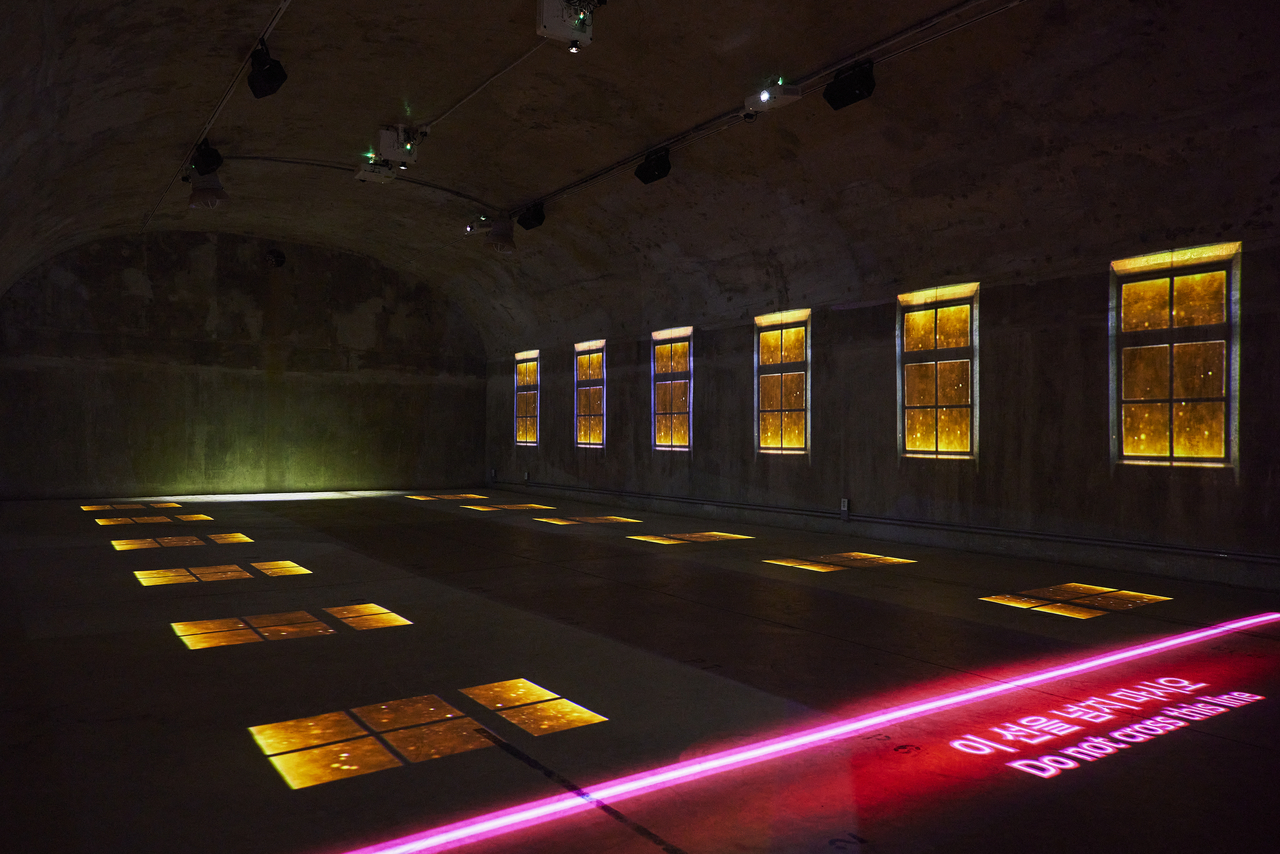
Both bunkers now serve as cultural and arts exhibition spaces. Ammunition Depot Hall 1 houses media artist Lee Seung-geun's work "Do Not Cross This Line," while Hall 2 holds installation artist Yeon Jin-young's "Wrinkled Habitat." Staged inside structures that once symbolized division and confrontation, these exhibitions offer a metaphor for Camp Greaves' own transformation — from a war base into a space for peace and culture.
![Cafe Greaves, converted from a former vehicle maintenance garage [Gyeonggi Tourism Organization]](https://wimg.heraldcorp.com/news/cms/2026/08/31/news-p.v1.20260831.ba8549808f054e828d5bc1f803f96124_P1.jpg)
Near the ammunition depots, a maintenance garage that once saw military vehicles come and go has become Cafe Greaves, a rest stop for visitors. Pop art pieces and playful sculptures give the space a distinctive character, and the generous ceiling height lends it an open, airy feel.
![Text inscribed on chairs at Cafe Greaves [Gyeonggi Tourism Organization]](https://wimg.heraldcorp.com/news/cms/2026/08/31/news-p.v1.20260831.162ad42bdc744f889dd89c452868fe15_P1.jpg)
Along the hillside path beyond the cafe, a colony of oxeye daisies preparing to bloom in autumn was spreading its green leaves through the peace garden.
The facilities inside the base have not remained mere relics with the old tension frozen inside them. A military base locked away for more than half a century has thawed in the warmth of people and art. A space once defined by division and confrontation now reminds visitors of the value of peaceful everyday life — and stands as a signpost pointing toward peace.
terry@heraldcorp.com