Ministry to release criteria on performance bonuses, business decisions Thursday
No statutory delegation means enforcement decree risks unconstitutionality
Guidelines cannot bind courts or labor-management parties, leaving disputes unresolved
Business community calls for revised union law to prevent confusion
![Participants hold placards and flags at a rally of 10,000 Korean Metal Workers' Union officials near Gwanghwamun Square in Jongno-gu, Seoul, amid ongoing confusion at industrial sites following the implementation of the Yellow Envelope Act. [Yonhap]](https://wimg.heraldcorp.com/news/cms/2026/08/31/news-p.v1.20260618.c78c49751ab3490fbb7cc321689b0463_P1.jpg)
The government has decided to clarify through administrative guidelines — rather than an enforcement decree — which management decisions qualify as labor dispute subjects under the Yellow Envelope Act, the revised Trade Union Act. The move comes despite President Lee Jae Myung having personally ordered the revision of subordinate legislation, including enforcement decrees, to reduce uncertainty at industrial sites. The Ministry of Employment and Labor opted for non-binding guidelines to enable swift application and avoid constitutional challenges, but critics say guidelines alone will not resolve legal disputes between labor and management or clear up confusion on the ground.
According to government sources, the ministry plans to release its "implementation guidelines on criteria for labor dispute subjects, including performance bonuses" on Thursday. The guidelines are expected to set out criteria and specific cases for determining whether operating-profit-linked bonuses and management decisions such as corporate investment and factory scale-ups fall within the scope of labor disputes under the Yellow Envelope Act. Before the release, the ministry will meet separately with the two major umbrella union federations and the Korea Enterprises Federation on Monday to explain the direction of the supplementary guidelines and gather labor and management opinions.
The Yellow Envelope Act, which took effect March 10, expanded the scope of labor disputes from the existing standard of "determination of working conditions" to include "business management decisions that affect working conditions" and clear violations of collective agreements by employers. The change has fueled ongoing debate over how far management decisions — such as performance bonuses, factory expansions and relocations — can be subject to labor disputes.
Under the current interpretive guidelines, management decisions such as mergers, splits, transfers, sales, corporate investment and factory scale-ups are in principle not subject to collective bargaining or labor disputes. However, if those decisions lead to substantive changes in working conditions — such as layoffs or reassignments — they can become subject to labor disputes.
The government's approach to supplementing the law has shifted course: it initially moved away from guidelines toward enforcement decrees and implementing rules, only to revert to guidelines.
President Lee ordered the establishment of clearer criteria to reduce industrial uncertainty at a Cabinet meeting on July 21, and on Aug. 11 told Labor Minister Kim Young-hoon that "an interpretation is just an opinion," directing him again to revise subordinate legislation. Kim said the following day in the National Assembly that he would review amending enforcement decrees and implementing rules. But on Friday the government announced it would instead prepare implementation guidelines that could be applied immediately on the ground.
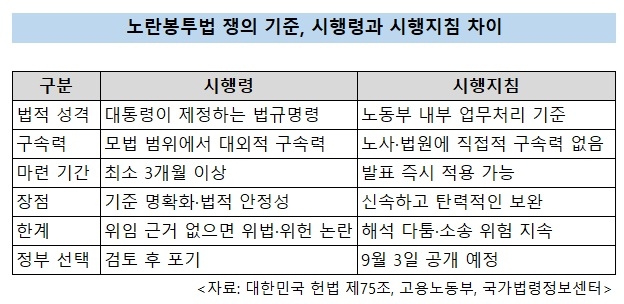
The primary reason the ministry chose not to pursue an enforcement decree despite the presidential directive is understood to be the absence of any explicit statutory delegation in the Yellow Envelope Act authorizing an enforcement decree to define the scope of labor disputes.
Under Article 75 of the Constitution, the president may issue enforcement decrees to specify matters delegated by law or to carry out the execution of laws. Enforcement decrees fall broadly into two categories: "delegated orders," which flesh out content entrusted by statute, and "executive orders," which set out the procedures and methods needed to implement a law.
An enforcement decree can therefore be issued even without an explicit statutory delegation, but the key question is how far it can go. If excluding performance bonuses or corporate investment decisions from the scope of labor disputes amounts to nothing more than setting detailed criteria for executing the law, an enforcement decree would suffice. But if it restricts the scope of the three fundamental labor rights guaranteed by the Yellow Envelope Act, a separate legal basis would be required.
The ministry is understood to have been concerned that drawing the boundaries of labor dispute subjects through an enforcement decree could trigger accusations of unconstitutionality and overreach — that the administration was unilaterally narrowing the scope of labor disputes. The Supreme Court ruled in a full bench decision in September 2020 that a provision in an enforcement decree establishing a system for notifying unions of "extra-legal" status, which had no basis in the Trade Union Act, was invalid.
The ministry's assessment is that the legal burden of setting restrictive criteria through an enforcement decree is substantial, given that the scope of labor disputes is a fundamental area where the three labor rights and corporate management prerogatives collide.
Speed was also a factor in choosing guidelines. An enforcement decree requires a minimum of three months for legislative notice, regulatory review, Ministry of Government Legislation review and Cabinet approval, whereas guidelines take effect immediately upon announcement. Guidelines also carry the advantage of being relatively easy to revise and supplement as conditions on the ground change. Cheong Wa Dae said the "practical effect on the ground is similar" between the two approaches.
However, while an enforcement decree carries external binding force within the scope of its parent law, guidelines serve only as internal operational standards for administrative agencies. They cannot bind labor and management parties, the Labor Relations Commission or the courts. Even with government-provided examples, labor and management are likely to dispute again how substantially any given decision affected working conditions in individual cases. The legality of industrial action will ultimately be left to the individual judgment of the Labor Relations Commission and the courts.
In business circles, there are complaints that the government has effectively sided with labor, which had opposed restricting the scope of disputes through an enforcement decree. The business community is calling for the Trade Union Act to be amended again — either to enumerate specific categories of business management decisions in the statute itself, or to delegate detailed criteria to an enforcement decree — in order to secure predictability.
"Decisions made in the course of business management that have no bearing on workers' interests are actually the rare exception," said Park Ji-soon, a professor at Korea University School of Law. "Supplementary legislation delegating authority to an enforcement decree is essential if we are to resolve the uncertainty."
fact0514@heraldcorp.com