Shinhan Financial's '2026 Korea Wealth Trend'
'MoneyMove' matters more than chasing surging stocks
Stocks 30%, bonds 20%, alternative assets 40%, liquidity 10%
US Treasuries even in a bull market — long-term assets held firm
After-tax returns, not pre-tax, and inheritance planning factor into every decision

"These days, wealthy investors react most sharply when they feel they are missing out on a rally everyone else is riding. This is a year when attention to MoneyMove — tracking where capital flows — is higher than ever."
Capital has not been sitting still this year. Money has rotated rapidly among shares, bonds, gold and real estate, and within equity markets, sector rotation has been relentless. In a market defined by heightened volatility, affluent investors have shifted their focus from picking promising stocks to reading MoneyMove. Rather than simply chasing where others made money, they are increasingly asking why capital moved there and whether that trend will last.
Shinhan Premier Pathfinder presented these findings as the core of its "2026 Korea Wealth Trend" report at Hyean 2026, a group wealth management forum held Monday at Dragon City Hotel in Yongsan, Seoul. "In the past, many customers asked which stocks or products were good," said Ahn Seong-ho, a senior adviser at Shinhan Premier Pathfinder. "Now they think first about where the money is flowing."
Experts at the forum drew a clear line between reading capital flows and chasing momentum. Buying into an asset that has already surged 30 to 40 percent, they said, is less about reading the trend than about fear of missing out. To tell the difference, Ahn said investors must ask three questions: why money is flowing there, what economic and social forces are driving it, and whether those forces can be sustained.
Wealthy investors track the flows but do not let go of assets they plan to hold for the long term. Senior adviser Kim Dae-su said a corporate chairman he recently met had been aggressively buying US Treasuries once yields climbed to around 5 percent — even amid the equity bull market — and kept dollar-denominated assets at roughly 10 percent of his total portfolio at all times. "What sets them apart from ordinary investors is that they do not shed assets they have judged necessary over the long term just because of short-term volatility," Kim said.
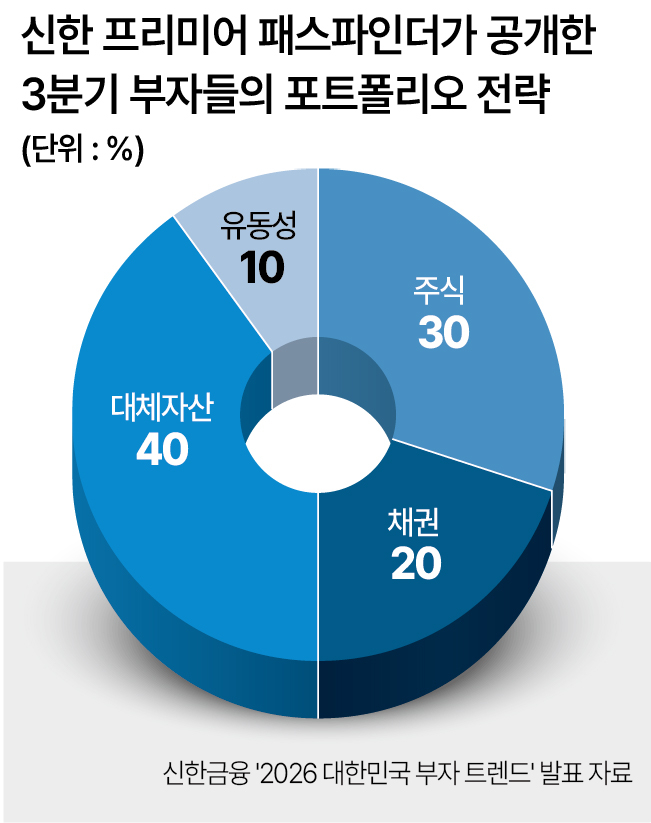
So what is the "golden ratio" that helps wealthy investors weather extreme volatility? Shinhan Premier Pathfinder's third-quarter asset allocation strategy calls for 30 percent in shares, 20 percent in bonds, 40 percent in alternative assets and 10 percent in liquidity. Investors with an aggressive risk appetite can raise the equity share to 40 percent, while those focused on protecting principal can increase their bond allocation to fill the gap.
Ahn explained that the 40 percent alternative-asset weighting reflects a desire to hedge risks that shares and bonds alone cannot cover. Gold, long-short funds, dollar-denominated insurance, equity-linked securities and bonds, and mezzanine products such as convertible bonds all fall into this category. When it comes to gold — a particular favorite among wealthy investors — they weigh carefully whether to hold physical gold bars, trade through an exchange-traded fund, or use a gold savings account or KRX gold spot market. Even the same underlying asset carries different tax treatment, costs, liquidity and convertibility depending on the vehicle chosen.
By far the most common topic wealthy investors raise at the end of an investment consultation is tax. As asset values grow, a 1-percentage-point gain after taxes and fees means more than a 1-percentage-point improvement in pre-tax returns. Because the tax treatment of investment income differs depending on whether it is classified as interest, dividends or capital gains, affluent investors make decisions — from account selection to gifting and inheritance planning — within a long-term framework.
Kim added that wealthy investors do not redeem all their equity holdings simply because share prices have risen sharply. "They keep riding the 'galloping horse' — assets they believe still have growth potential — and invest in them for the long term, while trimming some positions to diversify into other assets," he said. "They always check why they bought a given asset, how large a share of their total portfolio it represents, and how long they plan to hold it."

forest@heraldcorp.com