Budget up 38.5 billion won from prior year, targeting drug enforcement network, AI transformation and field-tailored R&D
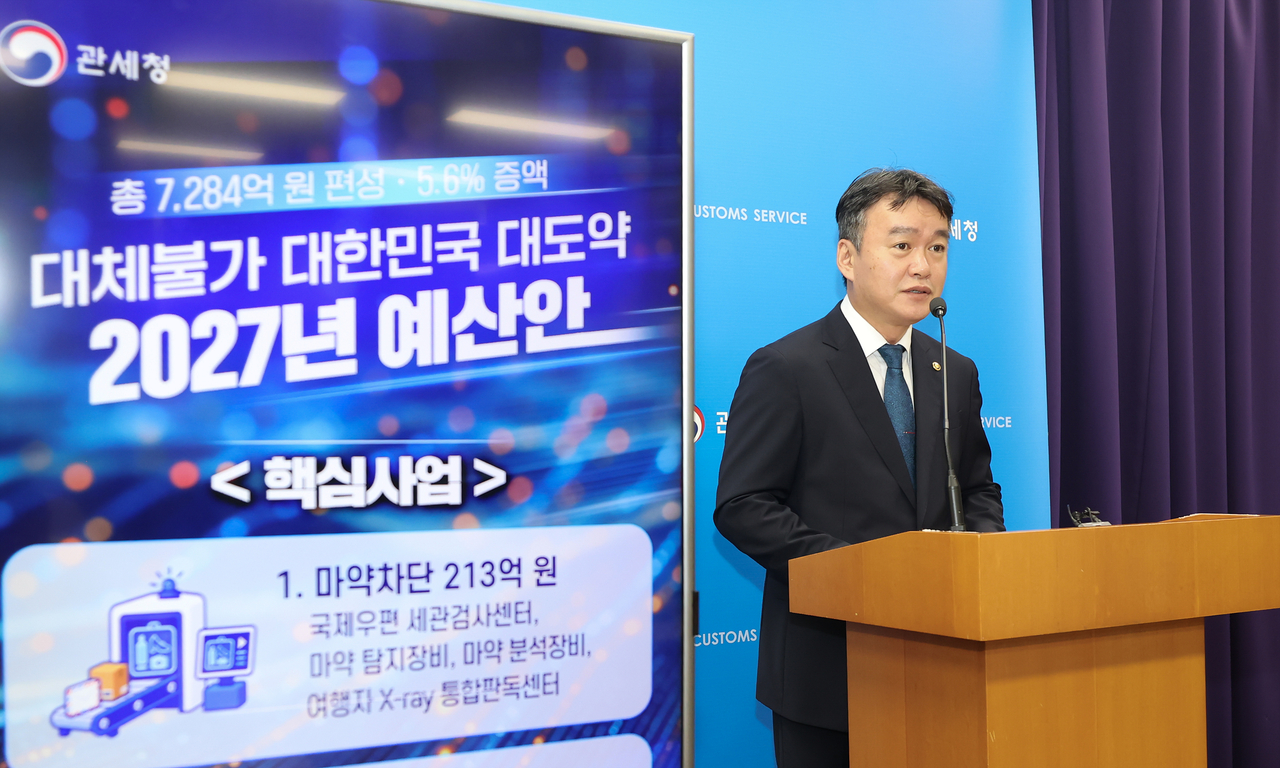
South Korea's customs administration is set to significantly strengthen its drug interdiction lines and overhaul its customs systems and equipment.
The Korea Customs Service announced Monday it has drawn up a 728.4 billion won ($528 million) budget proposal for 2027 — an increase of 38.5 billion won, or 5.6 percent, from the previous year — with concentrated investment planned in blocking drug smuggling, transforming customs administration through AI, and supporting field-tailored research and development.
The proposal, the largest in the agency's history, is composed of 407.6 billion won in personnel costs, 284.1 billion won in key project expenditures and 36.7 billion won in basic operating expenses.
The agency identified three core priorities for the 2027 budget: building a robust and tightly woven border defense network to block the domestic influx of drugs, which have emerged as a serious social problem; driving an AI-led transformation of customs administration suited to an era of sweeping technological change; and supporting research and development to overcome the limitations of current personnel and equipment and improve the efficiency of customs border management.
Drug enforcement network — 21.3 billion won
The Korea Customs Service seized 767 cases involving 1,007 kilograms of narcotics in the first half of this year, the largest haul on record for drugs intercepted before entering the country. The agency has designated blocking drug smuggling — which it describes as a threat to public and social safety — as its top priority, and plans a sweeping reinforcement of enforcement facilities and equipment at each border entry point.
To thoroughly inspect checked baggage from high-risk flights arriving at Incheon Airport, the agency will consolidate the separate screening centers at Terminal 1 and Terminal 2 into a single "X-ray multi-reader integrated center" equipped for two officers to simultaneously review suspicious cargo, at a cost of 5.2 billion won. It will also procure additional advanced screening equipment — including 3D X-ray scanners and millimeter-wave body scanners — for 4.6 billion won, and expand precision analysis equipment such as liquid chromatography devices to respond promptly to new synthetic drugs, at a cost of 2.1 billion won.
To more effectively intercept illegal goods flowing in through the rapidly growing e-commerce channel, the agency will build a new international mail customs inspection center at a cost of 9.4 billion won, automating the entire process from cargo intake through sorting and dispatch, and establishing a dedicated narcotics inspection room to prevent inspectors from direct exposure to drugs.
The agency will also form a dedicated task force under its Trade-Based Financial Crime (TBFC) special investigation unit to handle drug-related criminal investigations. The unit will conduct ongoing monitoring and investigations covering not only drug trafficking but also economic crimes such as inflated export values used to facilitate coin and stock price manipulation.
AI transformation of customs administration — 6.5 billion won
The Korea Customs Service, which operates a dedicated AI organization and has been recognized for applying AI across multiple areas, received a presidential commendation for contributions to AI-driven government advancement. The agency now plans to go further, fundamentally transforming how it works through an AI-based overhaul of customs administration to generate tangible results.
To prevent the smuggling of narcotics, firearms and other dangerous goods through overseas direct-purchase channels, the agency will upgrade an "AI screening model for illegal goods" — linked to a newly built e-commerce platform — that conducts multidimensional risk analysis of supply chains by product, at a cost of 1.8 billion won. It will also build a system that uses AI to integrate and analyze internal and external taxation and investigation data to more efficiently probe distorted import-export pricing and illegal foreign exchange transactions, at a cost of 2.6 billion won.
The agency additionally plans to introduce an AI monitoring system, at a cost of 1.4 billion won, that links data and risk intelligence held by the Ministry of Justice, the Ministry of Food and Drug Safety and other agencies to track imported goods from entry through retail distribution. It will also significantly enhance public-facing features on the Korea Customs Service mobile app — including private-sector authentication, simplified payment and AI consultation — at a cost of 700 million won.
Alongside these measures, the agency plans to pursue amendments to the Customs Act to enable the sharing and linking of information on illegal, substandard and hazardous goods among trade-related government bodies, establishing a legal basis for a pan-government risk management framework.
Field-tailored R&D — 4.9 billion won
The Korea Customs Service has recognized the limits of conventional responses — such as expanding systems and personnel — in keeping pace with increasingly sophisticated and diverse customs border crimes. It aims to guarantee inspector safety and substantially improve operational efficiency through tailored research and development in which frontline officers participate from the earliest stages of technology development.
The agency will develop a system, at a cost of 1.2 billion won, in which AI learns from decades of accumulated container smuggling cases — some 430,000 records — and generates algorithms to automatically flag contraband. It will also standardize X-ray screening data at a cost of 900 million won to streamline the import inspection process.
In addition, the agency will develop a portable drug-testing kit, at a cost of 700 million won, that inserts a needle into packaging without opening it and uses sensors to detect the presence of narcotics. Short-cycle R&D projects worth 2.1 billion won will also be pursued to respond quickly to urgent technology needs arising in the field.
Korea Customs Service Commissioner Lee Jong-wook said the agency had carried out a rigorous expenditure restructuring — adjusting priorities across projects and cutting costs in the public sector in line with the government's fiscal management direction. "We concentrated the resources secured through this process on core projects that the public can feel directly, including blocking drug imports and driving AI-based customs administration innovation," he said.
Lee added that once the 2027 budget proposal is finalized through National Assembly deliberations, the agency will do its utmost to actively address pressing national policy challenges while executing the budget entrusted by the public as efficiently as possible.
kwonhl@heraldcorp.com