Three mega-project and AI budgets to nearly double
'NEXT 10 strategic technologies' and '7 SEED' programs to anchor ultra-gap strategy
Energy, startups, culture and small business support also boosted
Experts warn of overlapping projects and weak parliamentary oversight of funds
![Construction work at the Yongin Semiconductor Cluster general industrial complex in Yongin, Gyeonggi Province. [Yonhap]](https://wimg.heraldcorp.com/news/cms/2026/09/01/news-p.v1.20260714.633fd4953fbd424b9362eeb2c442d9cf_P1.jpg)
The government plans to sharply increase fiscal investment in future industries such as AI and semiconductors next year. It will channel 21.3 trillion won ($15.5 billion) — a 97.2 percent jump from this year — into three mega-projects covering semiconductors, physical AI and domestically built AI data centers. An additional 41.4 trillion won will go toward future growth engines, including "post-semiconductor" industries such as nuclear fusion, small modular reactors, quantum technology, aerospace and advanced biotech.
The plan is to fund the expansion with surplus tax revenue generated by the semiconductor boom, but critics say stronger parliamentary oversight and rigorous performance reviews are needed to prevent overlapping projects and the use of funds as a discretionary spending tool.
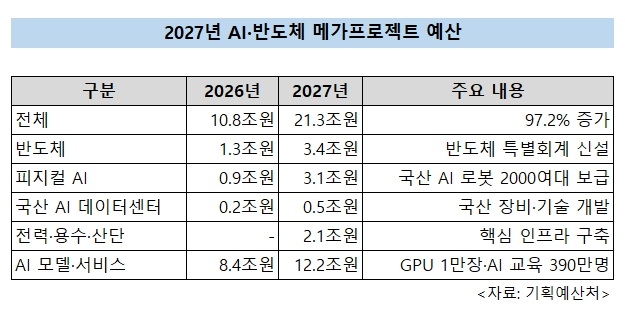
According to the Ministry of Planning and Budget's 2027 budget proposal released Tuesday, combined spending on the three mega-projects and AI support will rise from 10.8 trillion won this year to 21.3 trillion won next year — an increase of 10.5 trillion won, or 97.2 percent. The budget for expanding future growth engines will grow 11.6 trillion won, or 22.7 percent, from 51.2 trillion won to 62.8 trillion won. Within that, the allocation for nurturing post-semiconductor advanced strategic industries will expand 5.2 trillion won, or 14.4 percent, from 36.2 trillion won to 41.4 trillion won.
The government's push to invest heavily in future industries reflects its strategy to cultivate AI and semiconductors as next-generation growth drivers and secure an early competitive edge. The plan calls for growing physical AI and domestically built AI data centers into new pillars of growth alongside semiconductors, while stepping up preemptive investment in next-generation sectors including nuclear fusion, SMRs, quantum technology, aerospace and advanced biotech.
The three mega-project and AI budget breaks down as follows: 3.4 trillion won to maintain South Korea's semiconductor lead, 3.1 trillion won to develop physical AI, and 500 billion won to build a domestic AI data center ecosystem. Another 2.1 trillion won will go toward core infrastructure — power, water and industrial complexes — while 12.2 trillion won will fund the development of frontier-class AI models and a universal "AI for All" service.
The semiconductor support budget will grow 2.6 times, from 1.3 trillion won this year to 3.4 trillion won next year. Of that, 2.6 trillion won will go into a newly created special account for strengthening semiconductor industry competitiveness, providing a stable investment base.
The budget also supports the early establishment of semiconductor production bases in the greater Seoul area and the southwestern region, along with foundational R&D and talent cultivation. Some 400 billion won will go toward building semiconductor production facilities, 1.5 trillion won toward integrated support for the southwestern semiconductor cluster, and 100 billion won in private capital will be mobilized through the National Growth Fund and similar vehicles.
The physical AI budget will more than triple, from 900 billion won to 3.1 trillion won next year. The initiative will digitize the tacit knowledge — the accumulated experience and operational know-how held by master manufacturers — then use that data to develop AI solutions and fully integrated AI factories. Some 2.6 trillion won will fund physical AI demonstration projects, including field trials across eight key sectors such as manufacturing and care services.
Another 200 billion won is earmarked for automation projects that replace manual labor and hazardous processes in small and medium-sized factories with robots. The plan calls for deploying domestically made humanoid robots on factory floors and introducing more than 2,000 domestically produced AI robots in the public sector. R&D on applying manufacturing tacit knowledge will receive 1.5 trillion won, and 200 billion won will go toward producing AI training data.
The budget for building a domestic AI data center industry ecosystem will rise from 200 billion won to 500 billion won. The funds will support construction of test labs to verify the performance of domestically made AI data center equipment, as well as technology development for components and materials in ICT equipment, cloud, power and cooling.
To keep the three mega-projects on schedule, 2.1 trillion won will be invested in power, water and industrial complex infrastructure. Of that, 1.5 trillion won will go toward rapid grid expansion and capital contributions to Korea Electric Power Corporation, 400 billion won toward expanding water and water-resource facilities in the southwestern and Chungcheong regions, and 200 billion won toward developing long-term lease land at the Saemangeum industrial complex.
The budget for frontier-class AI models and the "AI for All" initiative will expand from 8.4 trillion won this year to 12.2 trillion won next year. Some 4.7 trillion won will be invested in 10,000 GPUs and support for data and AI talent. Another 100 billion won is set aside for developing specialized AI security models, and 250 billion won for building a free AI service accessible to all citizens.
Tailored AI education and training will be offered to 3.9 million people, including elementary, middle and high school students, university students, job seekers, employed workers and the general public. The aim is to raise AI literacy and capability across the entire population, not just in technology and infrastructure.
The government is also accelerating its push to nurture post-semiconductor industries, expanding the advanced strategic industry budget from 36.2 trillion won this year to 41.4 trillion won next year. Support for the "NEXT 10 strategic technologies" will increase from 11.2 trillion won to 15 trillion won, while 13.8 trillion won will be invested in R&D for future-leading technologies under the "7 SEED" framework and related programs. The government will also introduce a new investment-linked R&D model designed to channel corporate research outcomes back into reinvestment.
The energy transition budget will grow from 4.2 trillion won to 6.6 trillion won. Some 1.8 trillion won will go toward expanding renewable energy, including rooftop and agri-solar installations and "sunshine income villages." The number of electric vehicles eligible for subsidies will rise from 300,000 to a record 430,000, and the budget for distributing heat pumps to single-family homes and welfare facilities will rise from 15.7 billion won to 91.9 billion won.
The startup support budget will increase from 2.6 trillion won to 4.5 trillion won. The government will run an "Entrepreneurship for All" program, selecting 20,000 citizens and providing each with 5 million won, while expanding startup cities outside the greater Seoul area from four to 10. The budget for startup fund contributions and loans will rise from 1.8 trillion won to 2.6 trillion won, and support for failed entrepreneurs seeking a fresh start will grow from 600 billion won to 1 trillion won.
Budgets for cultural industry development and support for small and medium-sized enterprise growth and exports will also increase, to 3.7 trillion won and 6.6 trillion won respectively.
"We will provide full support for building core infrastructure so that investment in the three mega-projects — semiconductors, physical AI and AI data centers — does not stall for a single moment," a government official said. "We will also intensively nurture ultra-competitive industries such as nuclear fusion, SMRs, quantum technology, aerospace and advanced biotech to carry on the semiconductor success story."
A future response fund — built up by setting aside surplus tax revenue from the semiconductor boom — will also be tapped for future growth engine investment. The government plans to deposit 162.3 trillion won in additional domestic tax revenue that exceeded the average growth trend of the past decade into the fund, then direct 45.4 trillion won of that toward growth drivers and projects in youth, regional development, education and talent.
Critics, however, say the government must strengthen parliamentary oversight and performance verification to prevent overlapping projects under the banner of future industries and to stop the fund from becoming a vehicle for discretionary government spending.
Yang Jun-seok, a professor of economics at Catholic University of Korea, said that when unexpected surplus tax revenue arises, the priority should be reducing national debt or the fiscal deficit. "Accumulating it in a fund and using it for additional spending does not help reduce the fiscal deficit," he said. He added that unlike the main budget or supplementary budgets, funds face relatively less parliamentary oversight, making it difficult to rule out the possibility that the government could use the resources for political purposes.
fact0514@heraldcorp.com