![A file image related to initial public offerings. [Getty Images Bank]](https://wimg.heraldcorp.com/news/cms/2026/09/01/news-p.v1.20260901.6485ebe2fdad495cb260e03908d5054f_P1.jpg)
More companies knocked on the door of South Korea's stock markets this year than last, yet the number that actually completed initial public offerings fell to roughly half, data showed Tuesday. Analysts attributed the disconnect to regulatory uncertainty over dual listings, which prompted major companies to delay or withdraw their IPO applications, compounded by tightened listing requirements and heightened market volatility.
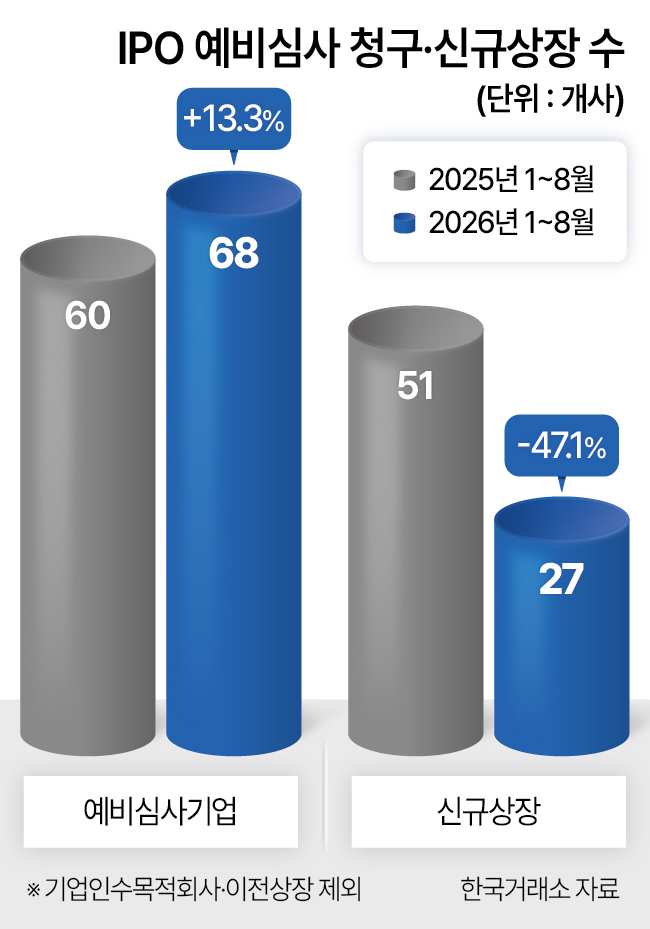
According to Korea Exchange, 68 general companies filed preliminary listing review applications on the Kospi and Kosdaq markets from January through August this year — up eight, or 13.3 percent, from 60 during the same period last year, excluding special purpose acquisition companies and transfer listings. The number of companies that actually completed new listings over the same period, however, fell from 51 to 27, a drop of 24, or 47.1 percent.
Preliminary review applications picked up after a slow start to the year, rising sharply from April onward. After five, two and four applications in January, February and March respectively, filings jumped to 14 in April and 13 in May, before coming in at 10 in June, 14 in July and six in August.
Investor demand for IPO shares remained strong despite the slowdown in new listings. According to Eugene Investment & Securities, the institutional book-building competition rate for the first half of this year stood at 969-to-1, surpassing the 2017–2025 average of 869-to-1. The general subscription competition rate also came in at 1,782-to-1, above the average of 985-to-1 over the same period.
Regulatory uncertainty surrounding dual listings — where both a parent and subsidiary are listed — was widely cited as a key reason for the decline in new listings. Debate over restrictions on such arrangements had been ongoing since last year, but detailed criteria and guidelines were not finalized until July, causing major companies to delay or pull their IPO plans. Only one company, K bank, completed a new Kospi listing in the first half of this year.
"The repeated delays in announcing dual-listing guidelines blocked the pipeline for companies preparing to go public," said Choi Jong-gyeong, a researcher at Heungkuk Securities. Essex Solutions, which had been valued at around 2 trillion won ($1.46 billion) at the time of its IPO push, withdrew its application, while DTS and Duksan Neolux saw their reviews delayed for extended periods — Duksan Neolux for 251 days and DTS for 305 days from application to result. After K bank listed on March 5, no new Kospi preliminary review applications were filed for roughly four months, until Sono International submitted one on June 26.
Beyond the dual-listing issue, tightened listing and delisting requirements and stock market volatility also weighed on companies' IPO plans, analysts said. Market watchers noted that these factors combined to delay listings by major companies and shift the IPO pipeline toward small and medium-sized enterprises.
A rally in existing stocks also drew attention away from the new-issue market. Choi said that as the Kospi climbed sharply in the first half of this year, investors shifted their attention to already-listed stocks, leaving the primary market relatively overlooked. With major IPOs delayed, investor interest migrated further toward the secondary market, he added.
Regulators are nonetheless moving to streamline the process. The Financial Supervisory Service announced Friday that it would introduce a tiered review system for securities registration statements — under which filings that adequately address correction requests during IPOs and rights offerings would be reviewed as quickly as possible, reducing delays caused by repeated amendment demands.
"About 40 companies have filed for IPO reviews to pursue listings in the second half, a slight increase from the first half," said Park Jong-seon, a researcher at Eugene Investment & Securities. "If things proceed as planned, companies that receive approval one to two months after filing will begin actively moving forward with their IPOs, and the market is expected to gradually recover from the end of the third quarter into the fourth quarter."
hajun825@heraldcorp.com