Unemployment benefit insurance rate to rise from 1.8% to 2.0% next year
Workers and employers to share 0.1 percentage point each; deficit driven by surge in maternity protection spending
Monthly floor for job-seeking benefits set at about 1.76 million won under 2027 minimum wage
Payouts to shift from 7 to 6 days a week — monthly amount falls but total stays the same
Early re-employment allowance cut off at monthly income of 3 million won or above
![The unemployment benefit application window at the Seoul West Employment and Welfare Plus Center in Mapo-gu, Seoul [Yonhap]](https://wimg.heraldcorp.com/news/cms/2026/09/01/rcv.YNA.20251210.PYH2025121011800001301_P1.jpg)
The government plans to raise employment insurance premiums for workers and businesses next year, even as it projects a sharp jump in tax revenue driven by a semiconductor boom. A worker earning 3 million won ($2,180) a month will pay an additional 3,000 won in premiums each month. Job-seeking benefits paid to the unemployed will also be restructured to reduce monthly payouts, with the monthly floor set at about 1.76 million won under the 2027 minimum wage once the payment cycle shifts from seven days a week to six.
The Ministry of Employment and Labor said Tuesday it had deliberated on the "employment insurance reform plan" at a meeting of the Employment Insurance Committee. The government drew up the specific implementation measures based on discussions by a task force involving labor, management and experts that had been meeting since November last year.
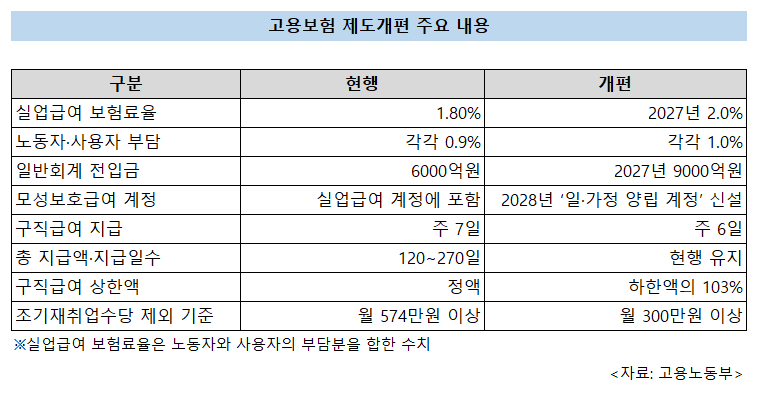
The insurance premium rate for the unemployment benefit account will rise from the current 1.8% to 2.0% next year, a 0.2 percentage point increase. The rate borne by both workers and employers will go up from 0.9% to 1.0% of wages each. A worker earning 3 million won a month will see monthly premiums rise from 27,000 won to 30,000 won, adding 36,000 won to their annual burden. Employers will pay the same additional amount for each such worker.
The government projected national tax revenue at 584.4 trillion won in next year's budget proposal, up about 169 trillion won from the 415.4 trillion won set in this year's supplementary budget. Officials attributed the expanded fiscal room to higher corporate and income taxes stemming from the semiconductor boom.
At the same time, general account transfers into employment insurance will increase by 300 billion won — from 600 billion won this year to 900 billion won next year, a 50% rise. Despite that increase, the government decided not to cover the cost of low birth rate measures such as parental leave benefits through fiscal support alone, opting instead to pair it with a premium hike.
State vows greater responsibility on low birth rate, but cost-sharing ratio still undecided
The government's decision to raise premiums stems from a deficit in the employment insurance fund. Separate from the broader surge in tax revenue, the unemployment benefit account — funded primarily by insurance premiums — faces growing financial strain from rising maternity protection spending.
Spending on maternity protection benefits more than doubled in three years, climbing from 2.1 trillion won in 2022 to 4.3 trillion won last year. The unemployment benefit account ran a deficit of 1.8 trillion won last year. While the reserve stands at 1.8 trillion won, the effective reserve is roughly negative 6 trillion won once 7.7 trillion won in borrowings from the Public Fund Management Fund is factored in.
The government plans to establish a tentatively named "work-family balance account" in 2028 to separate maternity protection spending — including parental leave benefits currently paid from the unemployment benefit account — into a dedicated fund. The aim is to manage income support for the unemployed and low birth rate funding separately, so that a surge in one area does not affect the other.
Next year, the increased premiums will first flow into the unemployment benefit account. When the new account is created in 2028, a portion of the 2.0% premium rate will be transferred to it. The share of the premium rate to be moved will be decided through further discussion based on the state of maternity protection spending at the time.
Benefits that employers are obligated to pay — such as maternity leave benefits — will be moved to the employment stability and vocational skills development account. The employment insurance fund will shift from its current two-account structure to a three-account system covering unemployment benefits, employment stability and vocational skills development, and work-family balance.
The government said it would gradually increase general account transfers through 2029 to strengthen state responsibility for addressing the low birth rate. However, the total amount the government will contribute by 2029 and the ratio in which costs will be shared among the government, labor and management have yet to be finalized. The Ministry of Employment and Labor, the Ministry of Planning and Budget, and labor and management are expected to sign an MOU to set specific cost-sharing principles and amounts.
A ministry official said the government had already increased general account support by 50% for next year and that the scale of fiscal support would be determined through future consultations in a direction that strengthens the government's responsibility for addressing the low birth rate. The government's position is that labor and management also acknowledged the inevitability of the premium increase.
Higher premiums, lower monthly payouts — but total benefit unchanged
Job-seeking benefits will be restructured to reduce monthly payouts while keeping the total benefit amount intact. The government is pursuing a plan to pay job-seeking benefits on a six-day-per-week basis, excluding unpaid rest days, rather than the current seven days a week. With one fewer payment day per week, the amount received over the same period will decrease.
According to the Ministry of Employment and Labor, if the payment method is revised, the monthly floor for job-seeking benefits will be about 1.76 million won based on the 2027 minimum wage. This does not mean all recipients will receive a flat 1.76 million won — job-seeking benefits are calculated based on pre-separation wages, and 1.76 million won is the floor converted to a monthly figure.
The total payment period of 120 to 270 days and the total benefit amount will remain unchanged. The number of days on which benefits are paid stays the same, but by excluding one day per week from the payment schedule, the period over which recipients receive the full amount will be extended. Even though the total is unchanged, the lower monthly payout could increase the immediate financial burden on recipients.
The government said the change corrects a mismatch between wage calculation standards and job-seeking benefit payments that arose after the five-day workweek was introduced. Wages for workers on a five-day schedule are calculated based on six days, including a paid weekly holiday, but job-seeking benefits have been paid on a seven-day basis — creating cases where minimum-wage workers received more while unemployed than when working.
A ministry official said the intent is to align the monthly payout with 80% of the monthly minimum wage equivalent while encouraging re-employment. The government also plans to strengthen personalized counseling and job placement support through dedicated case managers.
The ceiling for job-seeking benefits will shift from a fixed amount to a rate linked to 103% of the floor, replacing the current flat-rate cap. The change is meant to prevent a reversal in which the floor exceeds the ceiling as the minimum wage rises. The 80% floor calculation ratio itself will not be lowered.
The pool of recipients eligible for the early re-employment allowance will also be narrowed. Currently, those earning 5.74 million won or more per month after re-employment are excluded; going forward, anyone earning 3 million won or more a month will be ineligible. The rationale is to cut support for people likely to find re-employment even without the incentive.
The Ministry of Employment and Labor estimated that the unemployment benefit reforms, combined with a previously announced employment service overhaul, would generate about 1.4 trillion won in spending savings. Adding the premium increase and the expansion of general account support, the ministry projected that the unemployment benefit account would return to surplus next year.
The coverage of employment insurance will also be expanded. Starting in January, coverage will be broadened for four occupational categories including insurance agents and after-school instructors, with plans to extend it further to all personal service income earners whose income is reported to the National Tax Service. The approach will be to cover everyone in principle, with only a limited number of occupational categories excluded where identifying an employer is difficult.
The government is pushing to amend relevant laws and subordinate regulations within the year. The shift to a six-day weekly payment schedule for job-seeking benefits and the creation of the work-family balance account both require legislative changes, and the specific implementation dates will be determined through the legislative process.
fact0514@heraldcorp.com