
Series of meetings with Australian ministers
Proposal to combine Australian resources with Korean technology
Five-decade steel partnership expanding into lithium and energy
Australia supplies 70% of Posco's raw materials
Pilbara Minerals, Mineral Resources investments strengthen lithium supply
Senex gas output targeted for threefold expansion
![Posco Group Chairman Jang In-hwa delivers an opening address at the 46th Korea-Australia Joint Business Cooperation Committee meeting held at FKI Tower in Yeouido, Seoul, on Sept. 17 last year. [Posco Group]](https://wimg.heraldcorp.com/news/cms/2026/09/02/news-p.v1.20260901.530ae8b661fc44bb9a888eaac28ff888_P1.jpg)
Posco Group Chairman Jang In-hwa has launched a resource diplomacy push in Australia, seeking to broaden a partnership built over more than five decades around iron ore into lithium, natural gas and renewable energy to strengthen the group's critical resource supply chain.
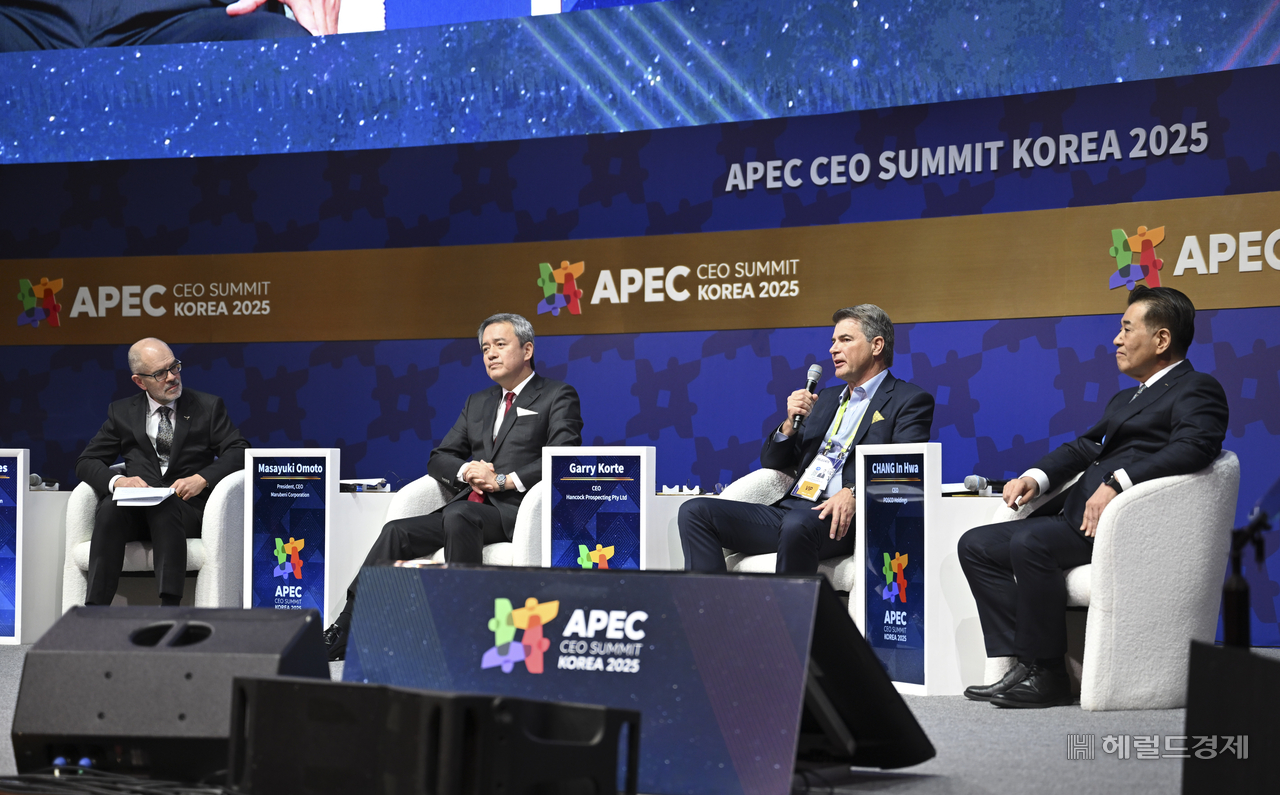
Jang attended the 47th Korea-Australia Joint Business Cooperation Committee annual meeting in Adelaide, Australia, on Wednesday (local time), representing the Korean side as committee chair.
The meeting drew about 200 business and government figures from both countries, including Australian Foreign Minister Penny Wong, Trade and Tourism Minister Don Farrell, and Australia-Korea Business Council Chair Martin Ferguson.
Founded in 1979, the Korea-Australia Business Cooperation Committee has served as a hub for bilateral corporate exchange. Posco Group has maintained a tradition of more than 20 years in which the group chairman leads the Korean delegation, keeping the conglomerate at the center of Korea-Australia economic cooperation.
With the 65th anniversary of Korea-Australia diplomatic ties this year, participants agreed on the need to take the bilateral economic relationship to the next level.
In his opening remarks, Jang said critical minerals "will hold even greater potential as a new growth pillar of industrial cooperation between the two countries," and proposed strengthening supply chains by combining Australia's abundant natural resources with Korea's advanced smelting and processing technology.
He also called for building a new energy ecosystem through stabilizing natural gas supply chains and expanding renewable energy cooperation, and said the partnership should extend into future advanced industries such as defense, space and research and development.
The meeting discussed specific cooperation measures across three areas: steel, secondary battery materials and critical minerals; innovation and R&D; and energy transition and decarbonization.
Jang had already begun private resource diplomacy the day before the formal session, meeting in succession with Australian Industry and Innovation Minister Tim Ayres and Trade and Tourism Minister Farrell on Tuesday to seek support and cooperation for Posco Group's steel, lithium and energy projects in Australia.
He also met with Kathleen Conlon, chair of Australian lithium company Pilbara Minerals, to discuss ways to strengthen cooperation on lithium projects.
![An aerial view of the Roy Hill iron ore mine in Western Australia. Posco made an early investment in the Roy Hill mine's development in 2010, securing a stable supply base for iron ore. [Posco Group]](https://wimg.heraldcorp.com/news/cms/2026/09/02/news-p.v1.20260901.9e1fe8127cee4c8b937b922b4f93f813_P1.jpg)
70% of raw materials from Australia — a resource alliance five decades in the making
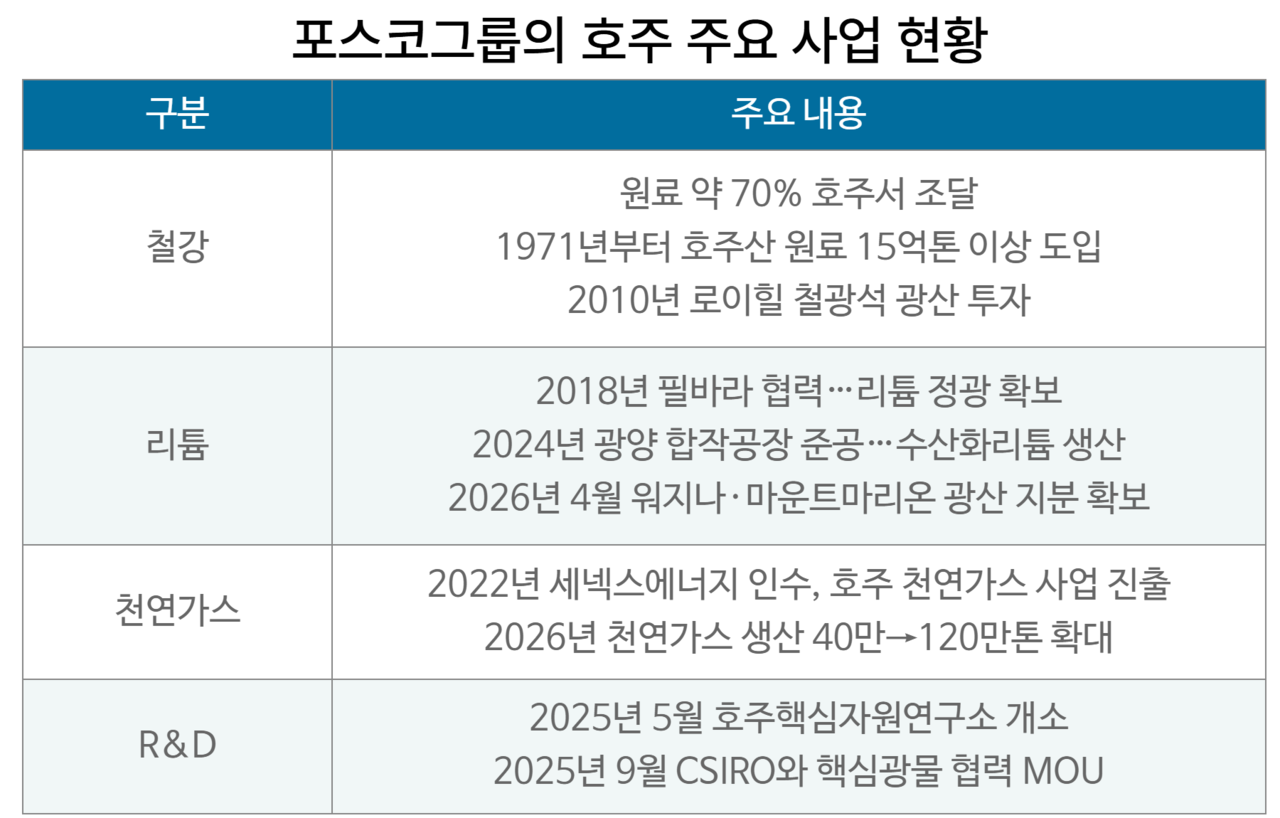
Australia is Posco Group's single most important resource supplier, accounting for roughly 70 percent of the group's total raw material procurement.
The relationship began with steel. Since Posco started purchasing Australian iron ore under long-term contracts in 1971, it has imported more than 1.5 billion tons of Australian raw materials. In 2010, Posco took a direct stake in the Roy Hill iron ore mine in Australia from the outset of its development, expanding the relationship from simple raw material buyer to resource development investor. The Roy Hill investment secured a stable iron ore supply base and generates dividend income from the mine.
![The Wodgina lithium mine in Western Australia, operated by Mineral Resources, in which Posco Holdings has made an equity investment. [Posco Holdings]](https://wimg.heraldcorp.com/news/cms/2026/09/02/news-p.v1.20260109.1c4dc671eee4499eb07a6507dd646ccb_P1.jpg)
Successive lithium mine investments push production capacity to 73,000 tons
The resource cooperation with Australia that has long centered on steel is now expanding rapidly into lithium as well.
Posco formed a strategic partnership with Australia's Pilbara Minerals in 2018, investing about A$79.6 million to secure a 4.75 percent stake and the right to receive 315,000 tons of spodumene concentrate annually from the Pilgangoora mine in Western Australia.
The two companies subsequently established a joint venture in Korea — Posco Pilbara Lithium Solution — to build a supply chain that processes lithium ore mined in Australia into battery-grade lithium hydroxide domestically. The plant has an annual lithium hydroxide production capacity of 43,000 tons.
![An exterior view of the second ore-based lithium hydroxide plant completed by Posco Pilbara Lithium Solution at the Yulchon Industrial Complex in South Jeolla Province. [Posco Holdings]](https://wimg.heraldcorp.com/news/cms/2026/09/02/news-p.v1.20241129.8db7694e2dac464e9bed22661cf3e2ac_P1.png)
Posco is also diversifying its sources of Australian lithium. Posco Holdings completed an equity investment in lithium mines held by Australia's Mineral Resources in April this year, committing $765 million to acquire a 30 percent stake in an intermediate holding company established by Mineral Resources. The deal gave Posco indirect stakes of 15 percent each in the Wodgina and Mount Marion mines in Western Australia, along with rights to secure lithium concentrate and dividend income.
Posco Group plans to further expand its domestic smelting capacity on the back of the lithium concentrate secured in Australia. The target is to raise ore-based lithium production capacity from the current 43,000 tons per year to 73,000 tons. Combined with brine lithium from Argentina, the group's total lithium production capacity is set to reach 173,000 tons by 2033. Posco Group aims to break into the top five global lithium producers through this expansion.
![Posco Group Chairman Jang In-hwa (second from left) inspects operations at the Senex Energy gas field in Queensland, Australia, on April 9, 2025 (local time). [Posco Group]](https://wimg.heraldcorp.com/news/cms/2026/09/02/news-p.v1.20250410.6d94fc96f4e54db5a8269368ed55da2a_P1.jpg)
Senex output to triple as energy cooperation expands
The partnership with Australia is also extending into energy resources. Since POSCO International acquired Australian natural gas company Senex Energy in 2022, it has been expanding local gas production and additional resource development.
Posco Group is currently pursuing a production expansion project to triple Senex's natural gas output from 400,000 tons per year to 1.2 million tons. The group also plans to secure additional adjacent gas fields, with the aim of developing Australia into a major natural gas production hub alongside Southeast Asia.
Alongside expanding global gas assets including Senex, Posco Group is also scaling up its broader energy business. The group aims to grow total gas sales from 2.597 million tons in 2025 to 4.202 million tons by 2031.
The group plans to move beyond gas field production into LNG shipping, trading, storage and power generation. Total LNG volumes handled by the group are targeted to more than triple from 1.822 million tons in 2025 to 6.347 million tons by 2031, while power generation capacity is set to expand from 3.5 gigawatts to 6 gigawatts over the same period.
![Posco Group Chairman Jang In-hwa (left) and Australian Prime Minister Anthony Albanese pose for a photo at Posco's Pohang steelworks in Pohang, North Gyeongsang Province, on Oct. 30, 2025. [Posco Group]](https://wimg.heraldcorp.com/news/cms/2026/09/02/news-p.v1.20251112.cac7cb0853e14733ba6c1ca16d50e411_P1.png)
Beyond resource procurement — deepening cooperation into technology
Posco Group is also working to elevate its relationship with Australia from simple resource procurement to technology cooperation. In May last year, the group opened its first overseas resource research institute — the Australia Critical Minerals Research Center — in Perth, Western Australia, launching research into steelmaking raw materials and critical minerals including lithium, nickel and rare earths.
That September, the group signed an MOU with Australia's Commonwealth Scientific and Industrial Research Organisation for cooperation in the critical minerals field, broadening its collaborative framework with local research institutions. The aim is not merely to secure resources but to jointly develop exploration, smelting and processing technology.
This expansion of Australian operations aligns with the "Triple Core" strategy Jang unveiled in July. Posco Group has laid out a blueprint to grow into a "national champion critical resource supplier" by building on its industrial resource base centered on steel and nurturing strategic resources — including lithium, cathode and anode materials, and rare earths — as well as energy resources such as LNG and renewable energy as new growth engines.
![Posco Group Chairman Jang In-hwa and representatives of major Australian resource companies and research institutions pose for a photo at the opening ceremony of Posco Holdings' Australia Critical Minerals Research Center in Perth, Australia, on May 30, 2025. [Posco Holdings]](https://wimg.heraldcorp.com/news/cms/2026/09/02/news-p.v1.20250530.c9129423f64f4e34a457d928b94e743b_P1.jpg)
To fund this strategy, Posco Group plans to invest a total of 29.1 trillion won ($21.2 billion) from 2026 to 2028, allocating 4.1 trillion won to strategic resources and 3.7 trillion won to energy resources. The strategic resource investment includes the Mineral Resources ore lithium project in Australia and additional smelting investments, while the energy resource allocation covers the Senex production expansion, among other projects.
Through this business restructuring, Posco Group aims to grow combined group sales from 116 trillion won in 2025 to 187 trillion won by 2035, while expanding operating profit from 2.2 trillion won to 13.1 trillion won over the same period.
After concluding his resource diplomacy in Australia, Jang will travel directly to the United States, where he is scheduled to attend the groundbreaking ceremony for an electric arc furnace steel mill in Louisiana — a project Posco is jointly pursuing with Hyundai Steel — on Friday (local time).

kwater@heraldcorp.com





