
Government keeps non-resident single-home deduction at 1.2 billion won
Tax burden cap stays at 150% after public backlash
Property tax on high-end non-resident homes to fall 15–25% vs. original plan
Experts: overall tightening trend intact, premium listings to keep flowing
![A real estate agency in Songpa-gu, Seoul, last month. [Yonhap]](https://wimg.heraldcorp.com/news/cms/2026/09/02/rcv.YNA.20260804.PYH2026080414820001300_P1.jpg)
The government has unveiled a revised tax reform plan that keeps the basic deduction and tax burden cap for the comprehensive real estate tax — known as jongbusae — on non-resident single-home owners at current levels, a move that will reduce next year's combined property tax bills for owners of high-end non-resident homes by hundreds of thousands to tens of millions of won compared with the original proposal. The compromise was crafted in response to market and political backlash over fairness concerns, but the broader thrust of tightening — including a phased increase in jongbusae rates, a higher fair market value ratio and a shift to a long-term residency deduction — remains intact. Analysts expect the flow of listings concentrated in the Gangnam area to continue for now.
According to the real estate industry and the Ministry of Economy and Finance, the government finalized the 2026 tax reform plan at a Cabinet meeting on Tuesday. The final version incorporated revisions to the original proposal announced Aug. 3, with changes focused on the jongbusae treatment of non-resident single-home owners.
The original plan had proposed splitting the jongbusae basic deduction for single-home owners into two tiers: raising it from 1.2 billion won to 1.4 billion won ($1.02 million) for residents, while cutting it from 1.2 billion won to 900 million won for non-residents. Growing concern that the change would sharply increase the tax burden on people living away from their registered home for unavoidable reasons — such as work, education or caring for elderly parents — and warnings of rental market disruption if owners rushed to move back in prompted the government to keep the non-resident deduction at 1.2 billion won. For jointly owned non-resident homes held by married couples, the government also stepped back from the original plan, which would have cut each spouse's deduction from 900 million won to 400 million won, and instead set it at 600 million won each. The plan to raise the jongbusae tax burden cap from 150 percent to 200 percent was also dropped, with the current 150 percent ceiling left in place.
Jamsil Jugong 5 bill drops from 25.2 million to 19.28 million won — high-end non-resident owners to see 15–25% relief vs. original plan
With the government restoring the non-resident single-home jongbusae deduction to its original level, the combined property tax burden on high-end homes with a publicly assessed value of 3 billion won or more is expected to fall roughly 15 to 25 percent compared with the original proposal.
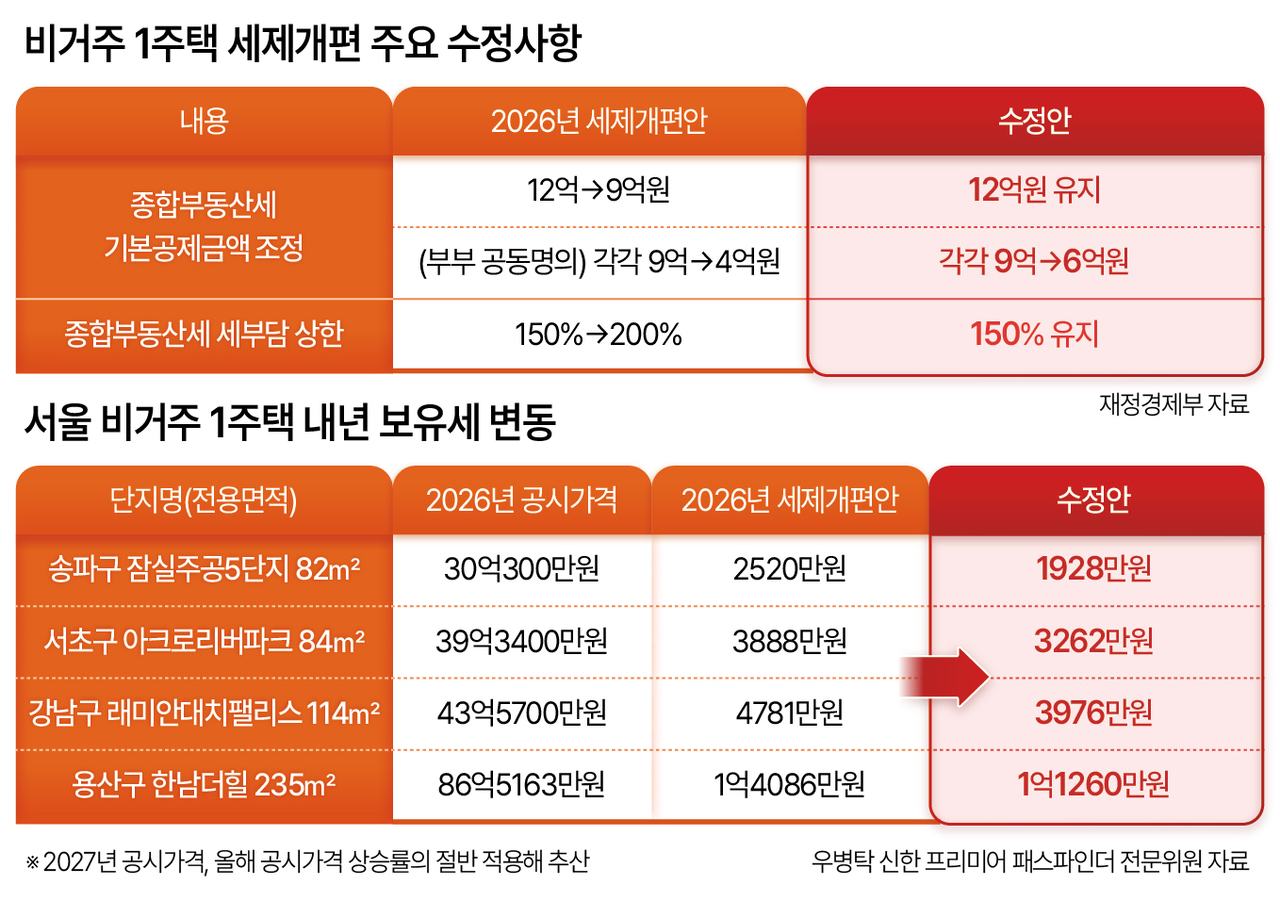
According to a simulation of property tax changes for non-resident single-home owners by Woo Byung-tak, a senior specialist at Shinhan Premier Pathfinder, applying a fair market value ratio of 70 percent, a non-resident owner of an 82-square-meter unit at Jamsil Jugong 5 complex in Songpa-gu, Seoul — with a publicly assessed value this year of 3 billion won — would have owed 25.2 million won in property taxes next year under the original plan. Under the revised plan, that bill falls to 19.28 million won, a reduction of 5.92 million won, or 23.5 percent. The estimate assumes next year's assessed value will rise at half the rate recorded this year.
For a non-resident owner of an 84-square-meter unit at Acro River Park in Seocho-gu, with an assessed value of 3.93 billion won, the tax burden drops from 38.88 million won to 32.62 million won. A non-resident owner of a 112-square-meter unit in the same complex, assessed at 5.47 billion won, would have faced a bill of 69.06 million won under the original plan; the revised plan cuts that to 56.13 million won, a reduction of more than 10 million won. A non-resident owner of a 235-square-meter unit at Hannam the Hill in Yongsan-gu, where the assessed value exceeds 8 billion won, will also see their bill fall from 140.86 million won to 112.6 million won.
A married couple jointly owning a single 84-square-meter unit at Banpo Xi in Seocho-gu will also see their combined property tax bill reduced from 21.84 million won to 16.84 million won.
Overall tightening trend intact as fair market value ratio rises — experts see continued flow of premium listings
Despite the partial easing of the tax burden on non-resident single-home owners, experts say the market will feel little relief in practice. The finalized government plan preserves the broader tightening direction of the original proposal across both property holding taxes and capital gains taxes — including a new cap on the long-term holding deduction for single-home owners and its conversion to a residency-based deduction, a phased elimination of the differentiated jongbusae rate structure based on the number of homes owned combined with a rate increase for the 600 million to 1.2 billion won tax base bracket, and a rise in the fair market value ratio from 60 to 70 percent.
Lee Eun-hyung, a research fellow at the Korea Construction Policy Research Institute, said the government's direction of tightening taxation remains unchanged, and that keeping the deduction amount and tax burden cap at current levels is not a relaxation but simply a preservation of the status quo. "The adjustment to the fair market value ratio just means it will take longer to push holding taxes higher in the future," she said. She added that the preference for owning a single quality home within an individually manageable range will persist, and that even high-end areas will likely recover in price once some of the distressed listings are absorbed.
Since the Aug. 3 tax reform announcement, tax-motivated listings with reduced asking prices have been appearing mainly in the Gangnam area, and analysts say the number of owners deciding to sell could grow further.
Song Seung-hyun, chief of Dosi wa Gyeongje, said that even with the revisions, the fair market value ratio will continue to rise, meaning the weight of jongbusae will feel different from next year or the year after. "Owners without income who have been sitting on the fence may now make a decision and put their properties on the market, since the government plan has been finalized," he said.
Park Won-gap, a senior real estate specialist at KB Kookmin Bank, also said the market trend is unlikely to change significantly from what has been seen since the original plan was announced. "Premium listings in the Gangnam area will keep coming through next year," he said.
However, some analysts note that maintaining the non-resident deduction at its current level removes part of the pressure driving listings to market, which could moderate the pace of new supply.
Ham Young-jin, head of the real estate research lab at Woori Bank, said the partial retreat from the originally announced jongbusae tightening for non-resident single-home owners is likely to be read by the housing market as a more accommodative signal than expected. "Non-resident owners of high-end Seoul apartments who have been renting them out on jeonse leases faced the prospect of choosing between selling or moving back in as their holding tax burden rose, but with the deduction maintained, that tax-driven pressure to list will ease considerably," he said.
Ham added that in an environment where buyers' purchasing capacity is already constrained by lending regulations and high home prices, a surge in tax-motivated distressed sales could have exerted downward price pressure on the Gangnam market — but that this scenario has now become less likely as a result of the revision.

hwshin@heraldcorp.com





