
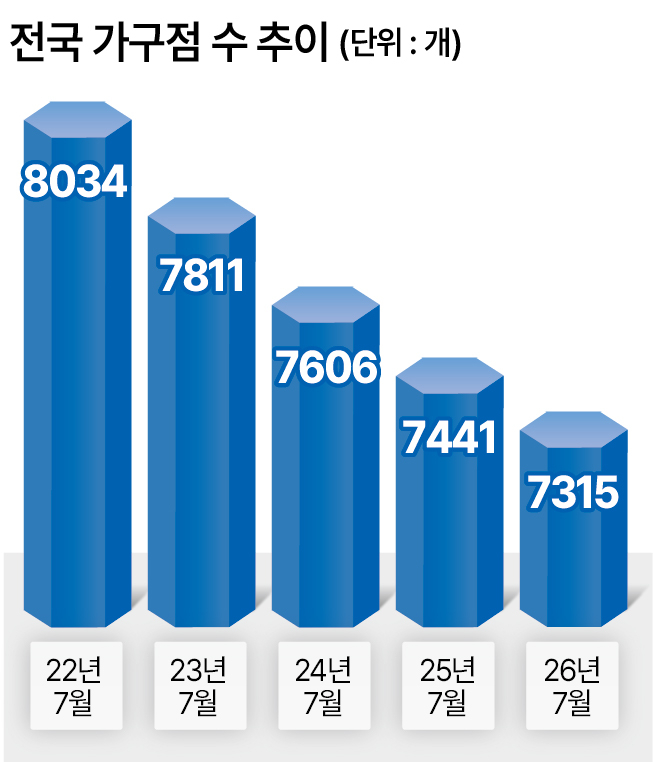
Number of offline furniture stores falls to 7,315 as of July
Online furniture sales grow to 5.72 trillion won
Rising high-involvement consumers drive ultra-premium import brand sales
![A chest of drawers by Swiss modular furniture brand USM (left), spotted in a photo posted by singer Kang Min-kyung, and a sofa by French furniture brand Roche Bobois, seen in a photo featuring singer Jennie. Both are high-end brands with products ranging from several million won to tens of millions of won per piece. [Instagram]](https://wimg.heraldcorp.com/news/cms/2026/09/02/news-p.v1.20260902.5d3b3ce2b5da4e18a14d5421a8ac7ba8_P1.png)
Even as brick-and-mortar furniture stores disappear across South Korea, ultra-premium furniture costing tens of millions of won is selling briskly — a polarization in consumer spending that analysts attribute to a broad shift in demand toward online channels and large specialty retailers as interest in interior design surges.
National Tax Service data show the number of furniture stores nationwide has been on a steady decline. From more than 8,000 stores in 2022, the count fell to 7,315 as of July — down 126 from 7,441 a year earlier. Areas in Seoul's Jongno-gu and neighborhoods such as Sadang-dong and Ahyeon-dong were once celebrated as "furniture streets," but stores have closed one after another as department stores, large specialty retailers and online platforms have claimed a growing share of the market.
Online furniture sales, meanwhile, have surged. According to the Korean Statistical Information Service (KOSIS), online furniture sales stood at around 3 trillion won ($2.19 billion) in 2019, broke through 5 trillion won in 2021, and reached 5.72 trillion won in 2025. "Furniture used to be a quintessential offline purchase — shoppers wanted to check the material, color and size in person," a retail industry official said. "But the rise of single-person households and the interior-design boom during the COVID-19 pandemic drove demand sharply online."
Sales of ultra-premium furniture have been rising consistently. CJ OnStyle said orders for premium living brands from January through August this year rose about 50 percent from the same period a year earlier. "Design accessories such as lighting, trolleys and vases were particularly popular," a CJ OnStyle official said, citing Italian lighting brand Artemide and Danish furniture brand Fritz Hansen as standout performers.
A living goods event held by 29CM from Aug. 10 to 20 also saw furniture category transactions climb 35 percent compared with the same event a year earlier. "Growth was broad-based, from imported brands such as Swiss modular brand USM and American brand Herman Miller to domestic labels," a 29CM official said. "Artemide's transactions jumped 85 percent in just the first four days of the event."
High-end furniture ranges from several million won to tens of millions of won per piece, depending on the brand and item. Despite the steep prices, word of mouth spread through television programs and SNS after celebrities were seen with the pieces. USM, known domestically as "Kang Min-kyung's chest of drawers," and French furniture brand Roche Bobois, which gained fame as "Jennie's sofa brand," are among the most prominent examples. Department stores have also emerged as a key sales channel: furniture sales at The Conran Shop, Lotte Department Store's premium living concept store, rose 60 percent in the January–August period from a year earlier.
"Unlike in the past, when buyers focused on function, more consumers today are purchasing furniture based on brand," one industry official said. "Demand that was initially concentrated in low-cost brands as the living market took off is gradually migrating toward high-end imported labels, and sales are following." Another official said the trend also reflects a growing appetite for "partial upgrades" — improving the feel of a space with a single distinctive piece of furniture or décor item rather than overhauling an entire home.

soho0902@heraldcorp.com





