
Report urges automatic adjustment mechanism reflecting demographic factors
Pension benefit adjustments currently tied only to inflation
'Hybrid' contribution system and stronger fund governance also recommended
![Korea Enterprises Federation headquarters [Herald DB]](https://wimg.heraldcorp.com/news/cms/2026/09/02/9/news-p.v1.20260902.21683679ce754029bef137e61f9926e1_P1.jpg)
As an amended National Pension Act — raising contribution rates in stages and increasing the income replacement ratio — took effect this year, calls have emerged to strengthen fiscal stability and lifetime contribution-benefit equity to improve public acceptance of the system.
The Korea Enterprises Federation released a report Wednesday titled "National Pension System Reform Measures to Enhance Public Trust," outlining structural improvements across the pension system's finances, contribution structure, benefits and fund management.
The federation said that despite an April last year revision to the National Pension Act that included parametric reforms and a statutory guarantee of state payment, a public survey conducted in November last year found that 55.7 percent of respondents did not trust the national pension system.
The federation identified five key factors undermining public trust: a fiscal base that fails to reflect demographic shifts; a dual contribution assessment and collection system depending on enrollment type; a pension reduction regime that does not align with changing social and economic conditions; a benefit structure skewed toward income redistribution; and insufficient expertise and independence in fund management governance. It proposed corresponding reforms for each.
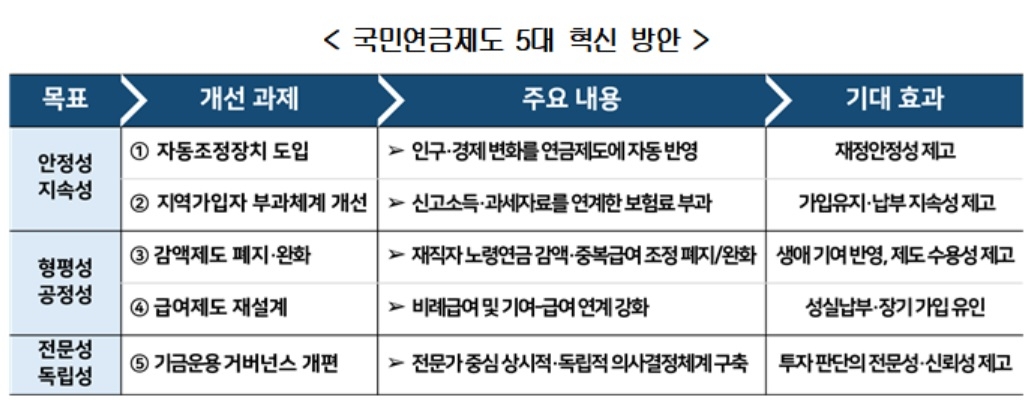
As a first measure, the federation said an automatic adjustment mechanism should be introduced alongside parametric reforms as part of a broader policy package to enhance fiscal stability. The mechanism would factor in demographic and economic variables — such as rising life expectancy and a shrinking contributor base — in addition to inflation when setting annual pension benefit increases. According to the OECD's pension report, 24 of the organization's 38 member countries already operate such automatic adjustment mechanisms to secure fiscal sustainability.
The federation also recommended shifting to a "hybrid contribution system" that retains the current self-reporting principle but strengthens cross-verification with National Tax Service tax data and allows timely adjustments to the standard monthly income base when discrepancies between reported and verified income are large. The rationale is that regional subscribers, who must report their own income and pay contributions directly, are prone to underreporting earnings or falling behind on payments.
In addition, the federation said the pension reduction scheme for working retirees and the benefit reduction applied when old-age and survivors' pensions overlap do not adequately reflect changed social and economic conditions or subscribers' lifetime contributions, and called for those reduction schemes to be abolished or significantly relaxed.
The federation further recommended strengthening the link between contributions and benefits to encourage consistent premium payment and long-term enrollment, and restructuring the National Pension Fund's top decision-making body — the Fund Management Committee — into a standing body led by investment and finance professionals to ensure expert and accountable fund management.
Lee Sang-cheol, head of the federation's employment and social policy division, said the low level of public trust in the national pension system even after parametric reforms "demonstrates the need to reexamine the system's fundamental principles and overall operating framework." He added that the system "must be reformed to improve intergenerational burden equity and ensure that subscribers' contributions are fairly reflected in their benefits, while also strengthening the expertise and independence of fund management, so that the national pension can become a system that every generation can trust and rely on."
likehyo85@heraldcorp.com





