Target: 40,000 units by 2031
78 of 112 sites still at association stage
30 sites stalled for over 2 years after approval
Construction costs, financing, resident disputes must be resolved
![A redevelopment-designated area in Seoul slated for a Moa Town project. [Herald Business DB]](https://wimg.heraldcorp.com/news/cms/2026/09/02/news-p.v1.20260823.40482e60e7694a32a1538fa5110234d0_P1.jpeg)
As Seoul pushes to break ground on 40,000 Moa Housing units by 2031, the key challenge is no longer finding new candidate sites — it is moving projects that have already formed associations into actual construction. A large number of sites remain stuck in post-association procedures, and how quickly they can resolve issues around project viability, construction costs, financing and resident disputes will determine the pace of delivery.
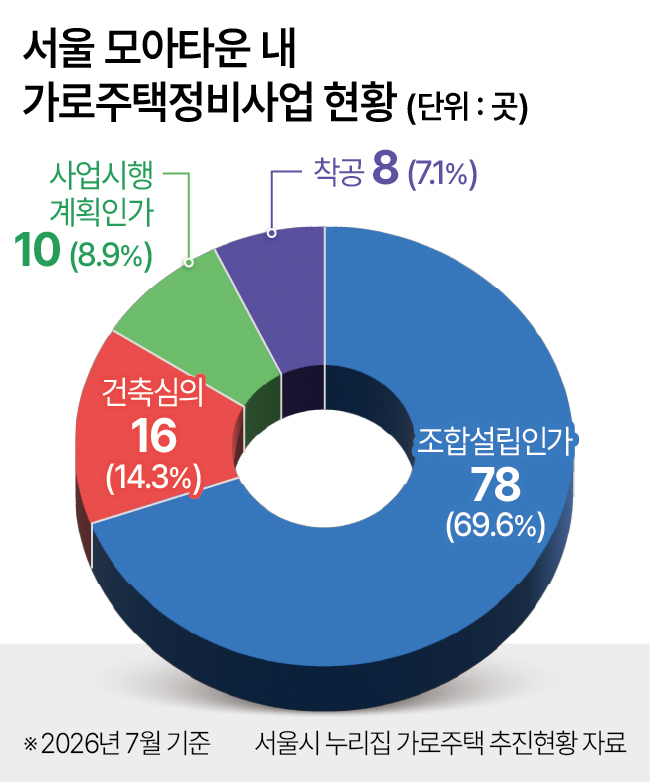
According to Seoul Metropolitan Government website data on street-block housing improvement projects as of July 2026, 112 such projects have been designated as Moa Town candidate sites. Of those, 78 — or 69.6 percent — remain at the association establishment approval stage. Sixteen sites, or 14.3 percent, have advanced to architectural review; 10 sites, or 8.9 percent, have received project implementation plan approval; and only 8 sites, or 7.1 percent, have broken ground.
Of the 78 sites still at the association establishment approval stage, 52 have been there for more than a year since receiving approval. Among those, 30 have been stalled for more than two years and 16 for more than three. Even after completing the association formation process, in other words, a significant number of sites have yet to advance to architectural review or project implementation plan approval.
Under the current Small-Scale Housing Improvement Act, if a project fails to apply for architectural review or integrated review within two years of receiving association establishment approval, the relevant mayor or county chief may order corrective action or revoke the approval. The deadline for applying for project implementation plan approval is three years after association establishment approval.
Approval procedures are split between the Seoul Metropolitan Government and individual district offices. Association establishment approval for street-block housing improvement projects falls under the jurisdiction of the relevant district mayor, while architectural review after association formation goes through either the district's architectural committee or Seoul's integrated review committee, depending on the project's scope. Projects requiring two or more types of review — covering architecture, urban planning, landscape or traffic — or those involving zoning changes or the application of maximum floor-area ratios may be subject to Seoul's integrated small-scale housing improvement review process.
Seoul's recent shift in focus — from securing new candidate sites to actively managing the progress of existing projects toward groundbreaking — reflects precisely this situation.
According to the "Moa Housing and Moa Town Fast-Track Integrated Promotion Plan" released by Seoul last month, 156 individual Moa Housing projects covering about 43,000 units are currently advancing after forming associations. Of those, 34 projects totaling about 5,000 units have received project implementation plan approval and are nearing groundbreaking.
Seoul plans to intensively manage 146 construction-ready zones, targeting groundbreaking on 14,000 units by 2028 and a cumulative 40,000 units by 2031. The city and district offices will hold monthly "rapid groundbreaking progress meetings" to track each site's status, and a "mobile rapid-resolution support team" will be dispatched to projects delayed by resident disputes, construction cost issues or relocation problems.
Financial support is also concentrated at the project execution stage. Seoul plans to inject about 619 billion won ($452 million) into Moa Housing and Moa Town projects through 2030. Of that, 200 billion won is earmarked for early-stage project cost support and 366 billion won for relocation loan financing — the bulk of the funding directed at bridging existing projects to actual groundbreaking.
Whether Seoul's progress management and financial support translate into more groundbreakings will depend on the pace of projects in the districts where the bulk of the targets are concentrated. Among Seoul's 2031 targets, Jungnang-gu leads with 10,000 units, followed by Geumcheon-gu with 5,700, Mapo-gu with 3,800 and Gangseo-gu with 3,600. The four districts together account for 23,100 units — 57.8 percent of the citywide target of 40,000.
Street-block housing improvement projects are similarly concentrated in these areas. Of the 112 Moa Town candidate sites, 68 — or 60.7 percent — are located in Jungnang-gu, Geumcheon-gu, Mapo-gu and Gangseo-gu. Among those 68 sites, 45 remain at the association establishment approval stage, 12 are at architectural review, 8 have received project implementation plan approval, and only 3 have broken ground.
In Jungnang-gu, which carries the largest groundbreaking target at 10,000 units, 23 of 34 sites remain at the association establishment approval stage. Of those, 10 have been stalled for more than two years since receiving approval and 6 for more than three years. In Geumcheon-gu, 10 of 16 sites are at the association establishment approval stage, with 5 having passed the two-year mark and 3 the three-year mark. Combined, Jungnang-gu and Geumcheon-gu account for 15,700 units — 39.3 percent of Seoul's total target.
Seoul is also revamping how new projects are planned. Starting next year, Moa Town management plan development will be consolidated under a "Moa integrated planning" model in which district mayors commission the work, with Seoul covering 70 percent of the planning consultancy costs. Day-to-day project management will be led by the districts, while the city provides broader support — including progress oversight, financial backing and project viability analysis through the Seoul Housing and Communities Corp.
This stands in contrast to the direction being pursued by the ruling party and government, which is pushing to transfer authority over designating redevelopment and reconstruction improvement zones of 500 units or fewer to individual districts. Street-block housing improvement projects already place most key procedures under district jurisdiction, yet even after associations are formed, many sites remain stuck for extended periods due to competing resident interests, project viability concerns, construction costs and financing. That is why Seoul is reinforcing the district-led implementation framework while separately expanding its own progress management and project viability support.
Kwon Dae-jung, a distinguished professor in the real estate studies department at Hansung University, said Moa Town projects often include a significant number of single-family and multi-unit homes with large ownership stakes, leading to frequent delays caused by resident opposition over the distribution of rights. "The current street-block housing improvement scheme already allows multi-unit homeowners to receive multiple units under certain conditions, but there is a need to improve compensation terms — such as the pre-sale prices of additionally allocated units — to raise incentives for participation," he said.
quq@heraldcorp.com