
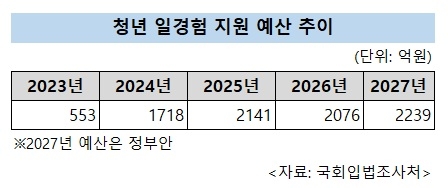
Budget rises from 55.33 billion won in 2023 to 223.9 billion won next year
Program to support 39,000 participants through internships, projects next year
Post-program tracking of employment, job retention and wages remains inadequate

The government has allocated 223.9 billion won ($163 million) for next year's Youth Work Experience Support Project, a program that helps young people gain on-the-job experience before entering the workforce. The figure is roughly four times the budget from 2023, the program's first year, yet critics say the system for tracking whether participants actually land and keep jobs remains inadequate.
According to the Ministry of Employment and Labor's 2027 budget proposal released Thursday, next year's allocation of 223.9 billion won represents a 16.3 billion won, or 7.9 percent, increase from this year's 207.6 billion won. The program is set to support 39,000 participants — 26,000 in internship placements, 10,000 in project-based tracks and 3,000 in customized support programs.
Data submitted by the ministry and cited in the National Assembly Research Service's "2026 National Audit Issue Analysis" show the program's budget has grown steadily: from 55.33 billion won in 2023 to 171.82 billion won in 2024 and 214.09 billion won in 2025. Next year's proposed budget is 168.57 billion won, or 304.7 percent, higher than in 2023 — nearly a fourfold increase in four years.
The Youth Work Experience Support Project was launched in 2023 to give young people with limited job experience a chance to work in real business settings, as hiring increasingly favors mid-career candidates with proven track records. The program aims to help participants build the experience needed to enter the labor market. Enrollment has grown from 21,000 in 2023 to 62,000 in 2025.
The concern is that as the program has expanded, the mechanisms for verifying whether it actually helps participants enter the labor market have not kept pace. The National Assembly Research Service said the Ministry of Employment and Labor has focused its performance management on participant satisfaction and improvements in job competency, while failing to systematically track post-program outcomes such as employment rates, job retention periods and wage levels.
The ministry has said it is difficult to use employment outcomes as a direct performance indicator because a large share of participants are still enrolled in school. The research service pushed back, saying that "using employment outcomes as a performance indicator and tracking whether program participants find jobs are two separate issues."
The report also flagged uneven quality across programs. Among the cases cited, some participants said they had been assigned relatively routine tasks — filing documents, conducting basic research and providing event support — leaving them with little opportunity to build meaningful job skills. Some programs, the report found, amounted to little more than short-term exposure rather than genuine skill development.
Participating companies are recruited by the operating agencies that run the program, meaning the quality of placements depends heavily on each agency's corporate network and outreach capacity. The research service said this structure can lead to significant disparities in the caliber of companies secured. The ministry itself acknowledged a lack of incentives to attract higher-quality firms as one of the program's operational challenges.
In next year's budget proposal, the government said it plans to expand work-experience and training opportunities that young people prefer, while strengthening support for building an initial career record and connecting participants to employment. The plan calls for redesigning the youth support framework to form a continuous path — from pre-entry preparation through experience and career building to job placement and long-term retention.
The National Assembly Research Service said "post-program employment support and follow-up management for youth participants remain insufficient." It added that whether company evaluation results feed back into program operations, and whether the program is properly linked to other youth employment policies such as the National Employment Support System and vocational training, are matters that should be examined at the upcoming national audit.
fact0514@heraldcorp.com





