Investment and relocation decisions themselves excluded from mandatory bargaining; talks required when working-condition changes are objectively foreseeable
Guidelines applicable even during planning stage; timing of information sharing and bargaining remain contested
Job succession guaranteed in mergers, but changes to duties and work locations still at issue
Government says guidelines carry normative force, but cannot guarantee legality of companies' refusal to bargain
![Union leaders from Korea Development Bank, Industrial Bank of Korea and Export-Import Bank of Korea chant slogans at a joint rally outside Korea Development Bank's headquarters in Yeouido, Seoul, on Wednesday, opposing plans to relocate the state-run lenders to regional areas. The union leaders called for an immediate halt to any review of forced relocation of state-owned banks, warning it would destroy financial competitiveness and deal a fatal blow to the national economy. [Yonhap]](https://wimg.heraldcorp.com/news/cms/2026/09/03/rcv.YNA.20260811.PYH2026081118630001300_P1.jpg)
The government has issued new standards governing labor bargaining over management decisions such as investment and relocation, but the seeds of labor-management conflict remain.
Even if a company or public institution refuses to bargain on the basis of the guidelines, that refusal is not guaranteed to be found lawful by a court. Disputes are expected over how far — and from when — working-condition changes must be subject to bargaining, both in Samsung Electronics' Honam semiconductor mega-project and in the ongoing relocation and consolidation of public institutions.
The Ministry of Employment and Labor on Thursday issued an implementation guideline on the scope of labor disputes — covering items such as performance bonuses — and specified that demands opposing or seeking the cancellation of factory construction, overseas investment or production-base relocation are not subject to mandatory bargaining. However, it said that once a concrete workforce management plan is confirmed and changes to working conditions are "objectively" foreseeable, related matters may become subject to bargaining.
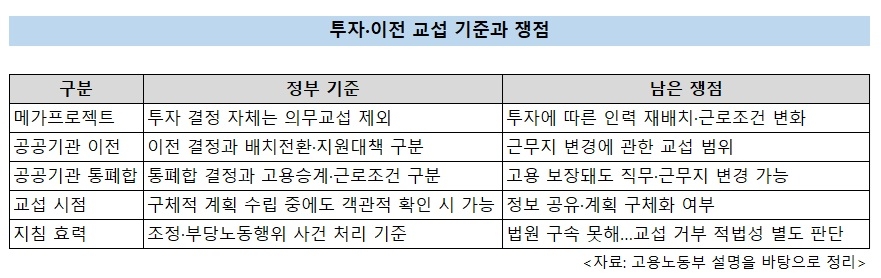
The ministry had already set out the principle of distinguishing between a management decision itself and the resulting changes to working conditions in its revised interpretation guidelines for the Trade Union Act in February. Thursday's guideline elaborates on the criteria and provides specific examples. The ministry said it will use the guideline as a standard for handling labor dispute mediation and unfair labor practice cases.
The guideline also states that if an employer refuses to bargain over demands that do not fall under mandatory bargaining, that refusal is unlikely to constitute an unfair labor practice. However, the ministry noted that excluding an item from mandatory bargaining does not mean voluntary bargaining and agreement between labor and management are prohibited.
Deputy Minister of Employment and Labor Kwon Chang-jun said the guideline sets the standard for the exercise of government authority and can indirectly influence labor and management through that process, adding that it "should be seen as carrying normative force in determining unfair labor practices."
However, the government's own case-handling standards and the binding effect on courts are separate matters.
The Supreme Court has previously ruled that internal administrative processing standards generally do not bind courts or the public, and that compliance with such standards alone does not ensure the legality of a disposition.
Companies or public institutions that follow the guideline may still face separate judicial scrutiny — based on applicable law, the actual demands made and the nature of any working-condition changes — if a dispute over a bargaining refusal proceeds to litigation.
On the ground, the central issue is drawing the line between a management decision and a change in working conditions.
Samsung Electronics announced June 30 a plan to invest about 400 trillion won ($292 billion) in Gwangju to build two new semiconductor factories. In response, the Samsung Electronics branch of the Samsung Group's cross-company union said in July that it would put the Honam semiconductor mega-project on the bargaining agenda for 2027.
Under the guideline, a demand to cancel factory construction must be distinguished from demands to negotiate the criteria and procedures for reassignment, changes to work schedules, and support for commuting or relocation costs arising from the project. The fact that the factory construction itself is not subject to mandatory bargaining does not mean all related bargaining demands can be dismissed.
Similar issues could arise at public institutions undergoing regional relocation and consolidation.
The government announced Thursday, through its public institution functional reform plan, that it would restructure public institutions and their subsidiaries to reduce the total number of agencies by 109. Five state-owned power generation companies will be merged into one, four regional port authorities will be consolidated into a single entity, and Korea National Oil Corporation will be merged with Korea Gas Corporation. Korea Coal Corporation will be dissolved after its debts are settled and relevant legislation is amended.
Under the ministry's standards, the mere announcement of a relocation or consolidation plan does not automatically make all related demands subject to mandatory bargaining. Demands to reverse the decision itself must be distinguished from demands concerning working conditions such as job succession and reassignment. Deputy Minister Kwon, while treating public institution relocation as a management decision, said that "if reassignment follows from it, bargaining is required."
The government said it will guarantee job succession for all employees — excluding executives — at institutions subject to consolidation, and will manage compensation structures to ensure that treatment does not deteriorate before or after the merger. Consultations through a government-labor council and between relevant ministries and individual institution unions will also proceed in parallel. Accordingly, the abolition or merger of an institution cannot be directly equated with employee dismissal.
That said, job succession does not mean all working conditions will remain unchanged.
The plan to merge the five power generation companies includes "streamlining of overlapping personnel," and the port authority consolidation plan calls for converting existing authorities into regional branches of the merged entity. Even if employment and pay are maintained, job duties, organizational affiliation and work locations may change, making it necessary to examine specific workforce management plans in detail.
In the financial sector, union opposition to the relocation of public institutions to regional areas is already intense. The financial sector union announced Thursday that it would hold a general strike Friday, citing opposition to the relocation of state-run banks and demands for a four-and-a-half-day workweek, among other issues. The union also demanded that management notify and reach agreement with unions before drawing up headquarters relocation plans.
Regional relocation and the current consolidation are separate issues, but they share a common question: at what stage unions may become involved in organizational and workplace changes. Public institutions subject to consolidation may also push back over the scope of union participation and bargaining rights during the restructuring process.
The key question is when changes to working conditions can be objectively anticipated. The guideline takes the position that an investment announcement, a medium- to long-term management plan or abstract remarks by executives are not sufficient on their own.
However, the guideline allows unions to demand bargaining when specific plans — such as layoffs, restructuring or related reassignments — are being drawn up or have been decided, and that fact becomes apparent through internal company notices, labor-management council materials or employer confirmations during the bargaining process. This does not mean unions must wait for a final decision or official announcement.
The problem is that labor and management may assess differently how concrete a plan has become.
A company or public institution may take the position that no workforce management plan has yet been finalized, while a union may argue that personnel movement resulting from organizational restructuring or a business push is sufficiently foreseeable. With relevant information concentrated in the hands of the government and employers, what materials unions can use to verify changes to working conditions also remains an open question.
The distinctions drawn by the guideline alone will not eliminate disputes over the scope and timing of bargaining. Further discussion will be needed on when information about specific workforce management plans arising from investment, relocation or consolidation is to be shared, and which working conditions are subject to bargaining.
How the government-labor consultations the government has promised will connect to bargaining at individual institutions is also expected to become a point of contention as the guideline is applied in practice. Deputy Minister Kwon said the guideline "is not one that restricts the scope of labor disputes beyond what the law allows," adding that its purpose is "to improve predictability so that problems can be resolved through dialogue between labor and management."
fact0514@heraldcorp.com