Labor Ministry clarifies dispute scope under 'yellow envelope law'
Factory construction itself excluded, but downstream transfers may be subject to bargaining
KEF warns routine personnel moves could become strike targets
Lobby also calls for clearer performance bonus standards, union law revision
![Participants hold placards and flags at a rally of 10,000 Korean Metal Workers' Union officials near Gwanghwamun Square in Jongno-gu, Seoul, on June 10, amid ongoing confusion at industrial sites following the implementation of the yellow envelope law. [Yonhap]](https://wimg.heraldcorp.com/news/cms/2026/09/03/news-p.v1.20260618.c78c49751ab3490fbb7cc321689b0463_P1.jpg)
South Korea's business community pushed back Thursday against the government's new guidelines on the scope of labor disputes, warning that the rules could constrain corporate investment and management decisions. The concern centers on whether workforce transfers arising from new factory construction or the adoption of AI and other emerging technologies could be drawn into labor disputes, potentially delaying or derailing large-scale investment projects.
The Korea Enterprises Federation issued a statement Thursday responding to the Ministry of Employment and Labor's implementation guidelines on the scope of labor disputes — covering performance bonuses and other management decisions — saying that making job transfers resulting from new factory construction or the introduction of AI and other new technologies subject to labor disputes "could excessively restrict employers' personnel and management authority, and risks derailing large-scale investment projects."
The Labor Ministry released the guidelines Thursday, providing more specific criteria for determining whether performance bonuses and corporate management decisions fall within the scope of labor disputes — an issue that has remained contentious since the revised Trade Union Act, commonly known as the yellow envelope law, took effect.
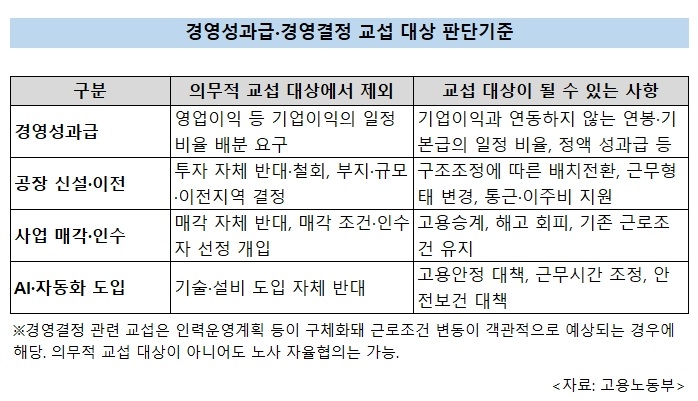
The government drew a line on certain demands, saying that calls for companies to pay out a fixed percentage of operating profit as bonuses, or outright opposition to new factory construction, would be difficult to treat as subjects of mandatory bargaining, mediation or industrial action.
However, the ministry said that once new factory construction, relocation, or the introduction of AI, robots or other new technologies reaches a stage where changes to working conditions — such as restructuring, job transfers or shift-schedule changes — can be objectively anticipated, those matters could become subject to bargaining.
The business community took direct aim at that provision.
The Korea Enterprises Federation said job transfers arising from the construction or expansion of factories and facilities are not intended to reduce existing workers' employment or shrink the organization, but are simply the process of assigning staff to newly created production units.
As long as no meaningful disadvantage to working conditions is involved, the federation said, such transfers should be treated as a routine exercise of the company's personnel authority.
The federation also pointed out that filling all skilled and research positions at a new factory through fresh hires alone is practically impossible. If collective bargaining over the placement of existing workers drags on or escalates into a strike, it said, the factory may not be able to begin operation on schedule.
The federation raised even sharper concerns about the introduction of AI and other new technologies.
It argued that applying new technologies and reorganizing work in the course of digital transformation are everyday management decisions, and that extending the scope of labor disputes to cover the resulting job transfers or changes in work methods could turn routine personnel and management decisions into labor-management conflicts.
The federation added that "in an era of sweeping transformation in AI and semiconductors, where the rapid and flexible deployment of personnel is essential, job transfers arising from new factory construction and the introduction of new technologies must be explicitly excluded from the scope of labor disputes to prevent disruptions caused by labor-management conflicts."
The federation also said the guidelines lack clarity on performance bonus standards.
In the guidelines, the Labor Ministry said that demands for a fixed percentage of a company's operating profit or net profit for the period to be set aside as a performance bonus pool could excessively restrict the rights of shareholders and other third parties, as well as the company's management judgment, and would therefore be difficult to treat as subjects of mandatory bargaining or industrial action.
At the same time, the ministry left open the possibility that performance bonuses tied to working conditions — such as demands for a fixed percentage of base pay or a set amount, without direct linkage to corporate profits — could be subject to mandatory bargaining.
The federation said that despite the wide variety of performance bonus types and their differing legal characteristics, the guidelines offer no concrete criteria for determining which bonuses qualify as wages or working conditions. It called on the ministry to spell out in the guidelines the requirements for performance bonuses that courts have recognized as wages, so that workplaces have a clearer standard to apply.
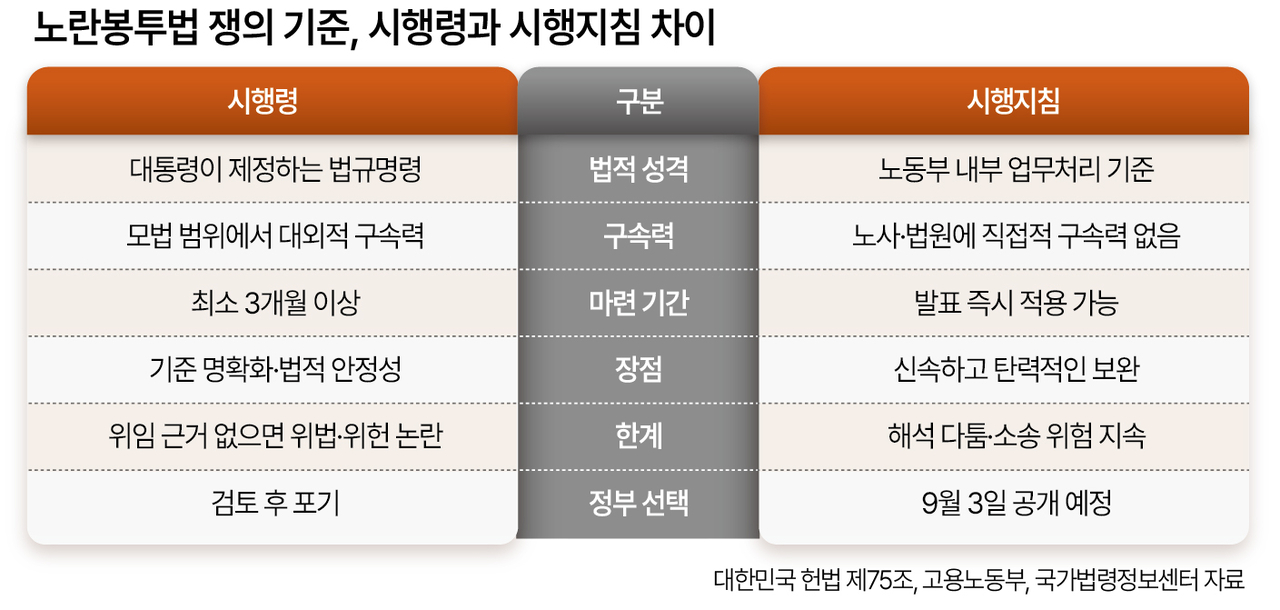
Another point of contention is that the document is an internal administrative guideline — not a law or enforcement decree. The Labor Ministry plans to use it as the official administrative standard for evaluating collective bargaining, labor dispute mediation, the legitimacy of industrial action, and whether unfair labor practices have occurred.
However, because the guidelines carry no legal binding force, if labor and management at individual workplaces reach different interpretations and disputes escalate into strikes or litigation, the final determination will ultimately rest with the courts.
The Korea Enterprises Federation noted that workplace conflicts over the scope of labor disputes continued even after the Labor Ministry issued interpretive guidelines on the yellow envelope law in February, arguing that implementation guidelines alone are unlikely to eliminate the uncertainty.
The federation said "it is ultimately necessary to amend the definition of labor disputes in the Trade Union Act to clearly stipulate that corporate decision-making matters — such as new factory construction and the resulting job transfers — are excluded from the scope of labor disputes, in order to prevent conflicts."
Labor groups have also pushed back against the guidelines, criticizing the government for using administrative directives to narrow the expanded scope of labor disputes that the legislative amendment was meant to create. With business groups arguing that uncertainty over corporate personnel and management authority remains, the debate between labor and management over the guidelines is expected to continue.
kwater@heraldcorp.com