Data submitted to People Power Party lawmaker Na Kyung-won's office show 23 of 31 cases filed by large conglomerate unions from January to August ended in mediation suspension, clearing the way for legal strikes — raising questions about the government's role as a labor mediator as the Yellow Envelope Act takes effect
![A general view of the National Labor Relations Commission's hearing chamber. [Herald DB]](https://wimg.heraldcorp.com/news/cms/2026/09/03/news-p.v1.20260825.10fdb3d04bbc4a24b0005a70679b53fa_P1.jpg)
About 70 percent of major conglomerate unions that filed labor dispute mediation requests with the labor commission this year have obtained the right to strike, data show, prompting critics to say the government is playing too passive a role in mediating labor-management conflicts. Business groups warn that the burden on management could grow further if subcontractor unions — which gained expanded bargaining rights against primary contractors under the Yellow Envelope Act — join the strike front.
70% of large conglomerate unions win strike authorization
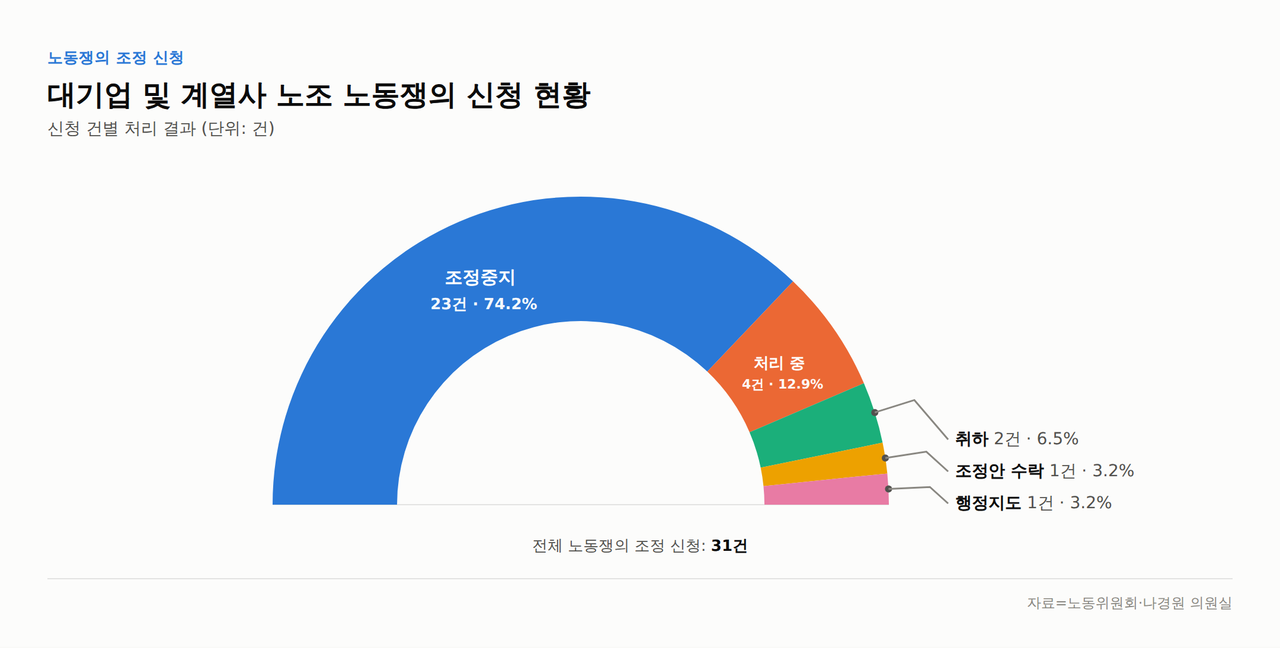
According to data the National Labor Relations Commission submitted to the office of People Power Party lawmaker Na Kyung-won, a member of the National Assembly's climate, energy, environment and labor committee, 74 percent — 23 of 31 labor dispute mediation cases filed by major conglomerate and affiliate unions between January and August this year — ended in a "mediation suspension" ruling.
Filing a labor dispute mediation request is the standard procedure unions go through to obtain the right to strike. When labor and management cannot narrow their differences, either side may ask the National Labor Relations Commission, as a neutral third party, to intervene. If the commission concludes that reaching an agreement is unlikely and issues a mediation suspension ruling, the union is legally permitted to strike.
Breaking the figures down by conglomerate, the number of mediation suspension rulings out of total filings by affiliate unions was: four out of 10 for Samsung Electronics affiliates, seven out of 10 for Hyundai Motor affiliates, five out of five for Hanwha affiliates, two out of three for Posco affiliates, three out of three for HD Hyundai affiliates, and one out of one for Lotte affiliates.
Of the remaining cases, one ended with the union accepting the commission's mediation proposal, two were withdrawn by the union, one was placed under administrative guidance — in which the commission takes a more active coordinating role — and four are still being processed.
The mediation suspension rate for major conglomerate unions is notably higher than the overall average. Of the 603 labor dispute mediation requests filed with the commission this year, 34.2 percent — 206 cases — ended in mediation suspension, roughly half the rate seen among large conglomerate affiliates.
Business groups urge government to take more active role in mediating strikes

Some observers say the high mediation suspension rate suggests the government is not actively engaging in strike mediation. Critics argue this runs counter to the need for the National Labor Relations Commission to strengthen its mediation function, particularly now that the Yellow Envelope Act has expanded subcontractor unions' right to bargain with primary contractors and broadened the scope of legitimate labor disputes.
Business groups have in fact repeatedly asked the commission to make more active use of its administrative guidance authority. Hwang Yong-yeon, director of the labor policy division at the Korea Enterprises Federation, said the federation has "continuously requested that administrative guidance rulings be issued when unions file dispute applications over matters that clearly fall outside the scope of legitimate labor disputes." The commission has not formally responded to those requests, according to sources familiar with the matter. When an administrative guidance ruling is issued, a union cannot immediately strike and must resume negotiations.
The commission issued only one administrative guidance ruling this year. After Posco announced it would directly hire more than 7,000 subcontractor workers, the relevant union immediately filed a labor dispute mediation request — but an administrative guidance ruling was issued, defusing the immediate strike threat. Posco said it would defer further discussion and put the direct-hire issue back on the agenda in this year's wage negotiations.
This year, the "N percent performance bonus" — the central issue in collective bargaining — could become a flashpoint for mediation suspension disputes. The Ministry of Employment and Labor on Thursday released implementation guidelines for the Yellow Envelope Act stating that demands to distribute a fixed percentage of operating profit as a performance bonus do not constitute a legitimate subject of labor dispute.
There is also growing frustration over the current system, which gives companies no formal avenue to challenge a mediation suspension ruling. Another business community official said: "From a company's perspective, even if we want to legally contest whether what the union is demanding truly qualifies as a subject of labor dispute, there is no appeals process — we simply have to accept the strike."
'Dispute filings will surge once employer-status battles are settled'
Fears that the Yellow Envelope Act would immediately trigger a surge in labor dispute mediation filings have not yet materialized. A total of 978 mediation requests were filed with the commission last year. With 603 cases logged through August this year, the full-year total is on track to remain near the historical average.
Legal experts, however, expect filings to spike sharply next year, once disputes over employer status are largely resolved. Song Yeon-chang, an attorney at law firm Yulchon, said many companies have not yet completed the process of determining employer status in relation to their unions, and collective bargaining agreements still in force mean many have not yet reached the point of a dispute. "Once companies have sorted out their employer-status obligations toward each union and more subcontractor unions begin serving notice of disputes to primary contractors, mediation filings will increase significantly," he said.
klee@heraldcorp.com