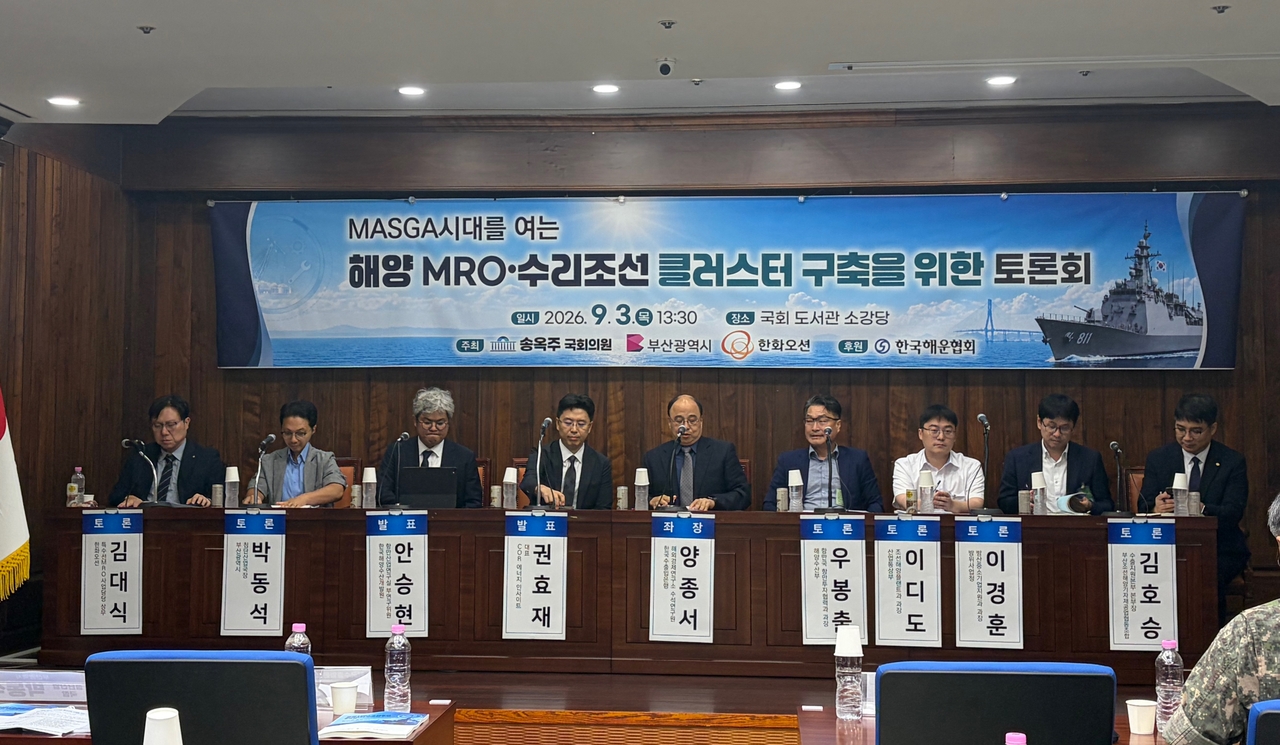
National Assembly forum on maritime MRO and ship repair cluster development
Hanwha Ocean executive calls for post-delivery maintenance contracts, smarter vendor selection
Global naval vessel MRO market forecast to reach $63 billion by 2029
Quality constraints persist amid gaps in regulation, data and supply chain
South Korea needs to build a domestic track record in naval maintenance and overhaul and reform the way contractors are selected for outsourced Navy repair work if it wants to compete in the global warship maintenance, repair and overhaul market, an industry executive said Thursday.
Kim Dae-sik, executive director for special vessel MRO business at Hanwha Ocean, made the remarks during the general discussion session of a forum on building a maritime MRO and ship repair cluster for the MASGA era, held at the National Assembly Library. He put forward five specific recommendations: pursuing post-delivery maintenance contracts for the next-generation destroyer program (KDDX); reforming the contractor selection process for Navy-outsourced maintenance work; establishing a legal basis for sharing military data to enable smart and remote maintenance; strengthening the spare-parts supply chain through expanded domestic production and a 3D-printing infrastructure; and supporting the development of dedicated repair shipyards to boost vessel maintenance activity.
Naval MRO market seen growing from $57 billion in 2024 to $63 billion by 2029
According to market research firm Mordor Intelligence, the global naval vessel MRO market is projected to grow from $57 billion in 2024 to $63 billion by 2029. Across a warship's total life cycle, depot-level maintenance accounts for an estimated 60 percent of costs, materials 22 percent, and unit maintenance and repair costs 9 percent each — meaning MRO spending over a 30-year operational period is comparable in scale to the original construction cost. The bulk of maintenance work arises after delivery, making it essential to design maintenance considerations into the construction phase from the outset.
The naval MRO market is also seeing a sustained expansion in long-term, high-complexity maintenance work, and price-based competition alone is insufficient to ensure quality. Effective life-cycle management requires access to military-held maintenance records and data on discontinued parts. While the industry has established a basic operational foundation, regulatory support is needed before Korean firms can sharpen their competitive edge in the global maritime MRO sector. Kim said constraints exist across four areas: regulation, data, supply chain and infrastructure.
On the regulatory side, there is currently no legal basis or budget for post-delivery maintenance contracts, and the absence of a domestic track record puts Korean firms at a disadvantage when bidding on export projects. Kim also flagged concerns that the current lowest-price bidding structure could allow underqualified contractors to enter the market. Restrictions on sharing military data with outside parties were cited as a barrier to obtaining the information needed for smart maintenance systems. Kim further noted that there are no mechanisms to address discontinued or long-lead-time parts, and that gaps in dry-dock certification, security zone requirements and shore power facilities limit industry participation in maintenance work.
'Korea must build domestic track record and reform outsourcing contractor selection'
Kim outlined five key recommendations to address these challenges. He said developing a total life-cycle maintenance business model through collaboration between shipyards and the military is essential to securing national competitiveness in warship maintenance.
"It would be effective to run the KDDX post-delivery maintenance program as a pilot project," he said. "MRO is one of the critical factors in warship export deals." He noted that in Canada's next-generation submarine program, known as CPSP, maintenance budgets accounted for more than half of the total project value. "The best approach is to have the Navy commission maintenance work to shipyards so they can build up experience," he added. "Building up a track record quickly and packaging it is what matters."
Kim said the contractor selection process for outsourced Navy maintenance work also needs to be reformed. Under the current system, there are no evaluation criteria for factors that benefit the military and local communities — such as investment in advanced maintenance technology or the expansion of regionally based personnel and facilities — and contracts are awarded through simple lowest-price competition, making it difficult to align with the direction needed to build MRO competitiveness. He recommended expanding the use of proposal-based evaluation tailored to the scope of each contract, raising the weight given to technical assessments within the eligibility review criteria set out in the Enforcement Decree of the State Contracts Act, and incorporating maintenance track records into the scoring system.
'Government should strengthen spare-parts supply chain and expand dedicated repair shipyard capacity'
Kim also proposed establishing a legal basis for sharing military data needed to apply advanced maintenance technologies. Such technologies presuppose access to relevant data including technical drawings and maintenance histories, but current military security regulations restrict the provision of that data to outside parties, limiting the on-site application of advanced technologies. He recommended adding a provision to the Defense Security Operations Directive that allows data to be shared with maintenance contractors, and called for procedures to be put in place for applying the relevant technologies and equipment.
Kim also called for strengthening the spare-parts supply chain. "Warships are produced in small batches across many variants, which means low-demand parts must be continuously supplied for 30 to 40 years — leading to frequent delivery delays, price increases and discontinuations," he said. "Resolving this is critical to the MRO business." To that end, he proposed designating discontinued and long-lead-time materials as priority items under Article 9 of the Defense Industry Development Act, and introducing certification and procurement procedures for 3D-printed parts in relevant laws and regulations, including the Defense Acquisition Program Administration's component localization development management rules.
Finally, Kim said the government should expand facilities at dedicated repair shipyards. "If the government encourages small and mid-sized shipyards to upgrade their facilities and builds new dedicated repair shipyards, a great deal of competitiveness will follow," he said. Expanding this maintenance infrastructure, he added, would allow the industry to meet both domestic and overseas maintenance demand while revitalizing the regional ship repair sector.

keg@heraldcorp.com