Interview with David Hsieh, Omdia's Taiwan display chief
China's OLED tech gap narrows from 5 years to 2-3 years
Korea retains edge in high-end market with Apple
Beijing's subsidies shift to semiconductors, constraining OLED scale-up
Analyst urges faster tech innovation and Gen 8.6 investment
Glass substrates seen as next growth area from around 2028
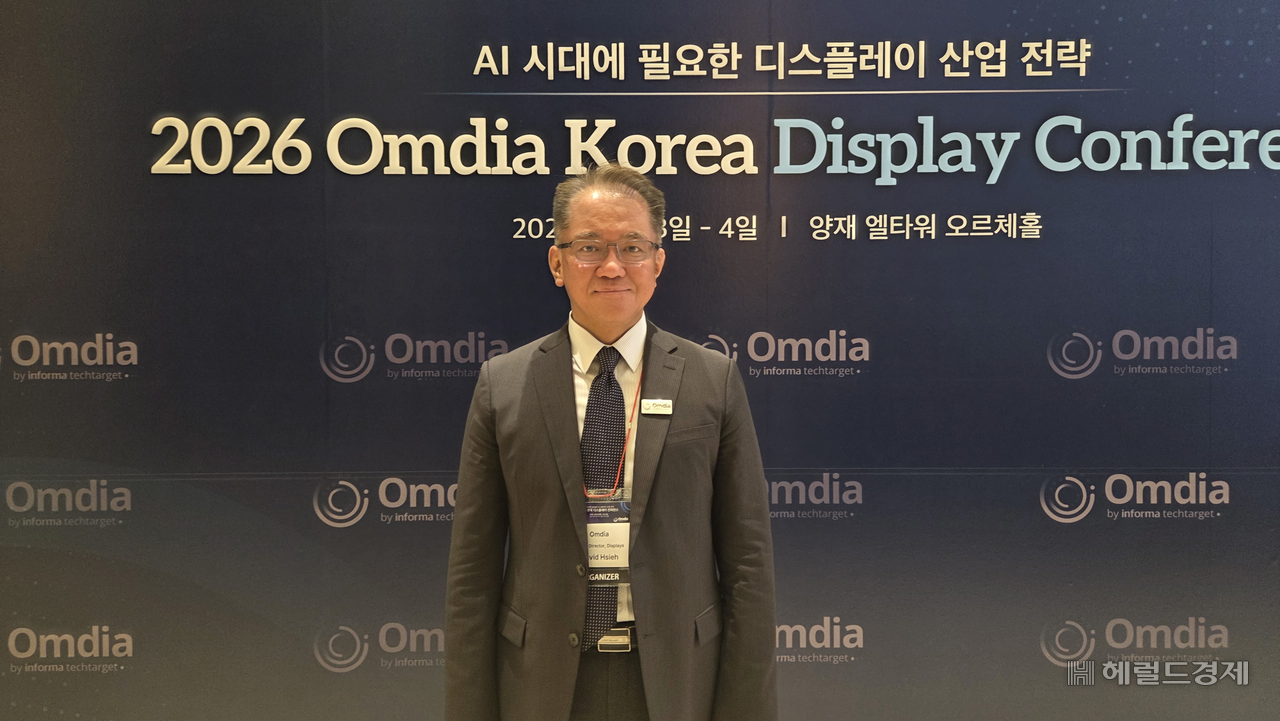
"OLED is different from LCD, which China's government nurtured with massive subsidies. Beijing's attention has now shifted to semiconductors. It will be very hard for China to expand its OLED production capacity as aggressively as it did with LCD. This is an opportunity for Korea."
David Hsieh, head of display research at Omdia's Taiwan office, said Thursday that Korea would not easily cede leadership in OLED to China. He made the remarks at the Omdia Korea Display Conference 2026, held at L Tower in Yangjae, Seoul.
Hsieh is a founding member of DisplaySearch and has analyzed the display industry for more than 24 years. He worked in sales and engineering at Hitachi and at Taiwanese panel maker HannStar before dedicating himself to market research from 2002.
Korea began losing its grip on the LCD market to China in the mid-2010s. Chinese manufacturers, backed by large-scale government support, aggressively expanded production capacity, triggering oversupply and sustained price declines. China seized control of the large-size LCD market around 2019 and surpassed a 50 percent share of the overall LCD market by 2021.
As profitability deteriorated sharply, Korean manufacturers scaled back and exited. Samsung Display halted LCD production entirely in 2022, and LG Display sold its LCD factory in Guangzhou, China, last year, effectively withdrawing from the large-size LCD business.
But the OLED market is a different story, Hsieh said. "Looking at the next five years, I think it will be very difficult for China to surpass Korea in total OLED shipments," he said. "Samsung Display and LG Display will continue to hold leading positions."
The key difference is profitability. "Korean companies exited LCD because China's capacity expansion created oversupply and made it impossible to turn a profit," Hsieh said. "In OLED, both Samsung Display and LG Display are profitable and continue to invest in technology development."
Chinese OLED makers, by contrast, have yet to escape the red. According to Omdia, major Chinese players including BOE, CSOT, Tianma and Visionox are not generating profit from OLED. Some are estimated to be running OLED operating margins of negative 40 percent, funding their OLED operations with cash and profits from LCD.
The government support environment has also changed since the peak of the LCD investment race. "Subsidies for the display industry still exist, but they have fallen sharply compared with the past," Hsieh said. "China's government support is now concentrated on the semiconductor industry, and there is nothing like the large-scale backing for new LCD fab construction that we saw before."
Tech gap narrows from 5 years to 2-3 years
China closes in on OLED, but Korea holds high-end edge
Investment must accelerate to stay ahead
Hsieh identified technology as the key to Korea maintaining its OLED leadership. "Chinese OLED manufacturers are still at least two to three years behind Korean companies technologically," he said. The gap has narrowed from roughly five years, he noted, but a meaningful difference remains.
He singled out OLED process know-how and product design capability as the areas China finds hardest to close. "Korean companies are consistently advancing product specifications — active privacy view, foldable displays, under-display cameras, under-display fingerprint sensors and other features," he said. "That continuous technological progress is helping to sustain a certain gap between Korean and Chinese OLED makers."
The Apple supply chain is another key line of defense for Korean OLED. BOE is pushing to enter the iPad OLED supply chain beyond the iPhone, but Korean manufacturers still hold a clear advantage in the high-end segment, Hsieh said.
"There is a possibility that BOE could become an OLED supplier for the iPad Air, but nothing has been confirmed," he said. "Apple's move to diversify its supply chain and secure alternative sources is a natural strategy."
He went on to say that "if Korean companies continue to lead OLED supply for high-end products — the iPhone, iPad Pro, MacBook Pro and MacBook Air — it will be difficult for Chinese makers to significantly grow their market share." Asked whether Apple represents a strength for the Korean OLED industry, he was direct: "Yes. Apple is very important to Korean OLED companies."
According to Omdia, Samsung Display held a 55 percent share and LG Display 20 percent of the iPhone panel supply chain in 2023; by 2026, those figures had grown to 60 percent and 30 percent, respectively. Korea's technological ability to stably supply the high-specification products Apple demands remains overwhelming, Hsieh said.
China's pace of catch-up is nonetheless formidable. In Gen 8.6 OLED capacity for mobile and PC applications, China is expected to account for 70 percent and Korea 30 percent by 2028. BOE is advancing its B16 fab, Visionox its V5 Gen 8.6 OLED facility, and CSOT is preparing to invest in Gen 8.6 OLED based on inkjet printing. Their long-term ambition is to extend into large-size displays, much as they did with OLED TV.
Against that backdrop, analysts warn that Korea cannot afford to slow its own investment. Samsung Display has moved early on Gen 8.6 IT OLED, but LG Display has yet to commit to major new investment.
"The long-term growth potential of OLED is far better than LCD," Hsieh said. "From the perspective of investing for the future, now is the time to invest."
He added that China "is clearly a very strong competitor and will keep pressing Korea," but said the most important thing for Korean companies to maintain their leading position is technological innovation. "As long as technology development and fab investment continue, it will not be easy for China to replace or surpass Korea," he said.
Hsieh also said development work is needed in glass substrates, a next-generation technology. "Display makers can extend the large-area glass processing, deposition and inspection expertise they have built up over many years into semiconductor packaging," he said. "There are still many technical bottlenecks to overcome, so mass production this year or next year will be difficult, but I expect meaningful growth in the advanced packaging glass substrate market to emerge around 2028. Preparation needs to start now."

go@heraldcorp.com