
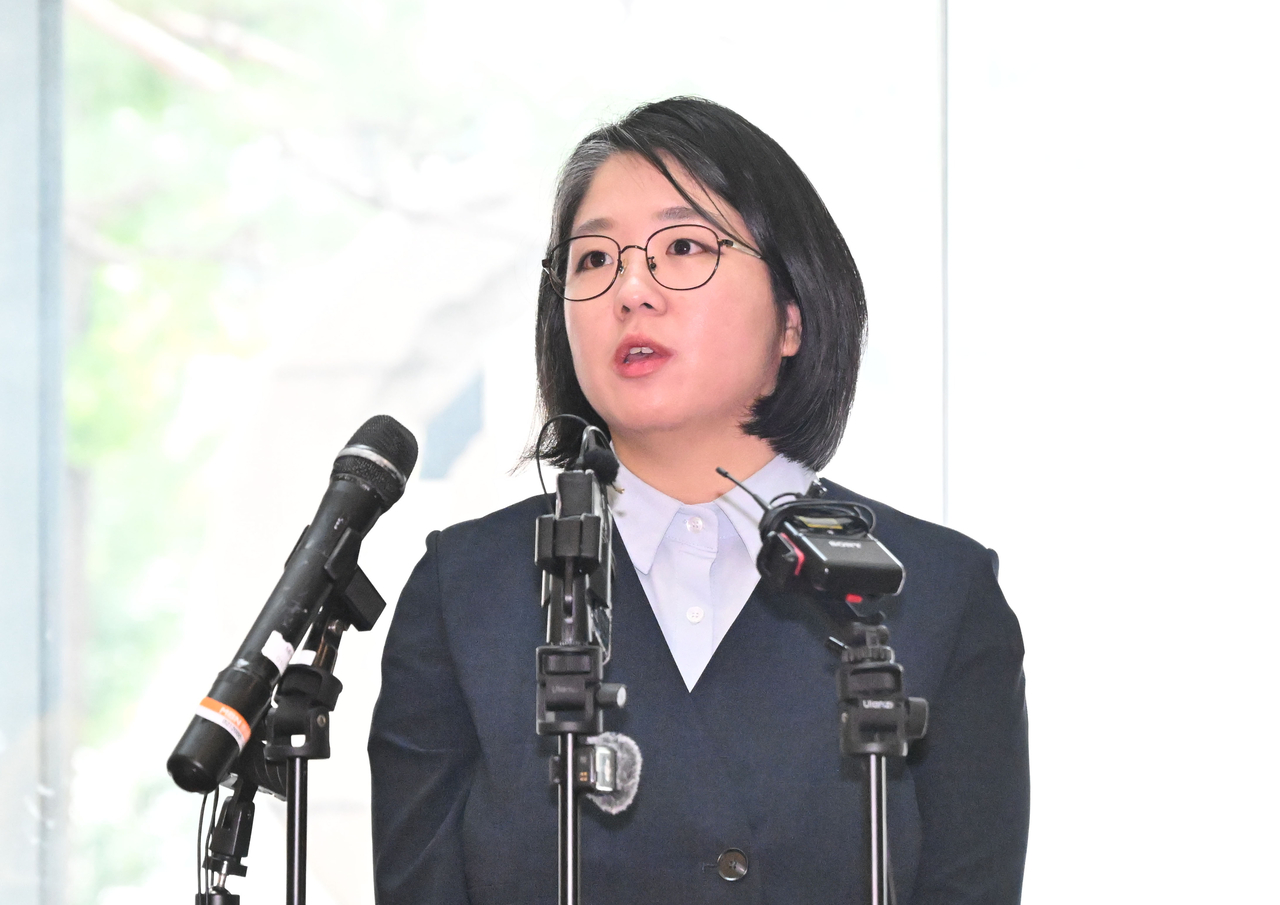
![Yong Hye-in, nominee for minister of gender equality and family, answers reporters' questions as she arrives at her confirmation hearing preparation office at the Korea Youth Activity Promotion Agency in Seodaemun-gu, Seoul, on Wednesday. [Photo by Lim Se-jun]](https://wimg.heraldcorp.com/news/cms/2026/09/04/news-p.v1.20260902.4480aa0ca81f4754ac4b9240d4c7db5d_P1.jpg)
Yong Hye-in, a Basic Income Party lawmaker nominated as minister of gender equality and family, is drawing criticism for saying she will keep her proportional-representation seat after taking the cabinet post — a move critics say is aimed at protecting her party's state subsidies. The backlash is sharpened by the fact that six years ago Yong herself compared parties that receive state subsidies to parasites and called for the subsidies to be abolished.
According to political sources, the Basic Income Party posted a press release and photos on its website in February 2020 under the title "Abolish the state subsidies that mass-produce parasite parties and introduce a political basic income."
Photos from the event showed Yong holding a sign reading "Abolish state subsidies and introduce a political basic income," standing alongside other participants in front of an image that parodied the poster for the film "Parasite."
In the press release, the party argued that "parasite politics targeting state subsidies keeps repeating itself," adding that "particularly ahead of elections, many political forces calculate their subsidy entitlements and form or dissolve alliances accordingly."
The party went on to say the solution was to "replace parasite politics — where parties split and merge based on subsidies — by distributing state subsidies directly to citizens and introducing a political basic income of 100,000 won ($74) per year so people can participate in politics directly."
Just six years later, however, Yong is taking a position that directly contradicts that stance.
While it is customary for proportional-representation lawmakers to resign their seats upon being appointed to the cabinet, Yong said she intends to serve as minister while retaining her Assembly seat. "If I resign, the Basic Income Party faces the hardship of becoming an extra-parliamentary party," she said.
Yong won re-election as a proportional representative on the ticket of the Democratic Party of Korea's satellite party. Because she is the Basic Income Party's sole Assembly member, her resignation would transfer the seat to a Democratic Party member rather than a Basic Income Party one, leaving the Basic Income Party without parliamentary representation.
The Basic Income Party received 277 million won in subsidies last month after winning 0.99 percent of the proportional vote in the June 3 local elections. If it retains its parliamentary status, it will continue to receive that subsidy every quarter through the next local elections. Should it lose parliamentary status, it would receive nothing.
Ultimately, if Yong keeps her seat, the regular subsidies and election subsidies the Basic Income Party stands to receive over the remainder of her term are estimated to exceed 2.9 billion won.
People Power Party lawmaker Kim So-hee calculated the figures based on data obtained from the National Assembly Secretariat and the National Election Commission. Under her estimate, the Basic Income Party would receive about 1.94 billion won in regular subsidies over the remaining 21 months of the term if Yong retains her seat. Adding the more than 1 billion won in election subsidies projected for the 2028 general election, party subsidies alone would surpass 2.9 billion won.
The total grows further when the budget for operating Yong's Assembly office is included.
Kim's office estimated that staff salaries and operating costs for the Assembly office over the remaining term would amount to about 1.1 billion won, bringing the total public funds that would be spent if Yong keeps her seat to approximately 4.3 billion won.
Meanwhile, opposition lawmakers criticized Yong as a hypocrite.
People Power Party lawmaker Jo Ji-yeon said Yong's conduct was "a textbook case of hypocrisy and the height of political double standards — crying out for justice and reform in public while quietly enjoying the very benefits of the system they once criticized."
yeonjoo7@heraldcorp.com





