Levy hits 160.25 billion won in 2024, up 111.65 billion won over four years
Number of agencies incurring levy more than doubles, from 88 to 187
Last year's compliance rate stands at 44.1%, just 2 percentage points above private sector
Stricter quotas demand stronger hiring plans and tighter oversight of lagging agencies
![Employment and Labor Minister Kim Young-hoon speaks at a field consultation on standard workplaces for people with disabilities, held at Ewha Seoul Hospital in Gangseo-gu, Seoul. [Ministry of Employment and Labor]](https://wimg.heraldcorp.com/news/cms/2026/09/04/rcv.YNA.20260605.PYH2026060514810001300_P1.jpg)
The government, which is supposed to lead the way on disability employment, is failing to meet its own mandatory hiring quotas within the civil service.
The disability employment levy — charged when agencies fall short of the legal quota — has grown roughly 3.3-fold in four years, surpassing 160 billion won ($118 million) in 2024. More than half of all subject agencies missed their quotas last year. The effectiveness of the government's hiring and oversight measures for enforcing the standards it sets is now under scrutiny.
According to data submitted by the Ministry of Employment and Labor and published Friday in the National Assembly Research Service's "2026 National Audit Issue Analysis," the disability employment levy for the government civil service sector rose from 48.59 billion won in 2020 to 160.25 billion won in 2024 — an increase of 111.65 billion won, or 229.8 percent, over four years.
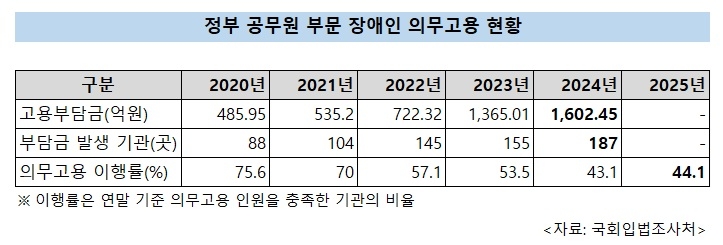
The number of agencies incurring the levy also grew over the same period, rising from 88 to 187 — an increase of 99 agencies. Both the total levy and the number of agencies paying it climbed together, reflecting a widening gap between legal requirements and actual hiring across the public sector.
The disability employment levy is a statutory charge imposed on employers that fail to meet their mandatory hiring quota for workers with disabilities. It is designed to equalize the economic burden between employers who hire people with disabilities and those who do not, while encouraging additional hiring. The true measure of the system's success lies not in the size of the levy itself, but in how much of the shortfall is actually filled.
Yet the compliance rate for the government civil service sector fell 31.5 percentage points, from 75.6 percent in 2020 to 44.1 percent in 2025. The rate measures the share of subject agencies that met their mandatory quota by year-end. Last year, 55.9 percent of subject agencies failed to meet the legally required headcount.
The annual compliance rate declined steadily: 70.0 percent in 2021, 57.1 percent in 2022, 53.5 percent in 2023 and 43.1 percent in 2024. The rate edged up 1.0 percentage point from the previous year in 2025, but remained below 50 percent for the second consecutive year.
Compared with the private sector, the government's performance is hardly exemplary. Private companies posted a compliance rate of 42.1 percent last year, leaving the gap with the civil service sector at just 2.0 percentage points. Public institutions recorded a rate of 70.0 percent, and the government worker sector — a separate category from civil servants — reached 88.9 percent. Even within the broader public sector, the civil service stands out for its poor compliance.
The impact of a tightened legal quota deserves separate consideration. The Ministry of Employment and Labor has cited the increase in the mandatory employment rate — from 3.4 percent to 3.6 percent since 2022 — as a factor behind the declining compliance rate in the civil service sector. When the benchmark rises, agencies can fall short of the required headcount even if the number of civil servants with disabilities stays the same or grows.
That makes targeted hiring plans all the more important. The purpose of raising the mandatory rate was to open more jobs to people with disabilities. As the bar has been raised, so too has the government's responsibility to manage each agency's hiring plans and track whether vacancies are actually being filled.
The causes behind the levy increase also warrant closer examination. The combined effect of changes to the mandatory rate and the levy calculation formula — alongside agency-by-agency trends in the shortfall — must be assessed together. Agencies that repeatedly fall short, in particular, need to identify at which stage of the hiring process positions go unfilled and connect that finding to concrete remedial action.
If paying the levy becomes an accepted substitute for meeting the hiring quota, the system's incentive to actually employ people with disabilities will inevitably weaken. This concern applies to government agencies no less than to private companies. Evaluating whether the system is working properly requires tracking whether actual hiring increases after the levy is imposed.
If the government wants to press the private sector to hire more people with disabilities, it must first raise compliance within its own civil service.
The National Assembly Research Service urged the government to "link each agency's shortfall, hiring plan and actual recruitment results in a unified management system, and clarify the accountability of agencies that repeatedly fall short." It added that "whether the growing levy is translating into broader access to public-sector jobs for people with disabilities must be placed at the center of policy evaluation."
fact0514@heraldcorp.com