Unions demanding performance bonuses tied to operating profit push back against Ministry of Employment and Labor guidelines
HD Hyundai Heavy union says demand is about welfare, not bonuses
Shinsegae union argues bonuses count as wages subject to mandatory bargaining
Business lobby calls for clearer rules on which bonuses qualify as wages
![Members of the Korean Confederation of Trade Unions hold a press conference Friday in front of the Seoul Regional Employment and Labor Office in Jung-gu, Seoul, denouncing the Ministry of Employment and Labor's implementation guidelines on the scope of legitimate labor disputes. [Yonhap]](https://wimg.heraldcorp.com/news/cms/2026/09/04/rcv.YNA.20260904.PYH2026090405310001300_P1.jpg)
Unions at major conglomerates demanding performance bonuses tied to a percentage of operating profit are pushing back against government guidelines calling for voluntary negotiations, with several vowing outright opposition and signaling they will hold firm on their existing demands in this year's wage and collective bargaining talks. The unions maintain that companies remain obligated to bargain over the issue, while the business community warns that legal disputes and workplace confusion over performance bonuses will persist as some unions advance their own interpretations of the guidelines.
HD Hyundai Heavy union: demand is about sharing profit through welfare, not bonuses
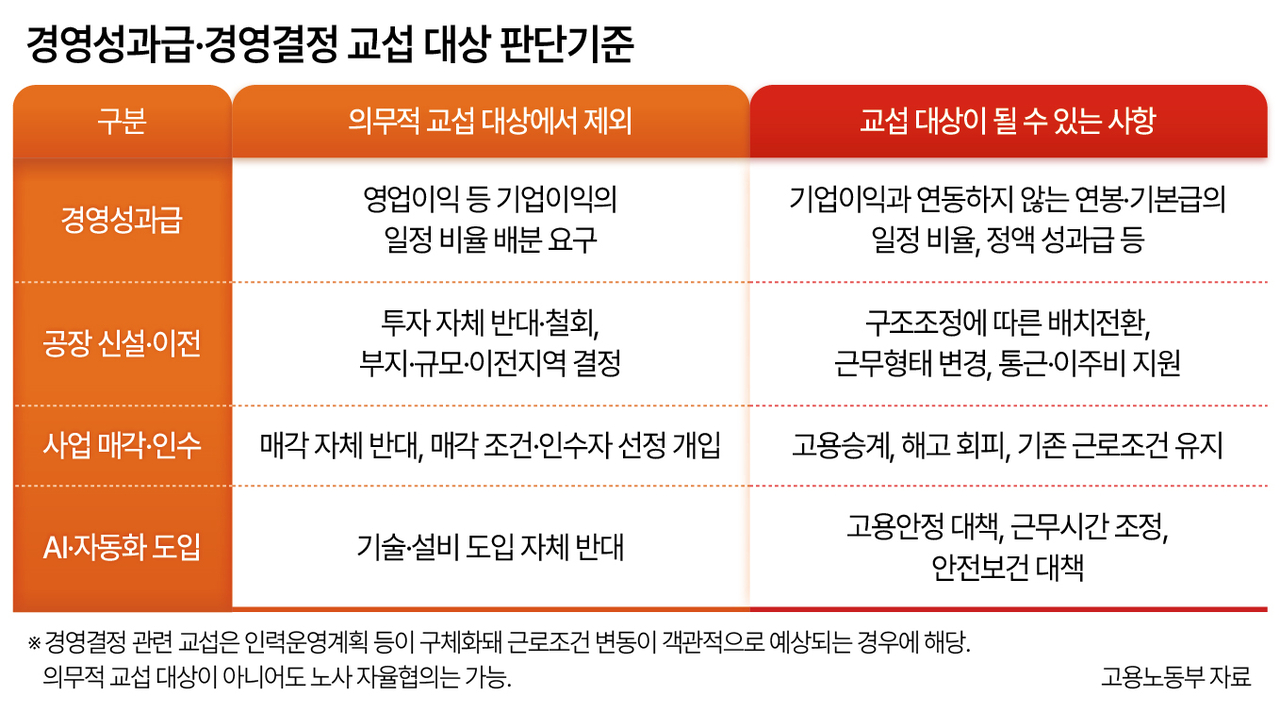
The union at HD Hyundai Heavy Industries, currently in wage and collective bargaining talks with the company, plans to maintain its demand that at least 30 percent of annual operating profit be shared with union members. The union says the Ministry of Employment and Labor's guidelines — which state that companies are not obligated to bargain over demands to distribute a fixed share of operating profit as bonuses — do not apply to its case.
A union official said the core demand is not simply that operating profit be paid out as performance bonuses, but that it be distributed in various forms, including base pay increases and improved welfare benefits.
The ministry said it cannot immediately determine whether the HD Hyundai Heavy Industries union's position is consistent with its implementation guidelines under the so-called yellow envelope law. A ministry official said the government would review the merits of the union's stance if a labor dispute arises.
Shinsegae union: court precedents show bonuses can count as wages
![Ministry of Employment and Labor [Herald DB]](https://wimg.heraldcorp.com/news/cms/2026/09/04/news-p.v1.20260612.a451308949fd41ed94d03a0d1cfebaad_P1.jpg)
The Shinsegae union is also holding firm on its demand that 15 percent of operating profit be paid out as performance bonuses, arguing that bonuses constitute part of wages.
That stance directly contradicts the ministry's guidelines, which draw a distinction between wages — over which companies must bargain — and performance bonuses, which they do not. The ministry's position is that performance bonuses involve not only labor and management but also shareholders, bondholders and the state, making mandatory bargaining inappropriate.
The Shinsegae union, however, says it cannot accept the guidelines given that courts have reached conflicting conclusions on whether performance bonuses qualify as wages. A union official argued that numerous court rulings have found bonuses to constitute wages, particularly at large companies where bonuses are paid on a regular basis and therefore take on the character of wages.
Court rulings on whether performance bonuses count as wages have varied by company. A notable case came in January, when the Supreme Court ruled in a Samsung Electronics severance pay lawsuit that "performance incentives" — which fluctuate based on business results — do not constitute wages, while "target incentives" paid upon achieving set performance goals do. By contrast, the Supreme Court ruled in 2018 and 2015 that performance bonuses at Korea Airports Corporation and the Korea Real Estate Board, respectively, did qualify as wages in severance pay disputes involving those state-run entities.
Most unions that have demanded performance bonuses tied to a percentage of operating profit in this year's wage and collective bargaining talks are expected to hold their ground. Korea Zinc's union, which is seeking a 10 percent share of operating profit, said its demands remain unchanged. LG Uplus and HD Hyundai Samho, both of which have demanded 30 percent of operating profit, have not issued separate statements.
Legal battles over percentage-based bonus strikes seen as inevitable; business lobby urges clearer guidelines
![SK hynix union members hold a rally last August demanding performance bonuses tied to operating profit. [Yonhap]](https://wimg.heraldcorp.com/news/cms/2026/09/04/news-p.v1.20260814.eef59a9c9c40483ba4443a749e36a5c8_P1.png)
With unions continuing to press their profit-sharing demands even after the government issued its implementation guidelines under the yellow envelope law, confusion in this year's corporate wage and collective bargaining talks appears unavoidable.
The Korea Enterprises Federation acknowledged that, as the Shinsegae union argues, there may be cases in which even performance bonuses fall within the scope of mandatory bargaining. In a statement released shortly after the guidelines were announced Thursday, the federation said it was concerned the guidelines could deepen workplace confusion by failing to specify under what circumstances performance bonuses qualify as wages or working conditions, even as the ministry acknowledged that bonuses vary in type and legal character.
The ministry plans to treat any strike launched under the banner of demanding percentage-based performance bonuses as illegal, on the grounds that such demands do not fall within the scope of mandatory bargaining, and intends to reject any dispute filings unions submit before striking. However, concerns remain that workplace disputes will continue regardless, as unions are expected to challenge the illegal-strike designation in court.
A business community official warned that courts could apply different standards and find that a strike was not illegal even where ministry guidelines say otherwise, ultimately prolonging labor-management conflict despite the guidance.
klee@heraldcorp.com
chami@heraldcorp.com