![Elon Musk, CEO of SpaceX [Reuters]](https://wimg.heraldcorp.com/news/cms/2026/09/04/news-p.v1.20260625.f5259077b9d64c549fb3ef5d81350979_P1.jpg)
SpaceX was the most heavily bought overseas stock among Korean retail investors over the past month. After the share price slipped below its IPO price of $135 last month and spent weeks trading sideways in the $130–$140 range, investors interpreted the weakness as a bargain-buying opportunity and moved in aggressively.
SpaceX Class A shares topped the net purchase rankings among Korean retail investors for the one-month period from Aug. 3 to Sept. 3, according to data released Friday by the Korea Securities Depository's SEIBro portal. Net purchases reached $333.64 million over the period.
Alphabet Class A shares came in second at $327.12 million, followed by the Vanguard S&P 500 ETF at $249.03 million.
As of Wednesday, Korean retail investors held $2.27 billion worth of SpaceX shares, ranking the stock 20th by custody value among all overseas holdings. Despite being listed for less than three months, SpaceX has already established itself as a signature overseas investment for Korean retail investors.
Korean retail investors moved particularly aggressively when SpaceX shares fell sharply. The stock surged 19.22 percent above its $135 IPO price to close at $160.95 on its first trading day, June 12, and at one point climbed as high as $225.64 — before tumbling to an intraday low of $104.83 on Aug. 3, roughly half its peak.
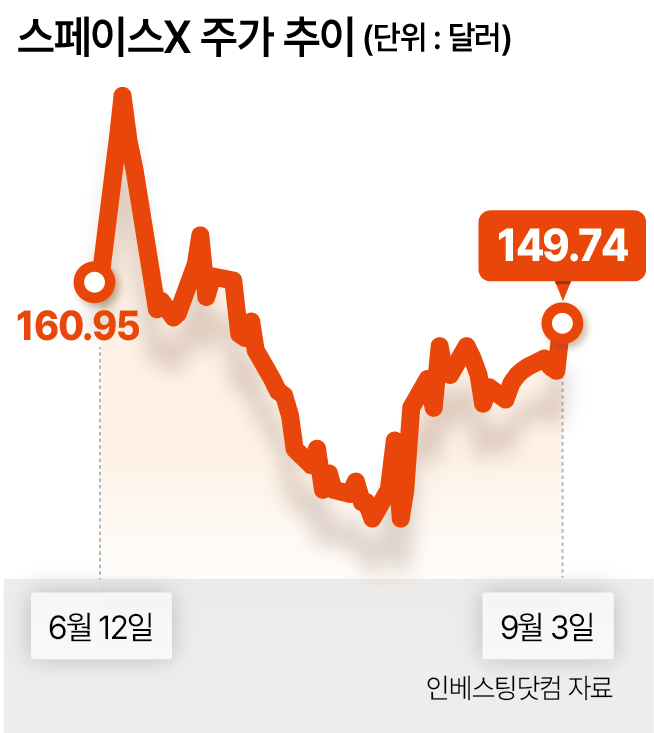
The stock subsequently settled into a $130–$140 trading range. On Thursday, however, shares jumped 6.4 percent to close at $149.74, stoking expectations of a return above the $150 level.
Two catalysts appeared to drive the move: the 14th test flight of the Starship mega-rocket, scheduled for mid-September, and a price-target increase by an Oppenheimer analyst on Wall Street, who raised the target from $250 to $280.
SpaceX operates across three business segments — launch, connectivity (satellite communications) and AI. Last year, those segments accounted for roughly 22 percent, 61 percent and 17 percent of total sales, respectively.
Analysts have been paying particular attention to SpaceX's AI business. Although it remains a heavy cash consumer, the segment is widely seen as the key long-term driver of the company's valuation.
SK Securities estimates SpaceX's sales this year will reach $43.6 billion, up 133.5 percent from a year earlier. Within that total, the AI segment is projected to surge 564.6 percent to $21.3 billion — surpassing the connectivity segment's $18.1 billion for the first time.
A potential merger with Tesla, the electric vehicle company also run by SpaceX CEO Elon Musk, is seen as another variable that could shape the stock's trajectory. Musk previously merged X and startup xAI in 2025, then folded xAI Holdings under SpaceX this year, effectively tying the three companies together. Prediction market platform Kalshi puts the probability of a Tesla-SpaceX merger by next year at 60 percent.
"If a merger goes through, it would most likely take the form of SpaceX acquiring Tesla," said Han Sang-won, an analyst at Toss Securities. "Musk holds only about 20 percent of voting rights at Tesla but around 85 percent at SpaceX. If SpaceX acquires Tesla, he could maintain roughly 75 percent voting control — but if it went the other way, that figure would drop to around 35 percent, based on late-August closing prices."
Concerns about profitability remain, however. "If SpaceX continues to simultaneously fund both its space business and its new data center operations, the path to profitability could be pushed back further," said Jo Jae-un, an analyst at Daishin Securities.
jiyun@heraldcorp.com