
HS division head Baek Seung-tae holds press briefing at IFA 2026 on Saturday
Robot actuator sales expected to grow as large as compressor business
60 years of motor technology underpins efficiency, cost competitiveness
Chinese rivals' low-price push losing steam; LG responds with flexible production
Exchange rates, logistics costs now treated as constants, not variables
LG defends IFA's value, citing B2B deal-making as key differentiator
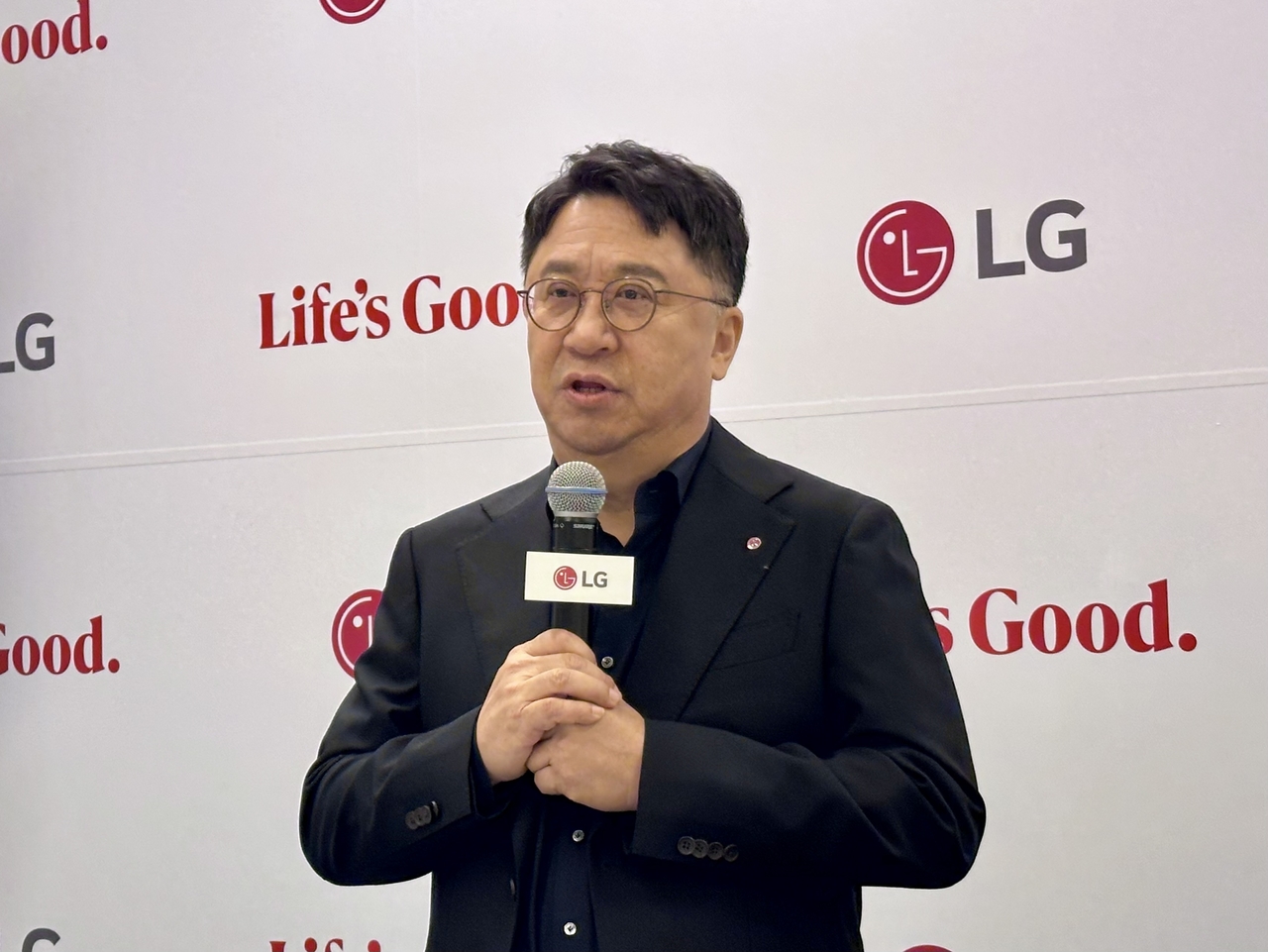
"We are in active talks with several big-tech companies over actuator orders. Nothing is finalized yet, but we have only a final meeting left with one particular company next month, and I am eager to share the news as soon as possible."
Baek Seung-tae, head of LG Electronics' HS business division, delivered that message at a press briefing held Saturday (local time) at the IFA 2026 venue in Berlin. LG Electronics hopes its robot actuator sales will grow within one to two years to rival those of its air-conditioner compressor business — a component segment that has already firmly established itself as a core revenue driver.
LG Electronics earlier this year launched LG AXIUM, a dedicated actuator brand for robots, drawing on six decades of motor and drive-control technology and core component design expertise built up through its home appliance business. The company plans to complete a fully automated actuator mass-production line at its Changwon factory before the end of this year and launch full-scale order activities.
Industry observers expect humanoid robot demand to reach an inflection point from 2030, when adoption is forecast to move beyond industrial settings and into homes in earnest. LG Electronics plans to sharpen its component technology in step with that timeline.
"The key components of an actuator are the motor that generates force, the reducer that transmits it, and the driver that controls it," Baek said. "Because we have ultra-high-speed motor technology capable of exceeding 100,000 RPM, we can produce motors that are more than 30 percent lighter and smaller than those of our competitors." He said the company has secured both high efficiency and cost competitiveness.
However, he acknowledged that the company has yet to secure reducer technology. "We are drawing up plans both to develop it in-house and to source it externally," he added.
At IFA 2026, LG Electronics drew visitors' attention by having its home robot LG CLOi conduct an AI-powered orchestra performance. CLOi runs on wheel-based autonomous driving technology. LG Electronics said it is preparing for all form factors — not only wheeled robots but also the bipedal robots more familiar to the general public.
"Both wheel-type and bipedal-type robots have their pros and cons," Baek said. "A robot assembling products on a washing machine production line has no need for legs or a head, so we are preparing a full range of robot forms depending on the operating environment." He added that while the robot business is being led at the company-wide level, the HS division is specifically responsible for actuators.
Baek also shared his views on Chinese home appliance companies rapidly closing the gap with Korean rivals through aggressive low pricing. "China's top three home appliance makers had been achieving cost reductions of 10 percent every year, but in the first half of this year their costs actually rose," he said. "Chinese companies will not be able to sustain a low-price offensive indefinitely if they want to grow their global market share."
LG Electronics, by contrast, has grown stronger fundamentally, Baek said. "We have made many changes to our supply chain to compete with Chinese brands and have also leveraged the Chinese ecosystem," he said. "Through flexible adjustments across our 12 production bases in 10 countries worldwide, our underlying strength has been steadily improving."
Beyond competition from Chinese companies, external uncertainties such as exchange rate swings and fluctuations in maritime freight costs also remain. "Exchange rates, raw material costs and logistics costs are variables in our business, but we now treat this kind of volatility as a constant," Baek said. "We are managing the risk through supply chain diversification and production-site adjustments."
He added that the company had expected the Shanghai Containerized Freight Index to fall from the third quarter onward, but that a tug-of-war between shipowners and cargo owners appears to be continuing. "We expect logistics costs to come down from the fourth quarter in line with supply-and-demand principles," he said.
Meanwhile, ahead of IFA 2026, questions arose about whether the trade show's standing had diminished after Samsung Electronics left the main Messe Berlin exhibition hall to set up a separate venue in the city center. LG Electronics, however, maintained that IFA's status remains as strong as ever and said it has no intention of leaving the show.
"What sets IFA apart from other trade shows is the opportunity to hold consultations with business partners," Baek said, adding that LG Electronics plans to continue attending. With the company pushing into the European built-in appliance market under its ultra-premium SKS and mass-premium LG Signature brands, there is no reason to walk away from IFA — especially as it looks to expand its B2B business.
jeongwan@heraldcorp.com





