Most heads of state energy firms under Lee government are political appointees with little sector expertise
Five power generation companies set to merge, forcing staff to relocate again after 2014 regional move
Dispersal of public agencies to regions seen as creating patronage posts for local politicians
As the Lee Jae Myung government moves to consolidate 109 public institutions, observers widely expect a sweeping replacement of executives appointed under the previous administration. As of the first quarter of this year, the total number of executives across all public institutions stood at roughly 3,500.
The government has pledged to guarantee 100 percent employment continuity for the approximately 120,000 workers at the 109 institutions slated for consolidation, covering both permanent and indefinite-contract employees.
While the government has drawn a clear line insisting the consolidation is not driven by cost-cutting, officials in government circles have raised questions about whether the real aim is to legally replace executives appointed under the previous administration.
According to government sources, the Ministry of Economy and Finance announced Thursday that it would reduce the number of public institutions from 524 to 415 by merging or dissolving 109 of them. The process is expected to eliminate roughly 100 executive leadership positions.
The majority of those facing replacement are believed to be appointees from the Yoon Suk Yeol administration. A survey of 342 public institutions conducted in June by corporate analysis firm Leaders Index found that 226 out of 306 institutions with sitting heads — or 73.9 percent — had chiefs appointed under Yoon.
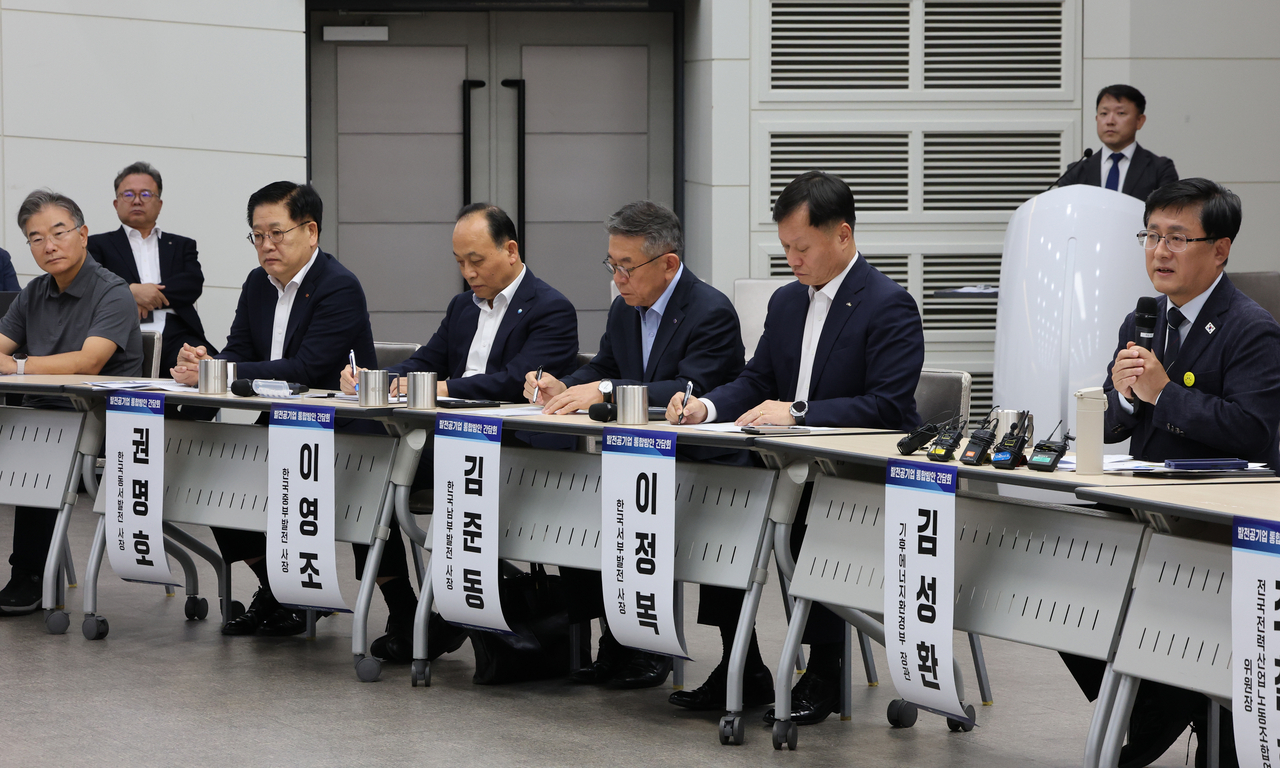
The five power generation companies — Korea South-East Power, Korea Southern Power, Korea East-West Power, Korea Western Power and Korea Midland Power — are expected to see leadership changes first. All four of the five firms that currently have a sitting president appointed their chief under the Yoon administration, and each has more than a year remaining on their term. The Korea South-East Power presidency is currently being filled through an open recruitment process, with only the final announcement pending.
Concerns have also been raised that a single integrated power generation company controlling more than 60 percent of the generation market could undermine fair competition with private power firms and reduce flexibility in the electricity market.
Inside each of the five companies, the question of whether employees will have to relocate after the new headquarters is announced has become the dominant concern. Starting with Korea South-East Power in 2014, the state-owned power firms all relocated their headquarters to regional cities — a move now 13 years in the past. The five companies are currently spread across the country: Korea East-West Power in Ulsan, Korea Western Power in Taean-gun, South Chungcheong Province, Korea Midland Power in Boryeong, South Chungcheong Province, Korea South-East Power in Jinju, South Gyeongsang Province, and Korea Southern Power in Busan.
The government has justified consolidating the five power firms into a single entity under the banner of achieving "economies of scale" and "preemptive responsiveness." It has also expressed hope that merging Korea National Oil Corporation and Korea Gas Corporation will create strong purchasing power in overseas resource development and infrastructure.
The merger of the gas and oil corporations faces a key hurdle: persuading Korea Gas Corporation shareholders. Because the gas corporation is nominally profitable — despite outstanding receivables — its shareholders have little incentive to absorb an oil corporation in a state of complete capital impairment.
The government, Korea Electric Power Corporation and local governments together hold 54.48 percent of Korea Gas Corporation — with the central government at 26.15 percent, Korea Electric Power Corporation at 20.47 percent and local governments at 7.86 percent. Foreign investors and general shareholders hold the remaining 39.05 percent, comprising 10.44 percent and 28.61 percent respectively.
The prevailing view in government circles is that if the oil corporation's 20 trillion won ($14.7 billion) in debt — accumulated amid complete capital impairment — were transferred to the gas corporation, a rise in gas tariffs could not be ruled out. Should the distressed assets be consolidated onto the merged entity's balance sheet, the resulting credit rating downgrade and higher financing costs could ultimately translate into upward pressure on gas prices.
Both the gas and oil corporations fall under the Ministry of Trade, Industry and Energy, but the consolidation plan includes hydrogen and carbon capture, utilization and storage — areas under the Ministry of Climate, Environment and Energy — making coordination between the two ministries necessary.
An official at the Ministry of Climate, Environment and Energy said the ministry only learned of the consolidation plan late in the afternoon on Wednesday — the day before the announcement — and discovered that hydrogen, a policy area under its purview, had been included in the merger of institutions under the Ministry of Trade, Industry and Energy. "There was no consultation or coordination with us during the process," the official said.
There is also growing criticism in government circles that public institution consolidations and regional relocations have done little more than create patronage posts for politicians. Since the Lee government took office, leadership positions at state energy firms have increasingly been filled by political appointees with limited sector expertise.
For the presidency of Korea Electric Power Corporation, headquartered in Naju, South Jeolla Province, former South Jeolla Province Governor Kim Young-rok is considered the frontrunner, while former Democratic Party Assembly member Oh Young-sik is said to be making a last-minute push to overturn the outcome.
Earlier, former Democratic Party Assembly member Hong Eui-rak took office in July as president of Korea Gas Corporation, headquartered in Daegu. At Korea Gas Technology Corporation in Yuseong-gu, Daejeon, attorney Im Jong-seok — who served as head of the election monitoring team at the campaign office of Kang Hoon-sik, then a candidate in the 2016 general election and now chief of staff at Cheong Wa Dae — has been serving as president since April.
Ha Dong-geun, an environmental activist from Seongnam, took office as president of Korea District Heating in April. Korea National Oil Corporation, which is in a state of complete capital impairment and carries annual interest expenses of 650 billion won, is led by Son Ju-seok, a former Democratic Party district committee chairman from Sosa-gu, Bucheon.
The upshot, critics say, is that the regional dispersal of public institutions has turned them into sinecures for local politicians — a trend that raises broader concerns about a decline in the quality of public institution management.
oskymoon@heraldcorp.com