'AI Policy Studies' charts national strategy, public policy and governance for the generative AI era
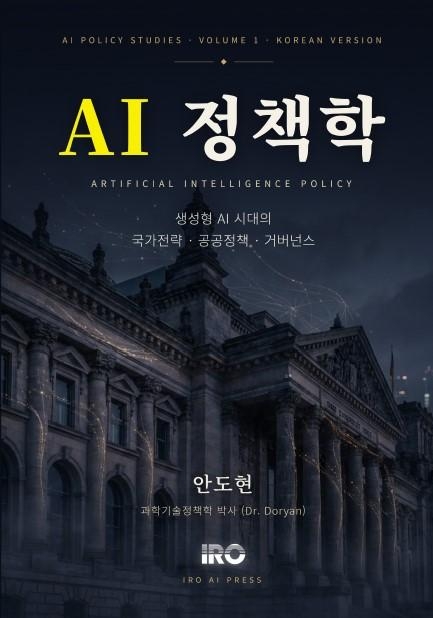
As generative AI rapidly reshapes decision-making in government and business, a new policy handbook has been published that moves beyond the question of how to use AI and asks instead how much of it can be trusted with consequential decisions.
Ahn Do-hyun, a doctor of science and technology policy and a former official at the Incheon Free Economic Zone Authority, has published "AI Policy Studies: National Strategy, Public Policy and Governance in the Generative AI Era."
The book poses three core questions: Should governments and companies accept AI-generated decisions at face value? Who bears responsibility when errors occur? And are citizens affected by AI-driven rulings guaranteed a meaningful right to appeal?
Current government-level AI training for civil servants has focused largely on practical skills — writing prompts, summarizing reports and drafting responses to public inquiries.
Ahn said proficiency in using AI alone is insufficient to address the deeper changes AI is bringing to public administration and policymaking.
The crux, he argues, lies not in the speed of technology adoption but in the regulatory and institutional frameworks that govern it. The book compares AI policies across eight major countries and regions, including the United States, the EU and China. The US leans toward rapid adoption, the EU centers its approach on regulation, and China tightens control through technical standards. Drawing on those contrasts, the book maps out the policy directions South Korea could pursue.
The book approaches AI from three angles at once: as a subject requiring governance, as an administrative tool for government use, and as an environment shaping national strategy.
Spanning seven parts, 12 sections and 66 chapters, the book covers AI framework legislation, personal data protection, copyright, liability principles, sector-by-sector AI transformation, policy design and evaluation, and automated administrative decisions and due process — the full range of issues policymakers are likely to encounter in practice.
It also includes 10 case studies, 52 theoretical analyses and 12 practical appendices.
Ahn said a government's competitiveness in the AI era depends less on how quickly it adopts new technology than on how well it embeds that technology within the principles of due process, equality and accountability.
Ahn has spent 26 years working across the private and public sectors at the intersection of technology and institutional governance. He currently serves as chief executive and chief AI officer of IRO and as an adjunct professor of AI policy at Stanton University. He previously served as a local secretary at the Incheon Free Economic Zone Authority, where he handled investment attraction.
Ahn said he expects demand for specialists in AI policy and governance to grow significantly. As the government expands AI training for civil servants, public institutions establish AI governance units and companies face mounting regulatory compliance needs, he said, the field will require professionals who understand not just the technology but also the policy and institutional frameworks surrounding it.
gilbert@heraldcorp.com