Production floor expands from 7,920 to 15,183 square meters; maximum output rises from 300 to 500 units per eight-hour shift
110 mattress types made to order — production begins only after a customer order is placed
Spring factory set for completion in 2028 as company targets role as Asia's core manufacturing hub
"We do not make a mattress without a production ticket."
Factory Manager Yoo Dong-wan made that statement Monday at Sealy's new plant in Yeoju, Gyeonggi Province, explaining the company's pull-based production model: rather than building inventory in anticipation of demand, the factory issues a production ticket for each item only after a customer order comes in.
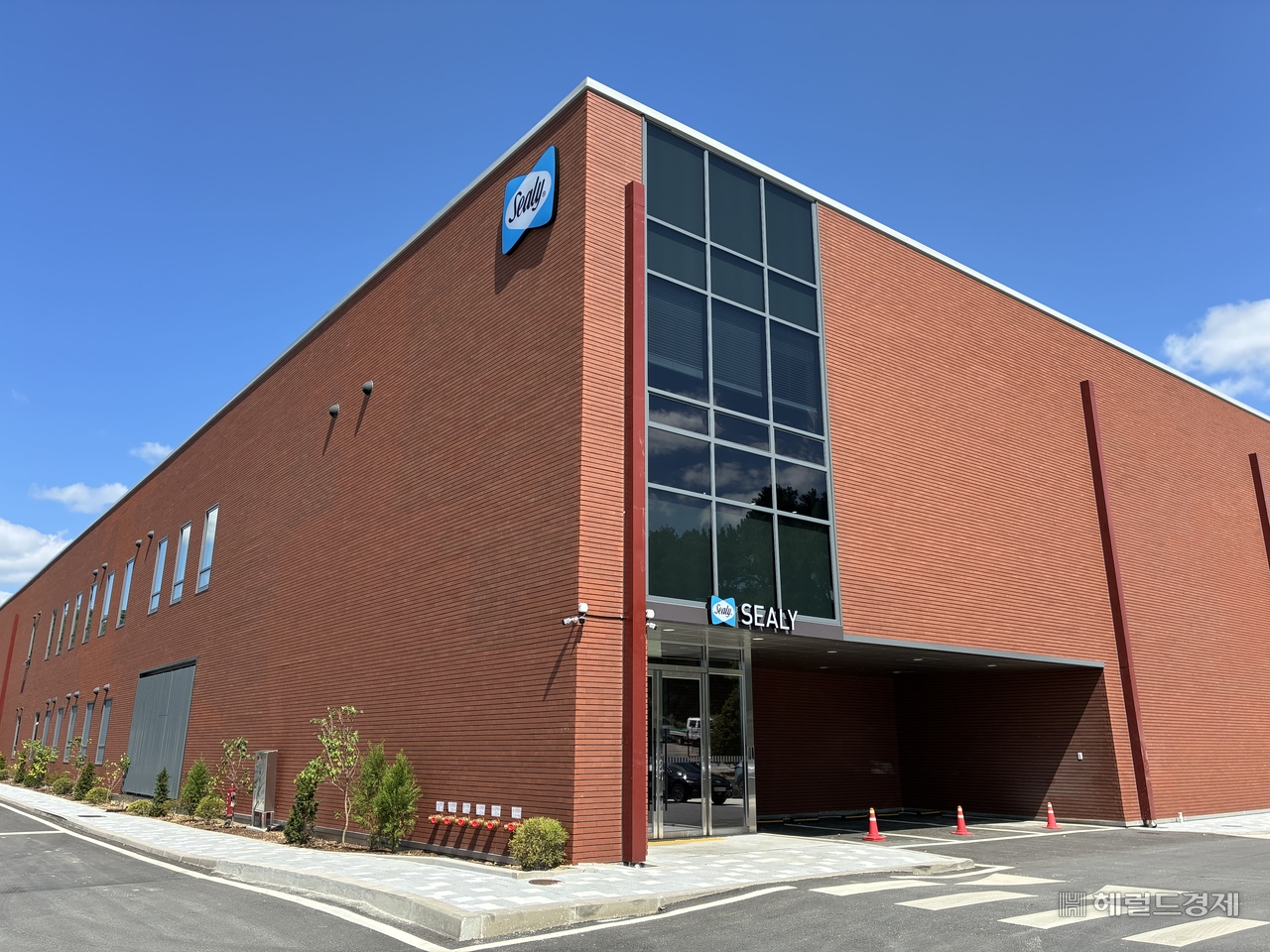
That made-to-order production base has nearly doubled in size over the past decade. Sealy relocated and expanded from its original Yeoju factory, built in 2016, to the new Ogeum-dong facility, which holds its completion ceremony Wednesday. The production floor has grown from 7,920 square meters to 15,183 square meters, and maximum output capacity over an eight-hour shift has risen from about 300 units to 500 units.
110 mattress types, handcrafted: the high-mix, low-volume principle

Stepping onto the production floor, a visitor takes in an open assembly line running from quilting through sewing to final assembly and sealing. Once an order is received, a production ticket bearing the customer's name and product details is issued and attached to the finished mattress. "We make nothing without a production ticket — there is no arbitrary production," Yoo said. "It takes five days from order to delivery."
Apart from the first quilting step, most of the work is done by hand. Four large quilting machines — two for top panels and two for side panels — layer fabric and filling to form the panels. Workers then stitch the top and side panels together by hand, attaching handles and reinforcements one by one. In the final assembly and sealing stage, different foam layers and components specific to each model are stacked in sequence on top of the springs, aligned and secured manually.
The high proportion of handwork reflects the company's commitment to high-mix, low-volume production. Sealy manufactures about 110 mattress types domestically, across five size specifications. "We swap out fabric about 50 times a day and produce at least 50 different models in a single shift," Yoo said. "The order in which different sheet-foam layers are stacked determines whether the mattress feels cozy, firm or plush."
Along one wall of the production floor, springs — the core component of any mattress — were stacked in compressed bales. Currently imported from Australia and China, the springs undergo double heat treatment at their origin before being compressed and bundled in a process called baling for shipment to Yeoju. At the factory, the compressed coils are transferred to yellow "un-bailer" machines that release the binding wire and decompress the springs, allowing them to expand back to the height specified for each model. "This process minimizes deformation and maintains stable elasticity," Yoo said.
Radon safety management is another pillar of the production process. Raw materials — fabric, foam and padding — are tested for hazardous substances by an external specialist before entering the production line, and finished mattresses are checked again on-site using a RAD8 precision radon meter. New products undergo testing at Yonsei University's Radon Safety Center before launch, and all products manufactured and sold domestically receive annual "Radon Safe Product" certification from the Korean Standards Association — a three-tier management system the company operates year-round.
In-house production push: springs to be made domestically by 2028
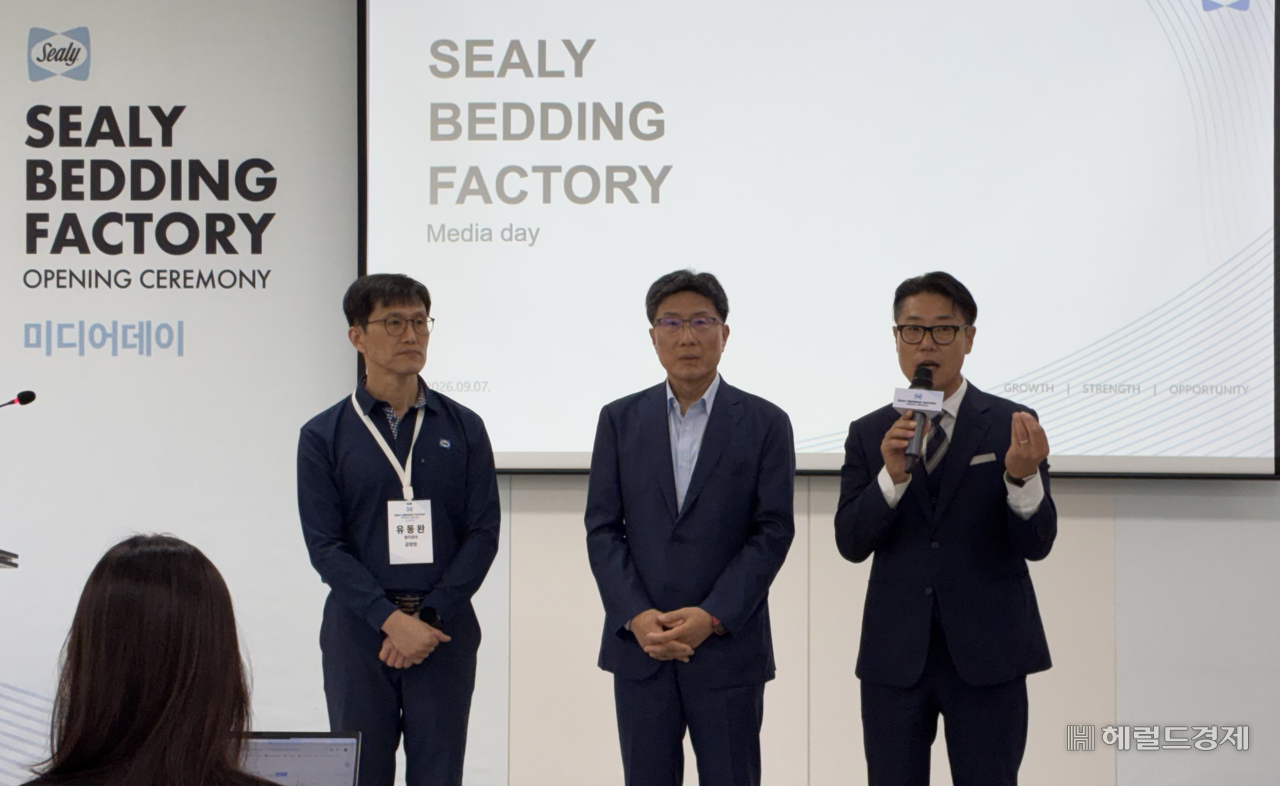
Sealy plans to use the new factory as a springboard to accelerate in-house production. The company had long relied on imports of finished goods from the United States and OEM manufacturing, but after hitting the limits of that model in terms of domestic market growth and quality control, it opened its first production plant in Yeoju in 2016. Sealy Korea CEO Yoon Jong-hyo called the latest expansion "the engine for a second leap forward."
The growth that followed the shift to domestic production drove the investment in the new facility, Yoon said. "Sealy Korea has posted the highest growth rate among all global subsidiaries over the past five years, and this year's sales are expected to reach 22 to 23 times the 2012 level," he said. "Our production target for the new factory this year is 75,000 to 80,000 units. As we expand capacity, sales growth and market expansion will follow naturally."
The expanded production capacity will also support a push into Asian markets. Products made at the Yeoju plant are already exported to China and Kazakhstan, and the company is in talks to extend exports to Singapore, Hong Kong and Taiwan. "The new factory will become the central production base covering all of Asia," said Kim Jeong-min, Sealy Korea's marketing executive director.
The next step is bringing spring production in-house. Sealy has purchased land near the new factory to build a spring manufacturing facility and is working through the permitting process, with a target completion date of 2028. "We currently import springs in roughly equal shares from Australia and China, but we plan to produce them domestically going forward," Yoon said. "We are looking at using wire rod from Posco."
As the broader bedding industry moves to take direct control of key materials and production processes, Sealy is extending its in-house manufacturing reach to springs. "Once the spring factory is complete, we will have a one-stop production system from raw materials to finished products — a core manufacturing hub for Asia," Yoon said.
hong@heraldcorp.com
snsd@heraldcorp.com