Two new bureaus to be established for peace economy and regional growth
Provincial capital relocation task force renamed, restructured
Deputy governor post to take on political affairs role
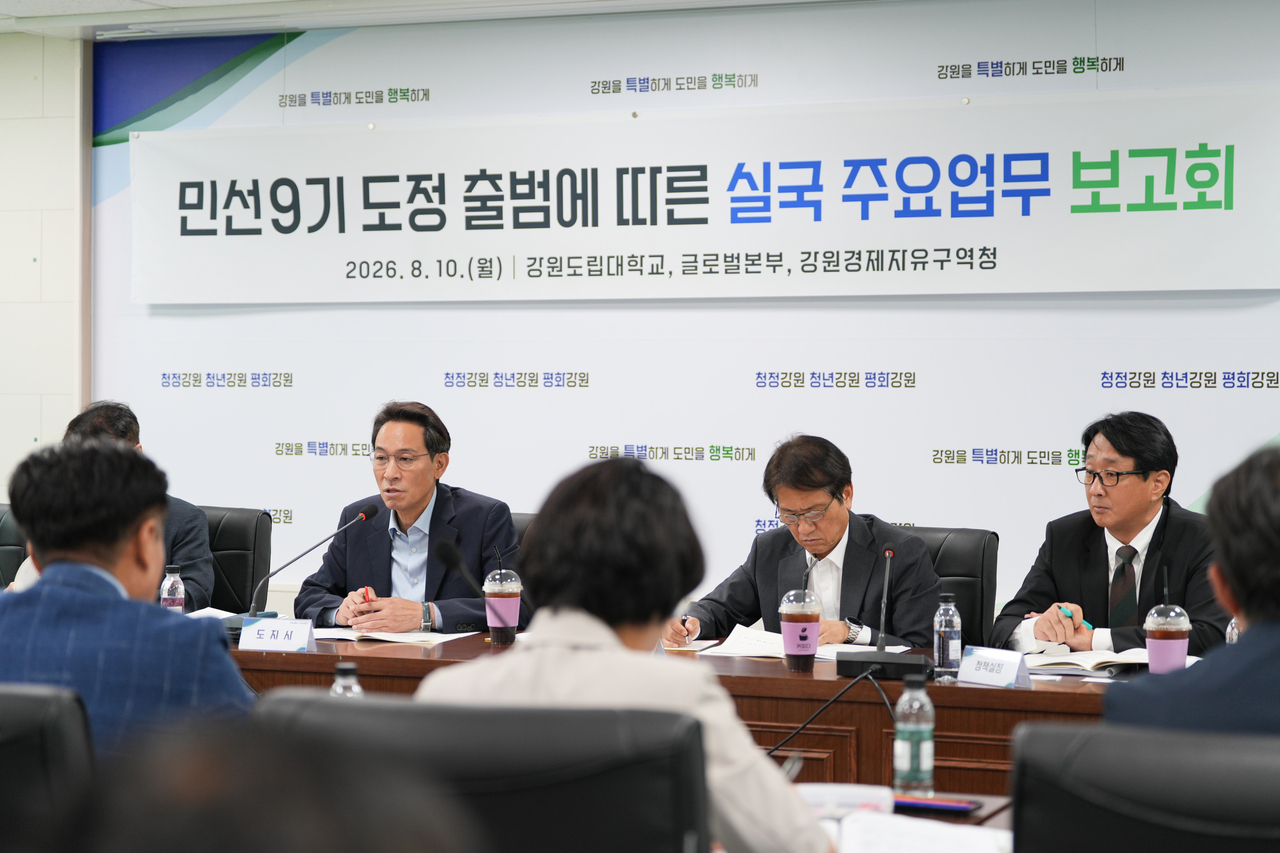

Gangwon Special Self-Governing Province, led by Governor Woo Sang-ho, is undertaking a sweeping organizational restructuring to sharpen the execution of core policies under the ninth elected administration, including the creation of two new bureaus — the Peace Development Bureau and the Regional Growth Bureau.
According to the provincial government Tuesday, the reorganization moves away from the existing function-based, administrative management model toward a "campaign pledge execution structure" focused on key tasks and measurable outcomes.
The four pillars of the overhaul are: the peace economy and development of border regions; building a regional growth foundation that draws young people back; fostering future industries centered on AI and clean energy; and restructuring operational units around core functions.
"The purpose of this reorganization is not to drastically overhaul the existing bureau and division structure, but to maintain organizational stability while delivering results that residents can actually feel," Woo said. "We will preserve the strengths of the existing organization, boldly reform what needs to change, and build a structure that properly executes the key projects for Gangwon's future."
The province plans to implement the restructuring in connection with the regular personnel reshuffle in January 2027, following legislative notice, legal review and deliberation by the provincial assembly.
The most prominent change is the creation of the Peace Development Bureau, designed to transform border areas into new growth zones centered on a peace economy special zone — a move aligned with President Lee Jae Myung's policy direction that "peace is a benefit."
The bureau will house four divisions: the Peace Region Development Division, the Peace Special Zone Division, the Regulatory Innovation Division and the Emergency Planning Division. A dedicated Peace Special Zone Division will be newly established to systematically advance the special zone's development and infrastructure, while linking border-area development, military-civilian cooperation and regulatory reform to strengthen policy execution.
A Regional Growth Bureau will also be established to address population decline, youth outflow and regional imbalance in a comprehensive manner.
The bureau will consist of five units: the Regional Development Division, the Regional Talent Division, the Population and Youth Division, the Child Care Division, and a task force for attracting public institutions. Functions previously scattered across multiple bureaus — including balanced development, population, youth, talent cultivation, child care and public institution attraction — will be consolidated to build a regional foundation where young people can study, work and settle.
The AI Data Center Task Force, which handles the attraction of AI data centers and the cultivation of related industries, will be upgraded from a temporary task force to a permanent divisional body. The existing Semiconductor Industry Division and Digital Industry Division will be merged into a new AI and Semiconductor Industry Division to strengthen linkages between the two sectors.
The Energy Policy Division will be reorganized into a Clean Energy Division to establish an implementation framework for the clean energy highway — a flagship project of the ninth elected administration. The plan envisions a strengthened policy execution chain spanning AI data center attraction, related industry development, and clean energy production and utilization.
The Economy Bureau will reinforce its functions in social solidarity economy, labor and defense economy. A new Labor Policy Division will be established following the delegation to local governments of labor oversight authority over workplaces with fewer than 30 employees, and the Defense Economy Division will be bolstered to support defense industry development, including the construction of a defense drone cluster. The existing Small Business Division will be expanded to incorporate social solidarity economy functions, broadening the foundation for local economic vitality and mutual growth.
A dedicated team will also be created within the Economic Policy Division to oversee Gangwon's signature regional products, with systematic support covering product development, retail and distribution expansion, and promotion and marketing through collaboration with related bureaus.
A new Rural Industry Division will be established to consolidate rural industry functions, and the Eco-Friendly Agriculture Division will be reorganized into an Agricultural Production Division. The overall agricultural policy framework will shift from a production-centered model to one that also encompasses rural industrialization and value creation.
The Planning and Coordination Office will strengthen the link between provincial planning and special self-governing functions. A new Special Self-Governing Division will be created at the divisional level and placed within the office to reinforce ties with provincial planning and strategy functions, while a Legal Affairs Division will be spun off from the Policy Planning Office.
The Provincial Capital Relocation Task Force will be reorganized into a Public Building Construction Division in line with the new government building construction plan and changes in project conditions, with enhanced expertise and project management capacity for public construction projects the province undertakes.
The Closed Mine Region Support Division under the Future Industry Bureau will be renamed the Coal Industry Transition Division following an amendment to the special act on development support for coal industry transition regions.
Team-level units will also be reinforced to support major campaign pledges of the ninth elected administration. A Timber Industry Team will be added to the Forest Policy Division to advance a "Gangwon-style forest economy industrial belt," and a Forest Trail Tourism Team will be created to develop "world-class trekking courses." A separate Industrialization Research Team will be established at the Forest Science Research Institute to support the commercialization of the forest economy.
A Culture Content Team will also be added to the Culture and Arts Division to support the creation of a "youth culture and arts theme town and regional content development."
In addition, the position of economic deputy governor will be retitled economic and political affairs deputy governor, with political coordination functions added to strengthen internal and external cooperation on major provincial issues.
The restructuring will increase the number of main provincial offices from 15 bureaus and headquarters with 80 divisions to 16 bureaus and headquarters with 86 divisions — a net gain of one bureau and six divisions. The total headcount will rise by 74, from 7,051 to 7,125.
Grade-level staffing will also be partially adjusted and expanded to boost morale among personnel in smaller job series, with the aim of improving balance across job categories and revitalizing the organization.
abc@heraldcorp.com