
Chinese stem lettuce dyed with food coloring banned for use on vegetables
Suspicions extend to cucumbers, green onions; consumers search for ways to spot Chinese produce
Stem lettuce imports nearly doubled in 3 years; 103 import declarations filed in past year
Authorities move to calm fears; emergency tests of 8 products show no dye detected
![A still from a video circulating on Chinese social media platform Weibo showing stem lettuce being dipped in a green liquid. [Yonhap]](https://wimg.heraldcorp.com/news/cms/2026/09/08/rcv.YNA.20260907.PYH2026090723140000900_P1.jpg)
Consumer anxiety in South Korea is growing as a "dyed lettuce" scandal out of China follows closely on the heels of an earlier "formaldehyde cabbage" controversy. Concern is running particularly high because stem lettuce — the vegetable at the center of the latest incident — is a staple in many Korean households.
According to Chinese media and social media reports, a video has been circulating showing workers at a vegetable processing facility in Yuzhong County, Gansu Province, dipping stem lettuce — known in Korea as gungchae — into a green liquid. The person who filmed the video said the vegetable was being soaked in food coloring to make it look fresh, and that while the dye itself was food-grade, its use at the vegetable processing stage is prohibited. As the controversy grew, local authorities were reported to have filed charges against six vegetable storage and distribution businesses for illegally using the dye.
As the video spread to South Korea, consumers grew alarmed. Coming so soon after the formaldehyde cabbage footage, the new incident has deepened distrust of Chinese food products. Posts on parenting forums and other social media platforms have urged people to avoid eating out as much as possible, warning that restaurants often use cheap Chinese ingredients, and to check country-of-origin labels carefully when buying groceries. Beyond food safety concerns, some users have raised allegations that other vegetables — including cucumbers and green onions — are also being dyed in China.
Families with young children have been especially rattled. A 40-year-old mother, identified only by her surname Jeon, who is raising a first-grade daughter in Seoul, said she had looked up ways to tell Chinese produce apart from domestic varieties. "I read that if cabbage, lettuce, spinach or broccoli looks too blue-green, you should suspect it might be Chinese," she said. "I try to buy only Korean-grown produce and check carefully, but I have no way of knowing whether I can really trust what I'm buying." A 39-year-old mother of two children, ages 7 and 9, identified only as Park, said there are limits to what individuals can do on their own. "The best solution is for the government to strengthen safety inspections," she said.
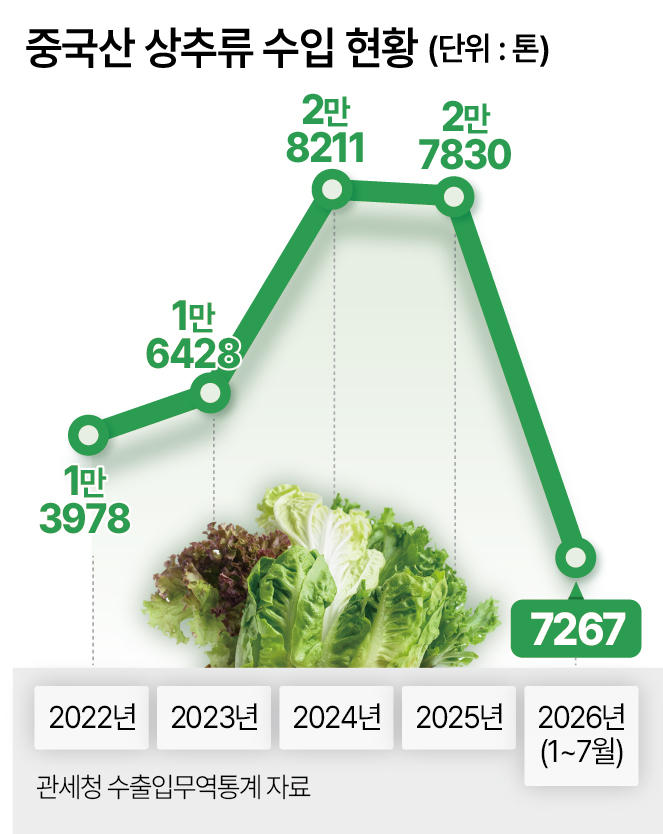
Imports of Chinese vegetables have been rising consistently. Data from the Korea Customs Service show that imports of Chinese lettuce jumped from 13,978 tons in 2022 to 27,830 tons last year — a near-doubling of 99.1 percent in three years. Chinese lettuce accounted for 88.8 percent of all lettuce imports last year. Chinese cabbage imports surged 384.2 percent over the same period, from 15,763 tons to 76,324 tons. Imports of Chinese onions and garlic rose 53.8 percent, while imports of carrots, turnips and beets climbed 25.4 percent.
Stem lettuce, the vegetable featured in the video, has become increasingly common in South Korea in recent years. Its crunchy texture has made it a popular ingredient not only in Chinese restaurants serving dishes such as malatang, but also as a namul banchan side dish at Korean restaurants and a regular item at side-dish shops. According to the Ministry of Food and Drug Safety's imported food information portal, 103 import declarations were filed in the past year alone under names including gungchae, dried gungchae and dried stem lettuce.
Authorities have moved to address consumer concerns. The Ministry of Food and Drug Safety said Tuesday it had conducted emergency tests on eight samples of Chinese stem lettuce currently in circulation in South Korea and found no food coloring in any of them. The ministry said it had tightened inspections of Chinese stem lettuce at the customs clearance stage starting Monday, checking for the presence of food dyes. In addition to the eight emergency samples, it is collecting and testing further products already on the domestic market.
The ministry is also working through the South Korean Embassy in Beijing to determine whether any stem lettuce treated with food coloring has entered the country. Earlier, the ministry confirmed through the same embassy that formaldehyde-treated cabbage had not been imported into South Korea. "We will respond swiftly to strengthen inspections not only at the import stage but also in domestic distribution, so that the public can eat with confidence," the ministry said.

spa@heraldcorp.com





