
Matching platform to link job-trained youth with work opportunities
Youth employment down 143,000, employment rate falls for 28th month
Government to promote next year's job programs ahead of budget confirmation
Youth employment has fallen for 46 consecutive months and the employment rate has declined for 28 straight months, prompting the government to accelerate the rollout of next year's youth job programs. It plans to build a cross-ministry platform called Youth Playground to connect youth who have completed job training with companies. It will also promote major support projects even before next year's budget is finalized to encourage youth participation.
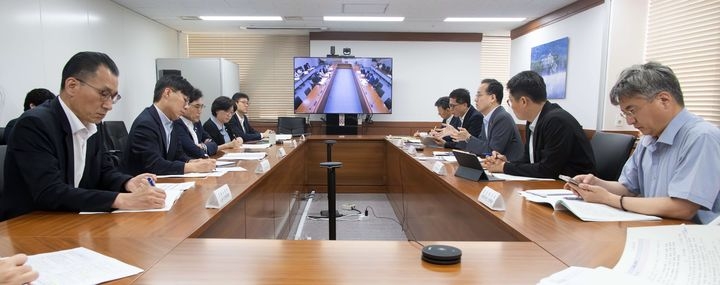
The Ministry of Economy and Finance and the Ministry of Employment and Labor held a joint interagency Job Task Force meeting at Government Complex Seoul on Wednesday. It was chaired by Kang Ki-ryong, vice minister for planning and coordination at the Ministry of Economy and Finance, and Im Yeong-mi, director general for employment policy at the Ministry of Employment and Labor. The meeting reviewed August employment trends, next year's job-program budgets by ministry, future promotion and implementation plans, and progress on this year's direct job creation projects.
The government plans to flesh out an implementation structure for Youth Playground, a new cross-ministry collaborative project set to launch next year. The goal is to ensure it can actually match young job seekers with employment opportunities. Officials aim to quickly define the roles and cooperation methods needed among ministries and agencies to connect youth who have completed training with available work.
The government will also begin promoting key measures under its recently announced Youth Employment Recovery Plan even before next year's budget is finalized. Related ministries plan to jointly provide advance guidance so that young people can familiarize themselves with major support programs and apply as soon as the budget is confirmed.
According to the Ministry of Employment and Labor, the youth job-related budget will grow from 2.6 trillion won ($1.94 billion) this year to 3.3 trillion won under next year's government proposal. That represents an increase of about 700 billion won, the largest increase since 2021. Of that, 20.1 billion won is earmarked for Youth Playground, 489.5 billion won for the K-New Deal Academy, and 379.3 billion won for the Youth First Job Support Program.

The government noted that despite a wider increase in overall employment in August, difficulties persisted for young people and vulnerable sectors such as manufacturing and construction. According to the Ministry of Statistics' August employment trends released Wednesday, the number of employed people aged 15 and older stood at 29,151,000 last month. That was up 184,000 from a year earlier. The employment gain has widened for three consecutive months, following increases of 63,000 in June and 108,000 in July.
However, employment among those aged 15 to 29 fell by 143,000, marking a 46th consecutive month of decline. The youth employment rate dropped 1.0 percentage point to 44.1 percent, extending its slide to a 28th straight month. The youth unemployment rate, meanwhile, rose 0.5 percentage point to 5.4 percent.
The number of young people who are neither working nor looking for a job — classified in official data as "resting" — fell by 51,000 from a year earlier to 395,000. That marked a seventh consecutive month of decline. However, the government said the change may partly reflect a shift within the non-economically active population rather than a genuine improvement in employment. That shift, it said, was driven by a shrinking youth population and a growing number of students and trainees. It added that it remains to be seen whether the underlying job situation has truly improved.
By industry, manufacturing employment fell by 38,000 and construction employment fell by 32,000. Both sectors saw smaller declines than the previous month, but the downward trend continued. Employment in agriculture, forestry and fisheries dropped by 109,000, a wider decline than before. Employment in accommodation and food service, a sector with a high share of young workers, also fell, by 61,000.
The government warned that escalating tensions in the Middle East and a base effect from last year could constrain future employment growth. In response, it plans to identify measures to boost industrial vitality and expand workforce training in sectors such as manufacturing, construction, and agriculture, forestry and fisheries. Job losses have persisted in these sectors. The government plans to announce these measures at a meeting of economy-related ministers.
The government also plans to manage risks related to energy and supply chains while accelerating three mega-projects to strengthen job creation across the economy. It will additionally identify and expand productive public-sector jobs that generate social benefits, in cooperation with related ministries.
Direct job creation programs targeting vulnerable groups had hired 1,343,000 people as of the end of August. That surpassed both the August target of 1,271,000 and this year's annual target of 1,288,000. The government plans to review the implementation status of each program through the end of the year and pursue additional hiring for programs with remaining capacity.
fact0514@heraldcorp.com





