
Constitution to specify independent audit committee with outside members
Party seeks National Assembly consent, presidential appointment for election commissioners
Kim Tae-nyeon: "Path open to dialogue and results with People Power Party"
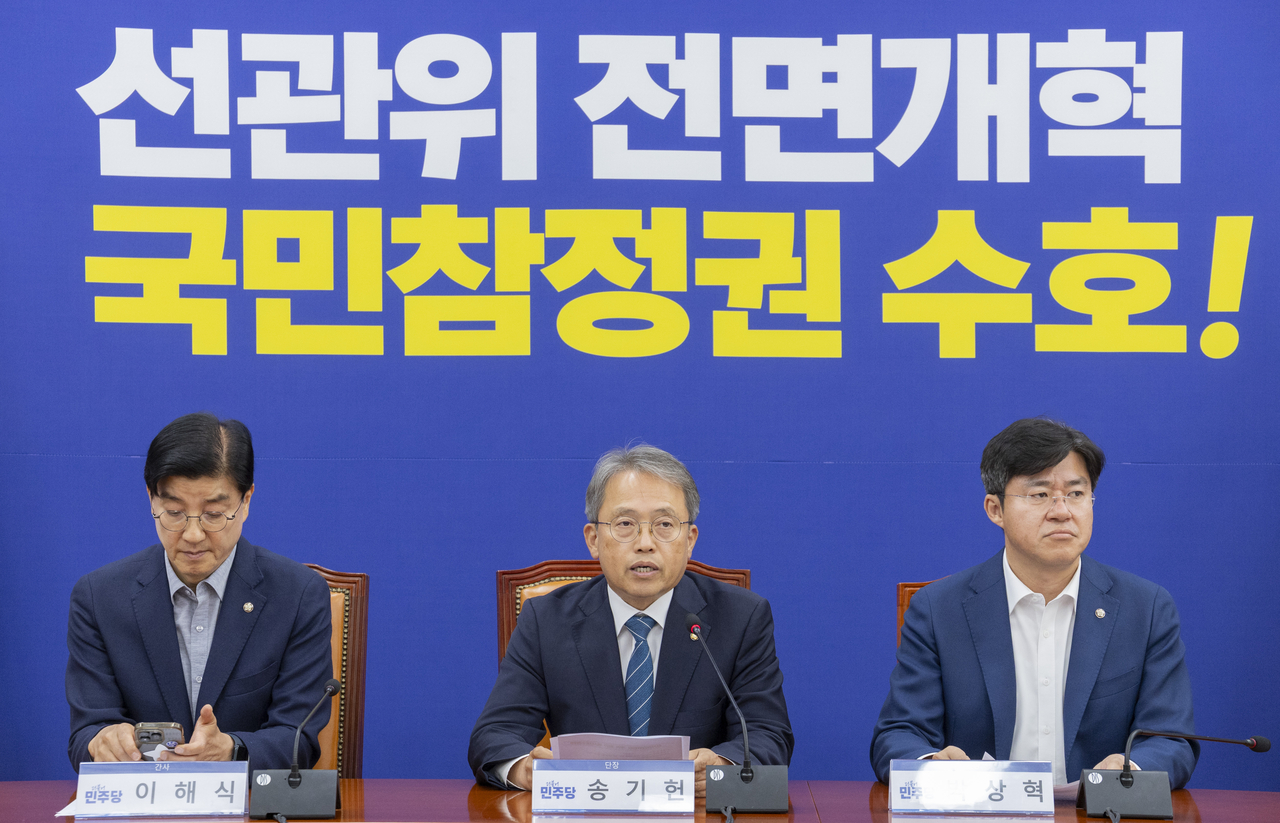
The Democratic Party of Korea is pushing a constitutional reform to rename the National Election Commission as the tentatively titled "National Suffrage Rights Commission." The reform would also create an independent audit committee that includes outside experts. The plan would also overhaul how election commissioners are appointed and how the commission is audited, aiming to strengthen accountability and transparency while preserving the commission's independence.
Rep. Song Ki-heon, head of the Democratic Party's task force for election commission reform to protect the people's right to suffrage, met with reporters at the National Assembly on Wednesday after a ceremony to report the task force's activities and hand over its constitutional reform agenda. "We have devised a plan to convert the commission into a new form of independent election management body and change its name," Song said. "The tentative name we came up with is the National Suffrage Rights Commission."
The task force has been discussing ways to reform the election commission system since the ballot shortage at polling stations during the June 3 local elections. The task force concluded that overhauling the commission's functions, name, composition and audit system requires not just legislative revisions but a constitutional amendment.
"The plan would enshrine in the Constitution the establishment of an independent audit committee that includes outside members, and redefine the commission's functions and role -- covering not only election management but also the expansion of the public's right to suffrage," Song explained.
Under the Constitution, the commission has nine members: three appointed by the president, three elected by the National Assembly and three nominated by the chief justice of the Supreme Court. The commissioners choose the chairperson through mutual vote.
The task force proposed requiring candidate nomination and selection procedures, National Assembly consent and presidential appointment in the process of naming election commissioners. It is also considering enshrining the status of the commission's standing commissioners in the Constitution.
"We also changed the current composition and the method of selecting the chairperson by mutual vote," Song said. "The specifics of these changes will need to be discussed going forward."
The task force also plans to strengthen the commission's audit function. It proposed placing the National Election Commission and its civil servants under the audit authority of the Board of Audit and Inspection. The task force argued that the commission's high degree of independence should be matched with adequate accountability and transparency.
The task force had earlier introduced what is known as the "three election commission reform bills." The bills included making the National Election Commission chairperson's post a full-time position and introducing a confirmation hearing for the commission's secretary-general. But it concluded that legislative revisions alone have limits in resolving the commission's structural problems.
"As the discussions continued, we clearly confirmed the structural limits that cannot be resolved through legislative revision alone," Song said. "We discussed issues that need to be reviewed at the constitutional level, including the commission's functions, name, composition and audit system, and after multiple meetings and expert discussions, we arrived at the task force's direction for constitutional reform."
The task force submitted its activity report and constitutional reform agenda to the Democratic Party's constitutional reform promotion team on Wednesday. Kim Tae-nyeon, head of the promotion team, said, "As the public watched the ballot shortage during the June 3 local elections and the controversy surrounding the election commission, they are asking how to reconcile the commission's independence with its accountability. The promotion team will responsibly carry forward the results the task force has left behind."
A constitutional amendment requires the support of at least two-thirds of the National Assembly's registered lawmakers, making negotiations with the main opposition People Power Party critical. Kim said he has recently been discussing the constitutional reform issue with People Power Party lawmakers, leaving open the possibility of negotiations with the opposition party.
Kim addressed concerns raised by People Power Party Floor Leader Jeong Jeom-sik, who spoke on behalf of his negotiating bloc on Tuesday. Jeong suggested that the Democratic Party's push for constitutional reform could be politically motivated, aimed at extending the president's term. Kim said he did not see the remarks as "blocking constitutional reform itself." He added, "If we push for constitutional reform in a manner and at a time when political calculations are minimized as much as possible, it will open a path to dialogue and tangible results with the People Power Party as well."
The party also decided to keep pushing for a revalidation of ballots at the Songpa-gu election commission, a matter that stirred controversy during the June 3 local elections. Rep. Lee Hae-sik said, "The People Power Party lawmakers' argument is that revalidation can proceed if a special prosecutor is present or conducts it jointly. We plan to push for a revalidation involving the special prosecutor and the National Assembly's Public Administration and Security Committee."
thanks@heraldcorp.com





