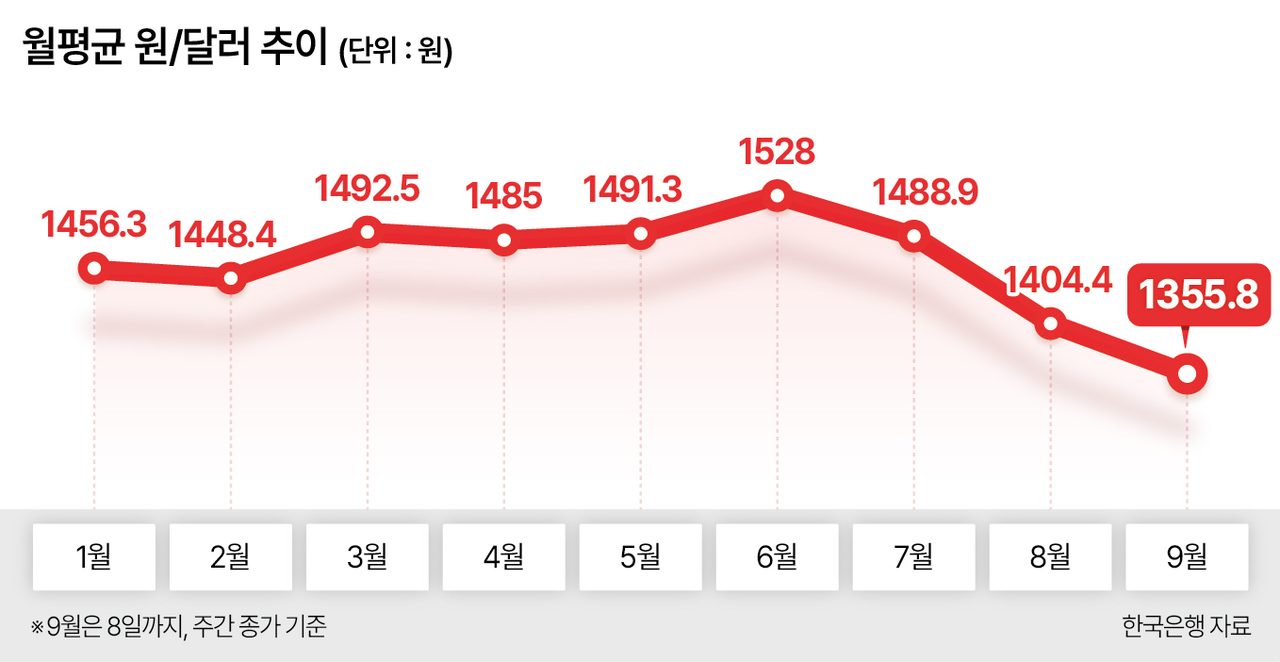
Monthly average rate falls from 1,528 won to 1,355.8 won
Won's strength squeezes exporters' profitability
Current account stays robust on chip excess demand
Other industries brace for shock as polarization deepens
The won-dollar exchange rate has fallen for three consecutive months, and analysts expect the downward trend to continue. Concerns are mounting that the sharp decline will further widen the gap between the semiconductor industry — which faces excess demand worldwide — and other sectors, such as automobiles and petrochemicals, where supply-side competition is fierce.
According to financial industry sources Wednesday, the won-dollar rate briefly fell to 1,334.7 won during intraday trading Monday, the lowest level since October 2024. The monthly average rate, based on weekly closing prices, peaked at 1,528 won in June before falling to 1,488.9 won in July and 1,404.4 won in August. It fell further to 1,355.8 won as of Tuesday.
Market watchers expect the won's strengthening trend — meaning a falling exchange rate — to continue. Cha Young-hoo, a researcher at Eugene Investment & Securities, said, "Given capital flows, the growth gap and interest rate paths between South Korea and the United States, and the authorities' policy stance, upward pressure on the won is likely to dominate through next year." He forecast that "the won-dollar exchange rate's floor is likely to form below the 1,300 level."
A stronger won hurts exports. When the won-dollar rate falls, exporters earn less in won even if they sell goods at the same dollar price. Raising dollar-denominated prices to offset the loss weakens price competitiveness, reducing demand and, ultimately, sales.
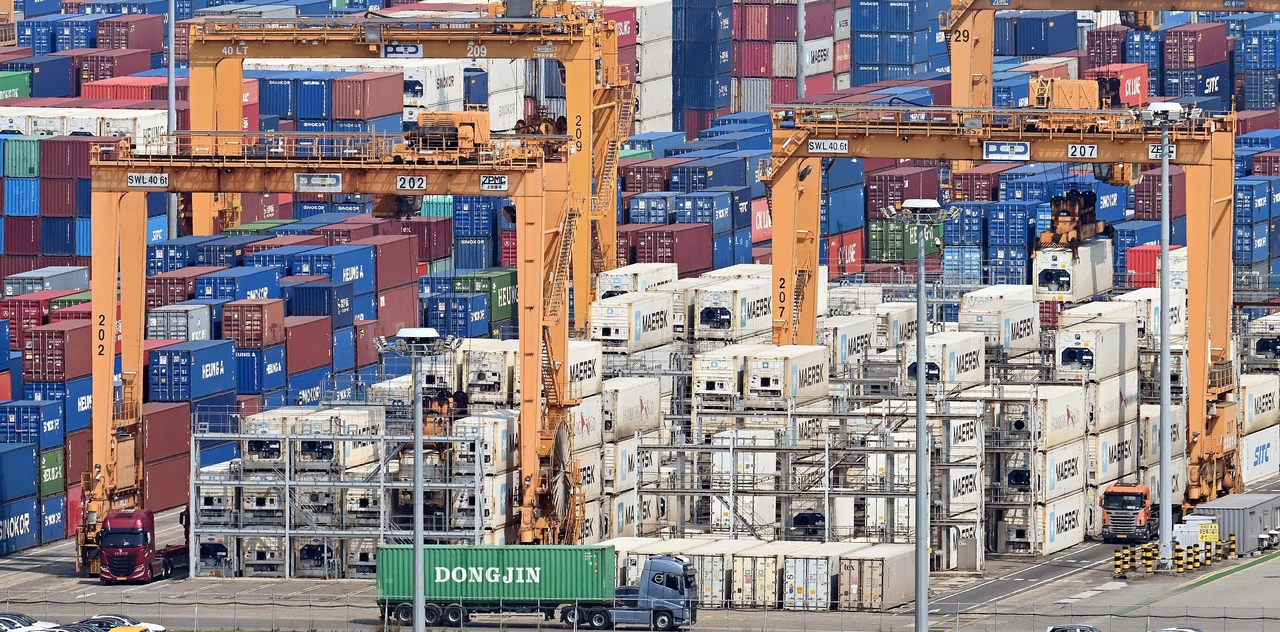
Still, the current account and export trends remain solid. In July, when the exchange rate's decline gathered pace, the current account posted a surplus of $42.08 billion, the highest on record for that month. As of Saturday, cumulative exports this year reached $709.4 billion, already surpassing last year's annual record of $709.3 billion. The Bank of Korea said, "Recent growth in goods exports has been led by semiconductors, and because it reflects sustained demand driven by AI-related chip investment, the impact of the exchange rate is limited — supply and demand are having a bigger effect."
In short, semiconductors — which account for a large share of the current account surplus — are expected to keep driving strong overall export performance, as global demand for chips continues to far outpace supply even as the exchange rate falls. Semiconductors made up 40.6 percent of cumulative exports through August.
The problem lies with other industries. Sectors with relatively weak global demand or intense supply-side competition are more exposed to the negative effects of a falling exchange rate.
A Bank of Korea official said, "A stronger won affects exporters' earnings through two channels — a direct effect that reduces operating profit when converted into won, and an indirect effect in which higher dollar-denominated prices dampen demand." The official added, "For semiconductors, the indirect effect is limited because of excess demand, but for industries facing fierce global supply competition, the decline in the exchange rate could deal a bigger blow to earnings."
Recent data show non-IT sectors are also performing reasonably well. Non-IT customs-cleared exports rose 18.3 percent in July from a year earlier. That is only about 13 percent of the IT sector's 140.6 percent growth, but the Bank of Korea assesses that the improvement is gradually spreading beyond semiconductors to other industries.
The concern is what comes next. With the exchange rate continuing to fall, and given the lag before its effects show up in demand, export growth in non-IT sectors could slow significantly. That could deepen the divide between the semiconductor-driven IT sector and other industries.
The industries most vulnerable to the won's strength are automobiles and petrochemicals — both sectors with high export shares and fierce global competition.
When automakers export domestically produced vehicles priced in dollars, a stronger won lowers per-unit revenue, directly hitting operating profit. Korean automakers compete with Japanese rivals in major overseas markets such as the United States and Europe, and if the won strengthens more than the yen, they risk losing customers on price. The monthly average won-yen rate fell from 950.4 won in June to 921.5 won in July and 885.6 won in August, before dropping further to 864.5 won in September through Tuesday.
The petrochemical industry faces a similar situation. Domestic petrochemical companies' exports are estimated to account for 30 to 40 percent of their business. When the won appreciates, the same overseas earnings are worth less when converted into won, hurting results. Unlike semiconductors, petrochemical products currently face a global oversupply — making it difficult for producers to pass exchange rate costs on to prices.
A similar case occurred in the Netherlands, where a boom in one industry strengthened the currency and eroded the competitiveness of other sectors. After discovering a natural gas field off its northern coast in 1959, the Netherlands earned tens of billions of dollars a year from gas exports and enjoyed an economic boom. But the resulting surge in the value of its currency weakened the manufacturing sector — apart from petroleum products — ultimately leading to an economic downturn.
In a recent report, the Bank of Korea warned, "Over the medium to long term, an excessive concentration of resources such as production factors in the IT sector could lead to the collapse of other key industries' ecosystems and deepening imbalances." It recommended that "policy should be designed with this in mind."
kimstar@heraldcorp.com