Critics slam selective support under 'Seoul National University x10' project
Public university funding stands at 0.7 percent of GDP, groups say
'Government needs a growth policy for all national and public universities'
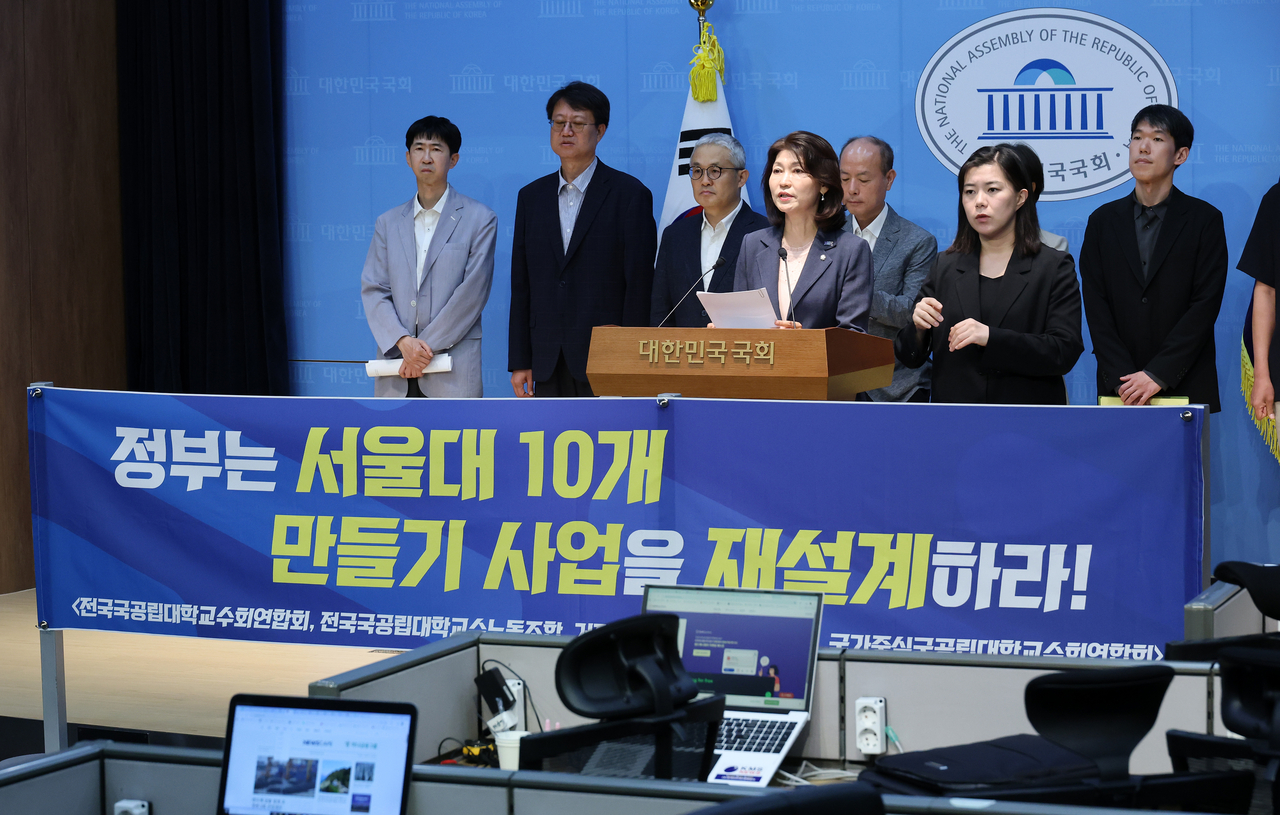
Professors' associations at national and public universities across South Korea urged the government to move away from selectively supporting specific universities. They called instead for a stable financial foundation for all national and public universities.
The National Federation of Public University Professors, the Federation of Flagship National University Professors' Councils and the Federation of Nationally Focused Public University Professors' Councils issued a joint statement Wednesday, saying, "Any change to the financial structure must align with the fundamental goal of strengthening the nation's higher education competitiveness."
The groups argued that Korea's higher education spending currently stands at about 0.7 percent of GDP, far below the OECD average of 1.0 to 1.1 percent, and said stable expansion of higher education funding is needed.
They particularly took issue with the government's selective, concentrated approach to university support. "The 'Seoul National University x10' initiative has strayed from its original purpose and degenerated into a general support project that selectively funds only three universities," the groups said. "University selection based on vague principles and criteria is fueling conflict among flagship universities and undermining cooperation between flagship and non-flagship national and public universities, as well as between national, public and private universities," they added.
They went on to say that instead of support broken up project by project, stable funding is needed to underpin the basic education and research environment of national and public universities.
Specifically, they called for the government to fully cover the facility and operating costs of national, public and corporatized universities from state coffers. They also urged the introduction of integrated financing and block funding so universities can autonomously allocate funds toward personnel costs, operating expenses, and research and education support.
The groups also said the academic ecosystem at universities is facing a crisis. They cited the declining school-age population, the risk of regional decline and the concentration of resources in specific academic fields as converging factors. They said that if the government concentrates support on select universities and fields under the pretext of fostering future industries, the gap between universities could widen further.
The government recently announced it would restructure the 55-year-old system linking local education grants to a fixed 20.79 percent share of national tax revenue, while increasing the higher education budget. The groups said they welcomed the funding increase but warned it must not lead to an overall reduction in education spending.
They also argued that the process of enacting the National University Act must not infringe on university autonomy. "Attempts to unilaterally push through a National University Act that infringes on university autonomy — such as using financial support as a pretext to pursue university mergers and corporatization — must be halted immediately," the groups said. They called for the Ministry of Education, the Korean Council of National and Public University Presidents and the National Federation of Public University Professors to form a consultative body.
In addition, they urged the government to establish a differentiated support system that distinguishes the roles of national and public universities from those of private universities. They also called for a cooperative framework so that expanding higher education funding does not come at the expense of elementary and secondary education.
"Taking this increase in the higher education budget as an opportunity, the government must carry out structural reforms so that education funding is used efficiently for the nation's future," the groups said. They called on the government to take decisive action.
newday@heraldcorp.com