Land Ministry picks Seoul as final project site: 'Linking public healthcare and Han River tourism'
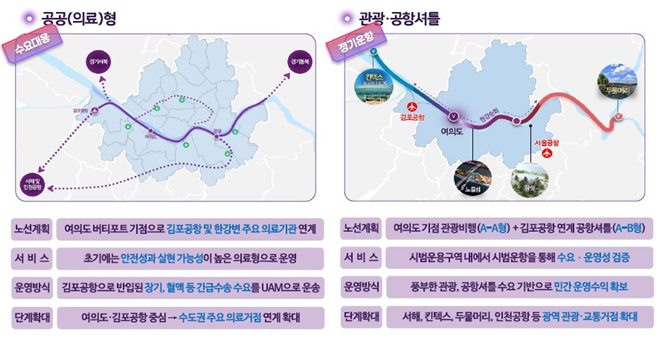
The final site for a regional pilot project on urban air mobility will be Seoul. The project will move forward as either a medicine-transport service shuttling between Gimpo Airport and hospitals along the Han River, or a tourism service connecting major points along the river.
The Ministry of Land, Infrastructure and Transport said Thursday that it selected Seoul Metropolitan Government as the final project site for its 2026 Urban Air Mobility Regional Pilot Project Support Program. The program aims to identify early commercialization models for UAM based on regional demand.
After the call for proposals opened in May, five metropolitan and provincial governments — Seoul, Gyeonggi Province, Busan, Ulsan and North Chungcheong Province — took part. Following an expert evaluation of the project's feasibility, including flight environment, infrastructure utilization, service demand and linkage with public services, the ministry selected Seoul.
Seoul proposed a hybrid UAM service model combining public healthcare and Han River tourism.
The city plans to run a public healthcare service linking Gimpo Airport with medical institutions along the Han River to support the swift transport of emergency medicine and transplant organs. It also plans a tourism service connecting major points along the river so tourists can take in the scenery from the air.
The ministry will provide Seoul with up to 1 billion won ($746,000) in state funding, which the city will match one-to-one. The funding will support the drafting of a detailed project plan and help lay the groundwork for early commercialization.
The funding will mainly go toward tasks needed to introduce UAM services, such as selecting vertiport locations and drawing up construction plans. It will also support analyzing flight routes and corridors, and assessing radio and communication conditions.
Last year, the ministry designated Jeju and the Daegu-North Gyeongsang region as budget-support areas. This year, it is backing the development of project plans and vertiport designs there, steadily working to identify UAM services tailored to each region's characteristics.
In addition, the ministry has included 15 billion won for aircraft procurement and 20 billion won for infrastructure development — such as route design and vertiports — in its 2027 UAM budget proposal. It is working to expand the foundation for demonstration and commercialization.
Following the pilot project, the ministry has particularly moved to prepare for UAM's commercialization in 2028 by establishing an early pilot service operating model. The model classifies services into categories such as tourism, airport-linked and region-linked types, as with Seoul's case. It also stipulates that a piloted aircraft operate only one unit per corridor between sunrise and sunset, with no more than 10 one-way flights per day.
Park Jun-hyung, director general of the ministry's Mobility and Automobile Bureau, said, "We will continue to identify feasible projects and provide the necessary support so that various UAM services tailored to regional demand and characteristics can lead to actual commercialization."
smh@heraldcorp.com