Banana prices fell 4%, mango prices 20% in special checks
One-time probe covered only 58 sites, no ongoing tracking for all items
Direct delivery from importers led to bigger discounts
Integrated system due by year-end; aT team planned for next year

The government granted 830.5 billion won ($619 million) in tariff quota benefits last year to help stabilize prices, but its review of whether the discounts reached consumers amounted to a one-off check covering only a handful of items and retailers, data showed.
Prices for items such as bananas and mangoes fell after the tariff cuts took effect, but no system exists to continuously track import prices, distribution margins and consumer prices across all items covered by the program. Authorities also have limited power to directly penalize importers and distributors that fail to fully pass on the tariff cuts to consumers.
According to the National Assembly Research Service's "2026 National Audit Issue Analysis" report and the government's follow-up measures on improving the tariff quota system, released Thursday, the total tariff quota support extended in 2025 is estimated at 830.5 billion won. The tariff quota system temporarily lowers the basic tariff rate on a set volume of imports to help stabilize prices and ensure a stable supply.
By item, mineral fuels such as crude oil, LNG and LPG accounted for 53 percent of the total support. Among food items, bananas received the largest tariff reduction at 56.3 billion won, followed by mangoes at 22 billion won and sugar at 20.7 billion won. Bananas and mangoes combined received 78.3 billion won in tariff benefits.
Tariff reductions granted under the quota system have totaled 5.31 trillion won over the past four years — 1.97 trillion won in 2022, 1.08 trillion won in 2023, 1.43 trillion won in 2024 and 830.5 billion won in 2025. The number of items covered stood at 119 in 2022, 117 in 2023, 125 in 2024 and 102 in 2025, before falling to 99 as of the end of June this year.
A joint inspection by related ministries in March and April confirmed the price-cutting effect for some items. The Ministry of Agriculture, Food and Rural Affairs, the Ministry of Economy and Finance and the Ministry of Oceans and Fisheries inspected 58 sites — including bonded warehouses, importers, wholesale markets and processing and distribution companies — from March 9 to April 16.
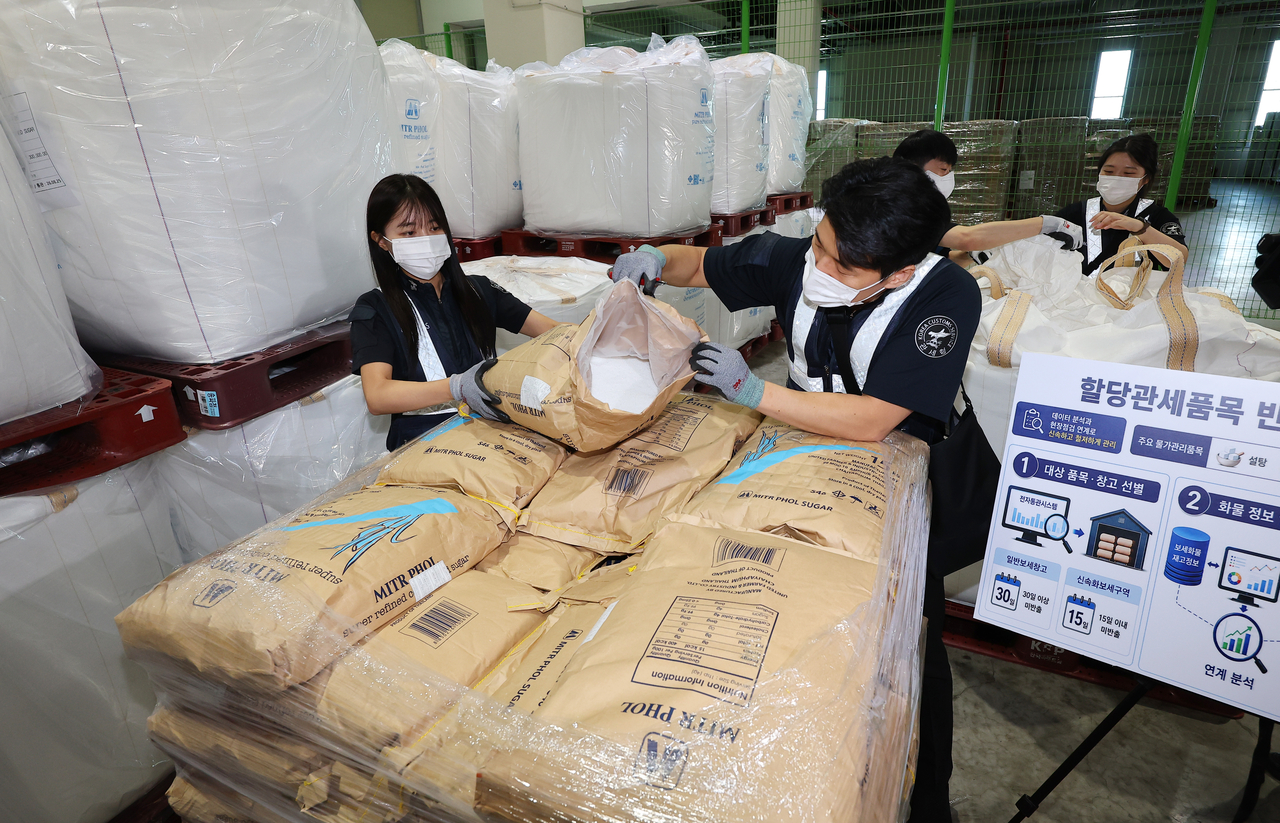
The inspection covered 181,000 tons of fruit — 129,000 tons of bananas, 18,500 tons of mangoes and 33,500 tons of pineapples — along with 120,000 tons of sugar and 25,000 tons of frozen mackerel. The government compared distribution channels and pre- and post-tariff-quota import and sale prices for each item.
The inspection found hypermarket prices fell 4 percent for bananas, 20 percent for mangoes, 11 percent for pineapples and 3 percent for frozen mackerel after the tariff cuts took effect. This confirmed a price-cutting effect on imported fruit and seafood.
The effect also varied by distribution channel. When importers supplied hypermarkets directly, the drop in consumer prices was relatively larger than when goods passed through wholesale and retail stages in sequence. For bananas, the markup from import price to consumer price was 50 percent through wholesale and retail channels but only 40 percent through direct delivery. This suggests that as more distribution stages are added, part of the tariff cut is absorbed into distribution costs or margins.
However, the review was limited to some agricultural and marine products and 58 businesses over about a month. Because the price survey focused mainly on hypermarkets, it remains unclear whether the same effect held across the broader retail market. This includes traditional markets, small and mid-sized stores and online sales.
The review only compared prices before and after the tariff cuts took effect. As a result, it is difficult to isolate the pure impact of the tariff reduction from other factors such as international prices, exchange rates, supply volumes and retailer discount promotions. There is likewise no analysis of how long the price cuts lasted, or how much of the tariff savings went to consumers versus how much stayed within the distribution chain.
The government also does not monitor price trends for tariff-quota items on an ongoing basis. There is no legal basis under the Customs Act to directly penalize cases where tariff cuts are not sufficiently reflected in final consumer prices. The Korea Customs Service's authority is limited to violations in the customs clearance and distribution process — such as under-reporting import prices, improperly securing quota volumes, or delaying the release of goods from bonded areas.
In fact, last year the Korea Customs Service recovered 14.7 billion won in tariffs from four companies that missed their bonded-area release deadlines. In a special tariff investigation this year, it caught nine companies for violations including missed release deadlines, improperly securing tariff quota volumes through third parties, and reporting inflated import prices.
The government unveiled related measures in February and has since strengthened management of tariff quota items. In April, it revised the Customs Act's enforcement decree to establish grounds for designating intensively managed items and setting release deadlines. Under the revision, recommendations can be canceled and reduced tariffs recovered when requirements are violated.
The 2026 tax revision plan, announced last month, moves up the deadline for imposing a delinquency surcharge on delayed import declarations for intensively managed tariff quota items. The surcharge now applies 20 days after goods enter a bonded area, instead of 30 days. It also includes a provision allowing customs chiefs to order cargo owners to release goods when swift supply is needed, with fines for noncompliance. Because this requires revising the Customs Act, it must go through National Assembly deliberation.
Item-specific management will also be strengthened. The mandatory release period for sugar under the tariff quota will be shortened from six months to four months. Five items, including frozen mackerel, will be added to the list of imported seafood subject to distribution history tracking.
The government plans to build an integrated management system by December to continuously monitor the entire import, distribution and sales process for agricultural and livestock tariff quota items. In 2027, it will also consult with related ministries such as the Ministry of Finance and Economy and the Ministry of Planning and Budget to establish a 30-member "tariff quota management team" at the Korea Agro-Fisheries and Food Trade Corporation (aT).
The National Assembly Research Service said, "There is a need to continuously monitor prices for items covered by the tariff quota system, beyond temporary on-site inspections." It added, "It is also worth considering conditions such as requiring a higher share of direct-to-consumer supply when allocating tariff quota volumes, or adjusting future quota allocations based on how much distribution structures have improved."
fact0514@heraldcorp.com