'4 mega-regions, 3 special zones regional autonomous R&D' initiative launches, 18 key technologies to be developed
KAIST, GIST, DGIST, UNIST and government-funded institutes to lead regional projects
The government will move away from its traditional practice of designating research and development projects centrally and handing them down to regions. It is launching a full-fledged "regional autonomous R&D" initiative under which localities choose and invest in the technologies they actually need. The government will allocate a combined 78.9 billion won ($59 million) across seven regions nationwide, including Daejeon, Sejong and the Chungcheong provinces.
The Ministry of Science and ICT held the launch ceremony for the "4 mega-regions, 3 special zones regional autonomous R&D project" at KAIST on Thursday, announcing that it would push forward with region-led R&D initiatives in earnest.
The four mega-regions are the central region (Daejeon, Sejong, North Chungcheong Province and South Chungcheong Province), the Honam region (Gwangju and South Jeolla Province), the Daegyeong region (Daegu and North Gyeongsang Province), and the Dongnam region (Busan, Ulsan and South Gyeongsang Province). The three special zones are Gangwon Province, North Jeolla Province and Jeju Special Self-Governing Province.
The project shifts from the previous model — centered on the central government and individual projects — to a regional "block funding" approach. Under the new system, each region analyzes its own industrial and scientific technology capabilities together with corporate demand, then selects the fields it needs and designs everything from R&D investment to demonstration and commercialization on its own.
This year, a combined 78.9 billion won will go to the seven regions. The four mega-regions each selected three key technology fields, and the three special zones each selected two, for a total of 18 priority technology areas. The government aims to establish a science and technology-based regional growth model for each region by 2030.
The country's four science and technology institutes — KAIST, GIST, DGIST and UNIST — along with government-funded research institutes, will take the lead in regional R&D. KAIST will head the project consortium for the central region, GIST for Honam, DGIST for Daegyeong and UNIST for Dongnam. In Gangwon and North Jeolla provinces, the Korea Institute of Science and Technology's Gangneung and Jeonbuk branches will take the lead, while in Jeju, the Korea Institute of Industrial Technology's Jeju Technology Commercialization Center will do so.
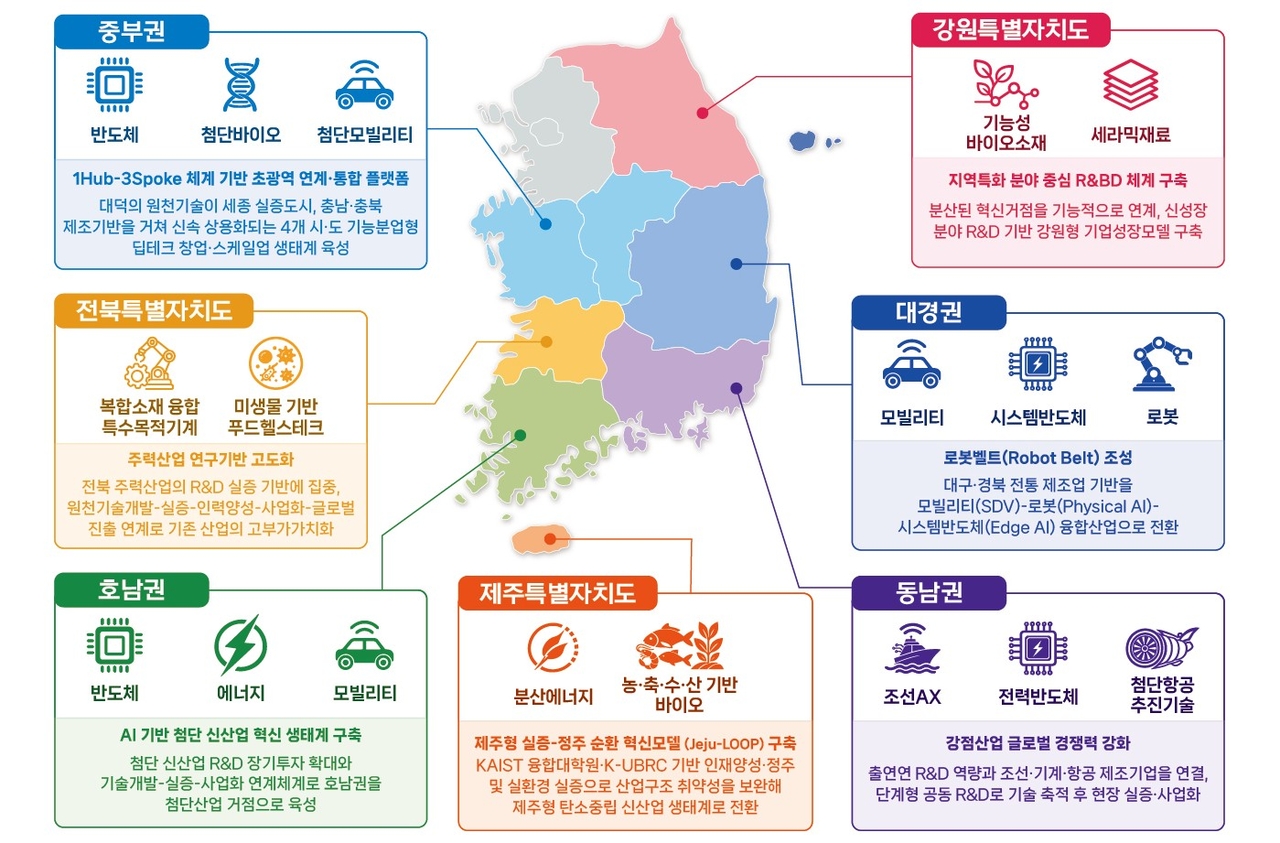
The central region will receive 13.1 billion won to foster the semiconductor, advanced biotech and advanced mobility industries. The project will link Daejeon's basic R&D capabilities, Sejong's policy and demonstration functions, and the manufacturing and industrialization capacity of South and North Chungcheong provinces to build a "mega-regional deep tech demonstration ecosystem."
The Honam region will also receive 13.1 billion won to connect AI and optical semiconductors with renewable energy and future mobility. The Daegyeong region will likewise receive 13.1 billion won to build a "robot belt" linking mobility, robots and system semiconductors. It will use physical AI and edge AI to help push the region's existing manufacturing industries toward advanced technology sectors.
The Dongnam region will receive 13.1 billion won to develop shipbuilding AI transformation, power semiconductors and advanced aviation propulsion technology. The project will combine the shipbuilding, machinery and aviation manufacturing base of Busan, Ulsan and South Gyeongsang Province with the technological capabilities of research institutes. This will establish a system to verify and commercialize developed technologies directly on manufacturing sites.
Gangwon, North Jeolla and Jeju will each receive 8.8 billion won. Gangwon Province will focus on functional biomaterials and ceramic materials, while North Jeolla Province will concentrate on composite material-based special-purpose machinery and microbe-based food and health technology. Jeju will build a carbon-neutral new industry ecosystem centered on distributed energy and agriculture, livestock and fisheries biotech.
"It is important to identify R&D projects tailored to each region's specific circumstances," said Jeong Hee-kwon, chairman of the Innopolis Foundation. "The foundation will do its utmost to serve as a hub that maximizes the characteristics and strengths of each region."
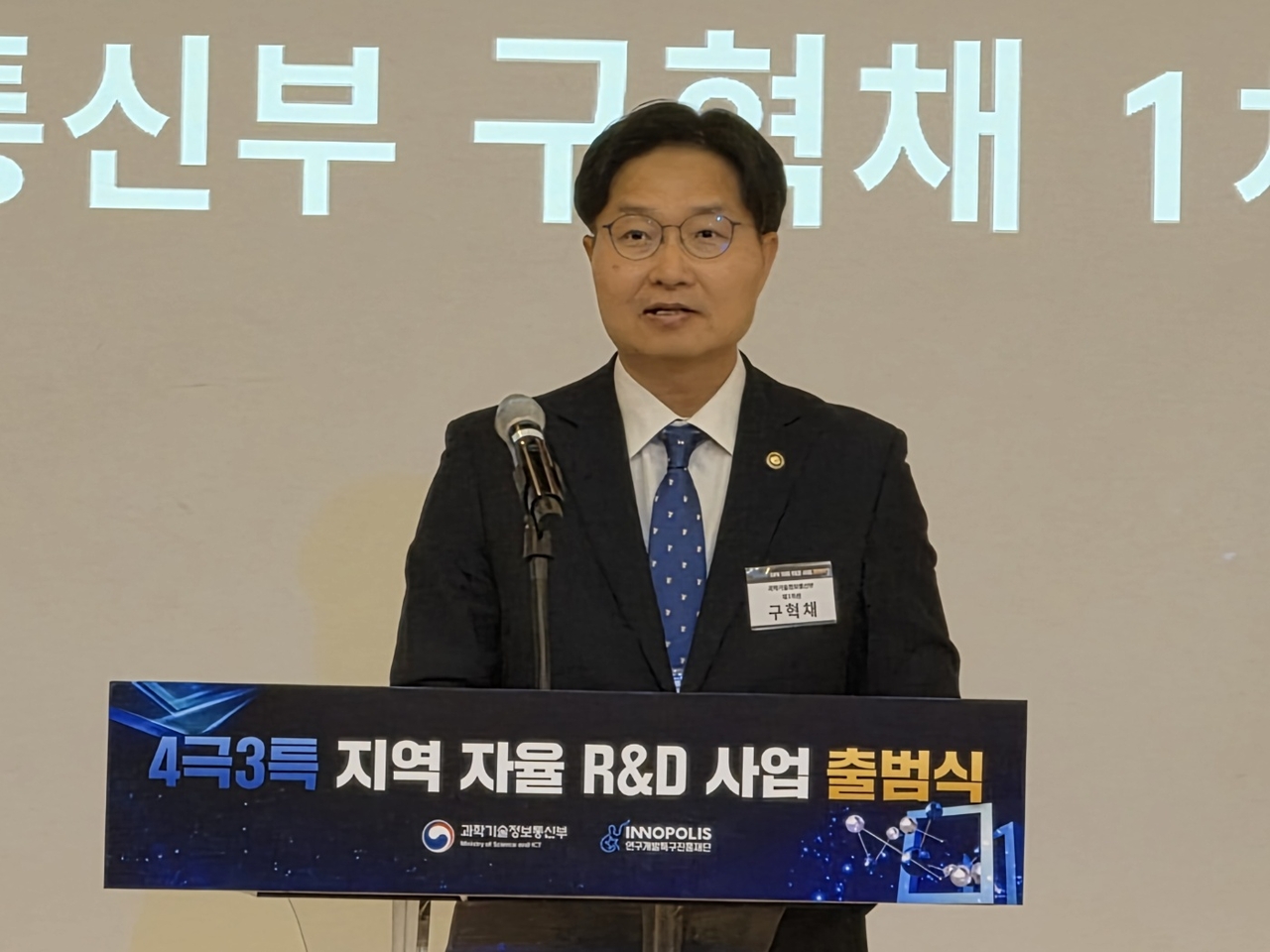
"This is the first project pursued as region-led autonomous R&D at the mega-regional level," said Koo Hyuk-chae, first vice minister of the Ministry of Science and ICT. "We will actively support the effort so that a virtuous cycle takes root in each region — one in which research outcomes lead to corporate growth and good jobs, and new talent and investment in turn spur further R&D."
nbgkoo@heraldcorp.com