- Korea Research Institute of Chemical Technology develops 15-micrometer ultra-thin electrolyte film using transfer-printing method
- Technique resolves electrode damage and uneven thickness, raising hopes for high-performance battery production
South Korean researchers have developed a next-generation manufacturing technology for all-solid-state batteries that could reduce fire risks and boost energy storage performance in electric vehicles.
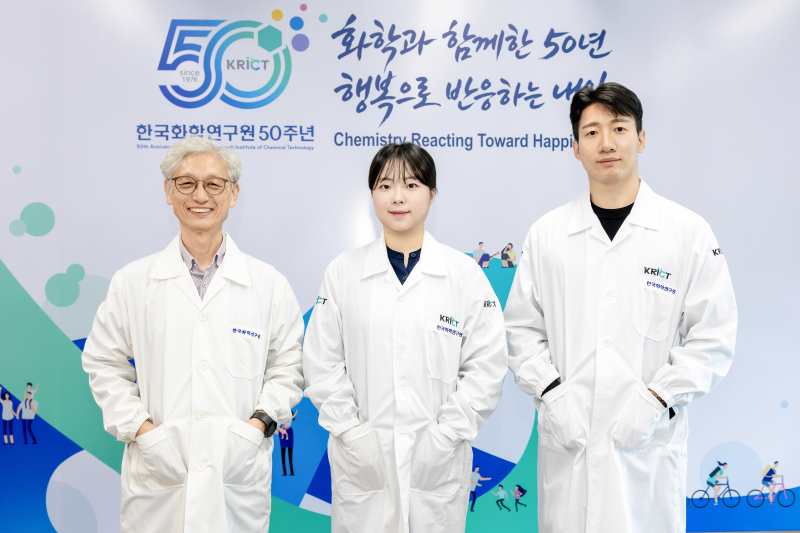
The Korea Research Institute of Chemical Technology announced Monday that a research team led by Senior Researchers Kang Young-gu and Park Myung-su had developed a "transfer-printing" technique that forms a solid electrolyte film on a separate substrate and then transfers it onto an electrode — much like peeling off a sticker and pressing it onto a surface.
All-solid-state batteries replace the liquid electrolyte in conventional lithium-ion batteries with a solid material. They have drawn attention as a key technology for electric vehicles and energy storage systems because they can lower fire risk and increase energy density.
Producing a thin, uniform solid electrolyte film, however, has been a major barrier to commercialization. Conventional film manufacturing methods required thicknesses of 70 to 120 micrometers to prevent tearing. Applying a liquid-form electrolyte directly onto an electrode caused the material to seep inside, deforming the electrode and producing uneven thickness.
To overcome these problems, the research team developed a transfer-printing process using LLZTO, a garnet-type oxide solid electrolyte.
The process involves thinly coating the solid electrolyte onto a specially designed substrate, drying it, and then pressing the finished film onto an electrode using a roller — a principle similar to peeling a sticker and applying it to a desired surface.
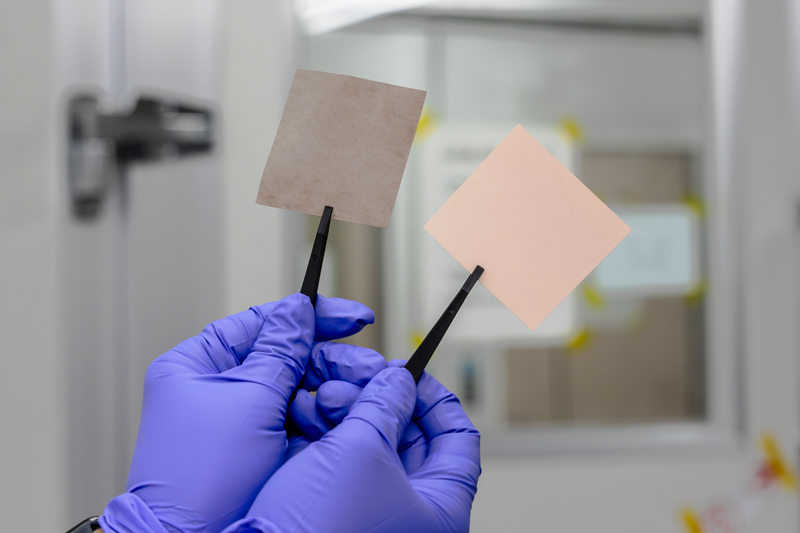
The team applied the Hansen Solubility Parameter (HSP), a quantitative index that measures compatibility between materials, to optimize the material combination — ensuring the electrolyte spreads evenly during coating and releases cleanly during transfer. This provided a data-driven design principle for selecting suitable materials without repeated trial and error.
As a result, the team produced a uniform solid electrolyte film with an average thickness of 15 micrometers and a thickness variation of about 1 micrometer across a total area of 120 square centimeters (6 centimeters wide by 20 centimeters long). By contrast, conventional direct-coating methods produced films with thicknesses ranging from 10 to 25 micrometers even over smaller areas.
Battery performance also improved significantly. Cells made using the transfer-printing method retained 83.6 percent of their initial capacity after 100 charge-discharge cycles — 47.5 percentage points higher than the 36.1 percent retention rate of conventional direct-coating cells.
Lithium-ion conductivity was also about 50 percent higher than a comparison group based on conventional polyethylene separators, and the lithium-ion transference number was approximately twice as high.
The technology also demonstrated superior safety. In a test of pouch-type cells at 150 degrees Celsius for two hours and 30 minutes, the transfer-printed cells maintained stable voltage throughout. Conventional polyethylene separator-based cells, by contrast, suffered internal short circuits caused by separator shrinkage and saw voltage drop sharply within about 10 minutes.
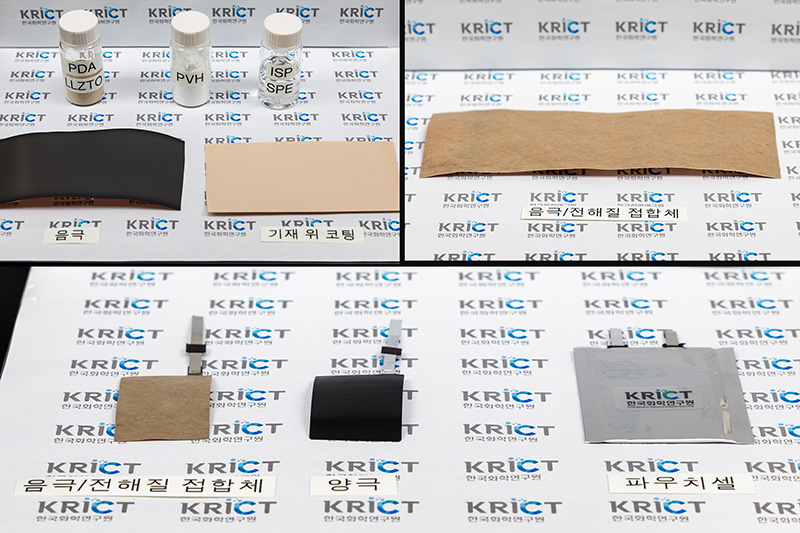
The pouch-type cells also recorded a capacity retention rate of 81.6 percent after 100 charge-discharge cycles, confirming the technology's potential for large-area battery applications.
The technique is expected to be combined with roll-to-roll continuous production processes to improve all-solid-state battery manufacturing efficiency. However, additional verification of long-term cycle life, production yield and manufacturing costs will be needed before commercial deployment.
"This technology can reduce defects that occur when a film is applied directly to an electrode, which should lower defect rates and improve production yield in large-area manufacturing," Kang said.
Shin Seok-min, director of the Korea Research Institute of Chemical Technology, said he hoped the HSP prediction know-how would be combined with AI and applied to manufacturing various thin films for secondary batteries, including protective layers and functional coating layers.
The findings were published in the September issue of Advanced Functional Materials.
nbgkoo@heraldcorp.com